The sky above us is not a velvet ceiling; it is a crowded shooting gallery. We spend our lives looking down at cracked screens and asphalt, trusting an invisible shield of atmospheric friction to burn away the debris of the cosmos before it reaches our doorsteps. Most of the time, that ancient bargain holds. The meteors streak across the dark like dying sparks, and we make wishes on them, blissfully unaware of how close we came to catastrophe.
The Moon has no such luxury.
Stripped of air, naked to the void, our satellite takes every blow meant for us, catching the celestial shrapnel in a slow-motion war that has lasted billions of years. Its face is a historical archive of violence, scarred by impacts from dust specks to mountain-sized monsters. Yet, for all its pockmarked resignation, the Moon can still surprise the people whose job it is to watch it sleep.
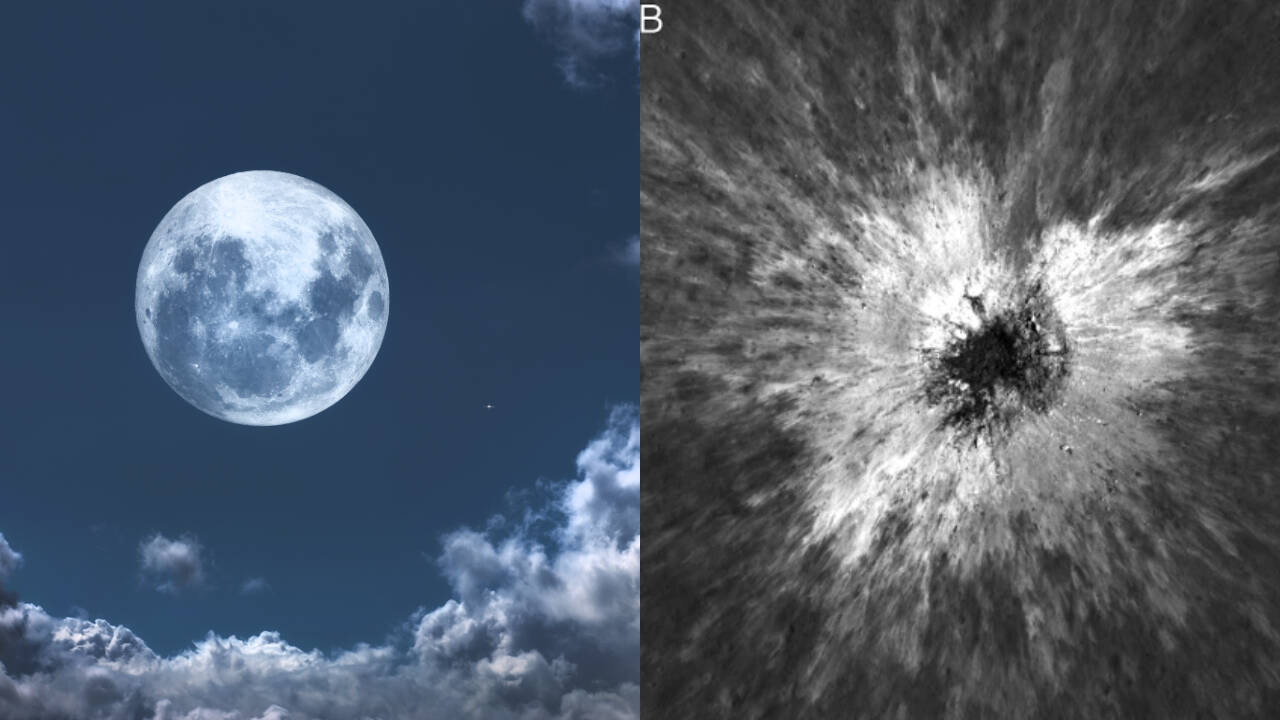
Sometime in 2024, a visitor arrived from the deep dark. It carried no transponder, no warning flare, no polite knock on the door of our terrestrial neighborhood. It struck the lunar surface with an incomprehensible kinetic fury, carving out a crater spanning seven hundred and twenty-eight feet across.
An impact of that magnitude should have rung the Moon like a bronze bell. It should have tossed a plume of pulverized regolith high into the airless night, visible through amateur telescopes across half the globe.
Instead, it happened in absolute silence. And for a long time, nobody noticed.
To understand why this is terrifying, you have to abandon the comforting fiction that space is empty. It is not. It is a dense, swirling current of orbital shrapnel, leftover building blocks from the formation of the solar system, and rogue wanderers knocked loose from distant belts.
When planetary scientists at NASA finally spotted the fresh scar—reconstructing the timeline through high-resolution orbital reconnaissance—a cold realization set in. We missed it. All of our sophisticated early-warning systems, our automated sky-sweepers, our panoptic arrays staring outward into the abyss for civilization-ending asteroids... and something nearly the length of three football fields slammed into our closest cosmic neighbor, and we only found the body afterward.
It is easy to romanticize the Moon as a silver lamp or a poetic anchor for human longing. But when viewed through the lenses of the Lunar Reconnaissance Orbiter, it reveals itself as Earth's battered bodyguard. Every fresh crater is a reminder of a bullet that missed us. Or, more accurately, a bullet that our silent partner intercepted.
Consider the physics of that 2024 strike. A projectile traveling at orbital velocities carries kinetic energy that dwarfs our most powerful thermonuclear arsenals. When it hits an atmosphere-free world, there is no cushion. The energy converts instantly into heat, shockwaves, and kinetic excavation. Rock vaporizes. Solid basalt behaves like liquid water, splashing outward in frozen waves of ejecta before hardening into rings of pulverized dust and shattered rubble.
If a projectile of that size had hit Earth, the consequences would not have been localized. A marine impact would have generated mega-tsunamis capable of wiping out coastal megacities across continents. An atmospheric entry could have created a Tunguska-level airburst multiplied by ten, flattening forests, shattering windows across entire countries, and throwing up enough particulate matter to choke out agricultural seasons.
Yet, out there, it was just another Tuesday for the dead world.
The mystery is not that the impact happened. In a universe governed by probability, low-frequency, high-consequence events are mathematical certainties. The mystery is our collective blindness.
We live in an era of unprecedented data collection, yet our blind spots remain vast and humbling. The vastness of the solar system means that things can hide behind the glare of the sun, approach from angles our instruments aren't facing, or simply slip through the cracks of overextended monitoring networks. We are like lighthouse keepers who spend ninety percent of our shift polishing the glass while ignoring the dark patches of coastline where the waves break without warning.
When the news of the 728-foot crater trickled out of the data pipelines, it was met not with public panic, but with a quiet, unsettling shrug. People read the headline on their phones, registered the scale of it for a brief second, and then scrolled down to check the weather or sports scores. We have developed an extraordinary capacity to normalize existential danger. As long as the sky looks blue and the ground stays still, we assume the story has already been written and the happy ending is guaranteed.
But the universe does not read our scripts.
The 2024 crater is still there, a jagged, raw-edged wound in the ancient gray dust of the lunar highlands. The dust kicked up by the blast has settled back into the valleys, burying the secret a little deeper under the weight of time. The rock that made it is gone, vaporized or crushed into the slurry of the impact basin, its atoms scattered across the vacuum.
Outlined against the blackness of space, the Moon continues its slow, hypnotic orbit. It turns its scarred face toward us every single night, glowing softly in the dark, reflecting the light of a star that is slowly burning through its fuel. It does not speak of the blows it takes for us. It simply absorbs them, holding the line at the edge of the dark, waiting for the next silent visitor to fall out of the sky.