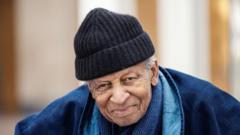
The air in the basement jazz clubs of District Six used to smell of cheap tobacco, spilled brandy, and the metallic tang of fear. It was the 1960s in Cape Town. If you were Black, your very existence after dark was a legal gamble. Yet, inside those cramped, sweat-slicked rooms, a lanky young man would sit at a upright piano, his hands hovering over the chipped ivory keys like a healer preparing for surgery. When his fingers dropped, the noise of the riot police outside faded. The world shrank to a single, pulsing truth.
That man was Dollar Brand, the name he carried before he reclaimed his identity as Abdullah Ibrahim.
He was 91 years old when his breathing finally synchronized with the silence. His passing marks the end of an era, but to call it a mere death is to misunderstand what he carried in his knuckles. He did not just play music. He documented a tragedy and engineered an escape hatch for the soul of a nation. Standard obituaries will tell you the dates, the discography, and the names of the prestigious halls he filled after the world finally learned his name. They miss the dirt. They miss the marrow of why his silence feels so loud today.
To understand Ibrahim, you have to understand the specific cruelty of the system that tried to mute him. Apartheid was not just a political structure; it was an assault on acoustic space. The regime wanted compliance, which requires monotony. They segregated the airwaves. They bulldozed District Six—the vibrant, multicultural heart of Cape Town jazz—turning a bustling neighborhood of musicians, writers, and tailors into a barren wasteland of white gravel. They wanted to erase the soundtrack of resistance.
Imagine a young girl named Thandiswa growing up in the township of Langa during the height of the state of emergency. This is a composite memory, a ghost stitched together from the thousands of children who lived through that smoke. Thandiswa’s father kept a bootleg cassette tape hidden beneath the floorboards, wrapped in oiled cloth to keep the dampness out. On that tape was a track called "Mannenberg."
When the police patrols passed their matchbox house, her father would put the tape into a battery-powered player, keeping the volume so low they had to press their ears against the plastic speaker.
That song was Ibrahim’s masterpiece. It was recorded in 1974 during a brief, impromptu session in Cape Town. The melody was deceptively simple, borrowing from the marabi tradition—the hypnotic, repetitive keyboard style born in the shebeens of the slums—blended with the sophisticated harmonies of American jazz. It sounded like Sunday morning church mixed with a Saturday night brawl. It was joyful, yet it carried a subterranean ache.
For Thandiswa and millions like her, that melody was not entertainment. It was a passport. For seven minutes, the corrugated iron walls of her home disappeared. The armored vehicles outside became irrelevant. Ibrahim’s piano was telling them that their humanity was intact, that the regime could steal their land but not their rhythm.
Nelson Mandela would later call "Mannenberg" the unofficial national anthem of the liberation movement. When you are locked in a concrete cell on Robben Island, music is the only thing that can scale the walls.
The mechanics of Ibrahim’s genius lay in his refusal to choose between his influences. He was a musical contradiction that made perfect sense. As a boy, he sang traditional African songs, soaked in the liturgical music of the AME Church, and listened to the jazz records brought into the Cape Town harbor by American sailors. He heard Duke Ellington and Thelonious Monk and realized that the piano could be used as a percussion instrument, a choir, and an orchestra all at once.
Listen closely to his early recordings. You can hear the physical weight of his approach. He didn’t glide over the keys; he struck them with a deliberate, massive force that seemed to draw energy straight from the bedrock of the Western Cape. He used repetition the way a preacher uses a refrain, building a trance-like state until the listener had no choice but to surrender to the movement. It was jazz, yes, but it was also an ancient communal ritual disguised as a bebop session.
Duke Ellington discovered him in Zurich in 1963. Ibrahim had fled South Africa, suffocated by the restrictions of the cultural boycott and the constant harassment of the state. Ellington got him into a recording studio, producing Duke Ellington Presents the Dollar Brand Trio. Almost overnight, the exile became an icon.
But exile is a specific kind of haunting. It is the condition of living in a beautiful room while your heart is trapped in a burning house across the ocean. Ibrahim lived in New York, toured Europe, and converted to Islam, finding a spiritual anchor that matched his artistic discipline. Yet, every note he played during those decades away was an interrogation of his absence.
When a musician is exiled, they carry their geography in their instrument. The rolling hills of the Eastern Cape, the sharp wind coming off Table Mountain, the clatter of the commuter trains packed with workers—Ibrahim compressed all of it into his left hand. His compositions became sonic maps for a diaspora that couldn’t go home.
Consider the sheer longevity of that weight. To play with that intensity for seven decades requires an immense physical and emotional toll. The hands stiffen. The friends pass away. You look around the stage and realize you are the last person who remembers the smell of the smoke in District Six before the bulldozers arrived.
His later performances were different. The furious, percussive anger of his youth gave way to something far more dangerous to oppressors: absolute serenity. He would sit at the piano in a spotless tailored suit, his white hair a halo under the spotlights. He would play a single note and let it decay for what felt like minutes. He was teaching audiences how to listen to the spaces between the sound. He was demonstrating that peace is not the absence of noise, but the mastery of it.
The news of his death at 91 arrived without warning, a sudden ellipsis at the end of a sprawling, epic sentence. The commentators will spend days analyzing his impact on the evolution of avant-garde jazz. They will categorize his work, archive his interviews, and debate his place in the pantheon alongside Monk and Coltrane.
But the true archive isn't in the libraries or the digital streaming platforms. It is in the collective memory of a people who used his chords to survive the darkest night of their history.
The piano in Cape Town is quiet now. The lid is closed, the wood cool to the touch. The man who taught an entire generation how to breathe through music has finally stopped playing. But if you stand on the coast where the Atlantic and Indian oceans meet, where the wind blows fierce and clean off the water, you can still hear the echo of that low, resonant left-hand chord, stubborn and beautiful, refusing to be forgotten.


