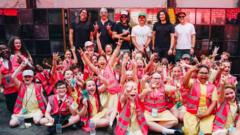
The backstage of a massive football stadium does not smell like rock and roll glory. It smells like damp concrete, industrial cleaning fluid, and the low-frequency hum of a hundred diesel generators vibrating through the soles of your shoes. For a seasoned roadie, it is just Tuesday.
For a fourteen-year-old holding a rented violin, it feels like the mouth of a volcano.
In the summer of 2024, sixty school pupils from the local education authority found themselves standing in that exact concrete labyrinth. They were not there for a guided educational tour. They were not there to sit in the nosebleed section with complimentary tickets. They were holding instruments, adjusting their school ties, and trying to remember how to breathe.
Outside the tunnel, 80,000 people were screaming. Dave Grohl was tuning his guitar. The Foo Fighters were waiting for them.
To understand how a group of ordinary teenagers ended up sharing a stadium stage with one of the biggest rock bands on earth, you have to look past the marquee lights and into the quiet, often underfunded world of music education. This was not a random stroke of viral luck. It was the culmination of a quiet experiment in human belief.
The Friction of the First Note
Every musician starts in the same agonizing place. It is a room filled with screeching strings, missed cues, and the relentless, mechanical ticking of a metronome. Music education in the modern era is a tough sell. We live in an age of instant feedback loops, where a teenager can swipe a screen and trigger a flawlessly mastered digital beat in milliseconds.
Learning an instrument is the exact opposite of that immediacy. It is slow. It is frustrating. It requires a high tolerance for public failure.
Consider a hypothetical student named Maya. She plays the cello. In the privacy of her bedroom, she can manage the notes of a classical suite. But the moment she sits in an orchestra assembly, the math changes. Suddenly, her sound is tied to the kid next to her who is slightly out of tune, and the trumpet player behind her who is blowing too hard. Group performance is an exercise in radical empathy. You have to listen harder than you play.
The local music service directors knew this friction well. For years, they had watched student retention numbers dip as budgets tightened and arts programs were pushed to the periphery of the curriculum. They needed something to bridge the gap between the chore of practice and the magic of performance.
They did not just need a concert. They needed a lightning strike.
The Call from the Stadium
When the management team for the Foo Fighters reached out to the local youth music hub, the initial reaction was disbelief. The band was bringing their massive stadium tour to town and wanted to feature local young musicians during their set. Specifically, they wanted a massive, live youth orchestra to flesh out the soaring melodic bones of one of their anthemic tracks.
The logistics alone were a nightmare. How do you integrate sixty children, most of whom have never seen a professional soundboard, into a highly choreographed rock show where every second costs thousands of dollars?
The rehearsals began in crowded school halls under fluorescent lights. The sheet music arrived, and it was a far cry from the traditional Bach pieces the students were used to. It was loud, syncopated, and aggressive. The string players had to learn how to dig their bows into the wood to create enough rasp to compete with a wall of overdriven amplifiers. The brass section had to find a way to project over the thunder of a stadium drum kit.
During those weeks, the project ceased to be about individual talent. It became a lesson in collective reliance. If one violin section faltered, the entire arrangement collapsed. The students began staying late after school, huddled over music stands, arguing over rhythms and correcting each other’s fingering. The shared anxiety of the upcoming show created an intense, focused camaraderie that no classroom lesson plan could ever replicate.
The Transition from Concrete to Sky
Then came the afternoon of the show.
The contrast was jarring. The students arrived in buses, clutching their instrument cases like lifelines, walking past semi-trucks filled with staging gear and security personnel with headsets. They were led into a holding area beneath the grandstands.
The human mind is not built to process the scale of a stadium from the ground up. When you look down from the top tier, the crowd is an abstract sea of color. When you stand at eye level on the turf, looking up at eighty thousand faces stacked toward the clouds, the scale becomes crushing.
During the soundcheck, Dave Grohl walked out in a faded t-shirt, a guitar slung over his shoulder. He did not give a speech about the transformative power of the arts. He just smiled, waved his pick at the kids, and counted down.
One. Two. Three. Four.
The first explosion of sound from the main PA system physically startled the younger string players. It was a sensory shockwave. But as the kids played their first notes, something shifted. The nervousness that had paralyzed them in the concrete tunnels began to transmute into something else.
Adrenaline is a strange chemical. In the dark, it feels like panic. Under the stadium lights, paired with sixty other people doing the exact same thing, it feels like flight.
The Value of the Invisible Stake
We often talk about funding the arts in terms of abstract statistics. We look at test scores, cognitive development metrics, and cultural enrichment data points. Those metrics are real, and they matter. But they fail to capture the true weight of what happens when a young person realizes they are capable of occupying a space that big.
The true value of that stadium performance was not the bragging rights, nor was it the videos that the students' parents frantically recorded from the stands. It was the permanent alteration of the students' internal boundaries.
Before that night, the world for many of these pupils was defined by the perimeter of their schoolyard and the neighborhood streets. After that night, they knew they could stand in front of eighty thousand people, face down the terror of a massive stage, and deliver something beautiful. That kind of confidence cannot be unlearned. It becomes a permanent part of a person's architecture.
The concert ended in a blur of strobe lights and ringing ears. The students were ushered off the stage, back into the quiet concrete tunnels, while the band transitioned into their next hit. The roar of the crowd followed them down the hallway, muffled by the thick walls.
In the dressing room, there were no speeches. The kids just looked at each other, breathless, their fingers raw, their eyes wide. A few were crying. Most were just laughing in disbelief. They packed away their violins and flutes into their worn cases, snapping the latches shut in the dim light.
They were the same kids who had arrived on the bus three hours earlier. But as they walked back out to the parking lot, the instrument cases felt a little lighter in their hands.