The midnight air in the borderlands of Khost province carries the scent of wild pine and cooling earth. It is a quiet that people in these mountains rely on. When you live where invisible lines separate nations, peace is not an abstract political concept. It is the silence that allows your children to sleep.
Then comes the whistle. A tearing, metallic shriek that rips the dark wide open. You might also find this similar story useful: Why China Downgraded Its Presence at the Shangri La Dialogue.
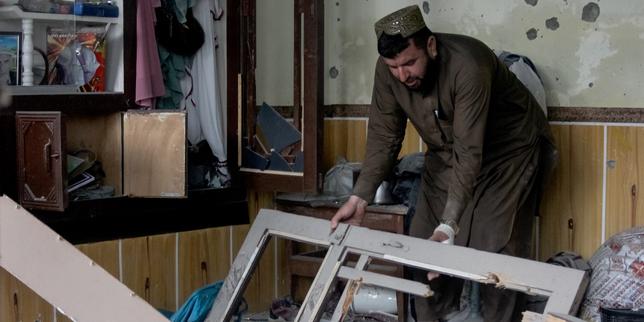
Before the brain can even register the sound, the ground erupts. Mud-brick walls, built to withstand decades of harsh winters, disintegrate into blinding dust. In those brief, chaotic seconds, geopolitical strategies and counter-terrorism doctrines cease to exist. There is only the roar of explosions, the smell of cordite, and the sudden, terrifying absence of a neighbor's house.
On March 18, Pakistani airstrikes targeted what they claimed were militant hideouts inside Afghanistan. The official press releases spoke of surgical precision, strategic deterrence, and cross-border security. They used the sterile vocabulary of modern warfare. But sterile words cannot cover the scent of blood or the sight of a child’s shoe buried in rubble. At least thirteen people died that night. Most of them were women and children. As highlighted in latest coverage by NBC News, the effects are widespread.
To understand how a border becomes a flashpoint, you have to look past the official maps.
The Invisible Line That Cuts Through Lives
Imagine a family whose ancestral lands span both sides of an arbitrary line drawn on a map over a century ago. This is not a hypothetical exercise for the millions living along the Durand Line. It is their daily reality. For generations, people have crossed this border to attend weddings, bury their dead, buy flour, and visit doctors. The border is a living, breathing community, not just a geopolitical boundary.
When relations between Kabul and Islamabad sour, this community bears the brunt of the friction.
The tension has been building for months. Islamabad points to a rise in terror attacks on its own soil, claiming that militants utilize Afghan sanctuaries to plan and execute operations. The incoming administration in Pakistan faced immediate pressure to show strength. They chose to show it from the air.
But from the ground, the view is entirely different. Consider a father waking up at midnight to the sound of his roof collapsing. He does not think about regional hegemony or diplomatic cables. He thinks about digging. He uses his bare hands, clawing through sharp rocks and splintered timber because the shovels are buried, and every second counts.
By sunrise, the numbers begin to trickle out. Five women and three children killed in one village. Three women killed in another. The cold tally of casualties grows, but numbers are poor vessels for grief.
The Rhetoric of Retaliation
The aftermath of the strikes followed a predictable, tragic script. Pakistan’s foreign ministry released statements emphasizing its commitment to sovereignty while demanding that Afghanistan take decisive action against anti-Pakistan elements. In Kabul, the Taliban administration condemned the strikes as a blatant violation of Afghan territory, warning of severe consequences.
This is the theater of international relations. It relies on a specific type of logic: action and reaction, threat and deterrence.
But this logic contains a profound flaw. Dropping bombs from thousands of feet above the earth is an exercise in statistics, not precision. Air power is inherently blunt. When a missile strikes a residential area, the concept of a "surgical strike" vanishes. The collateral damage is not an unfortunate byproduct; it is the primary reality for those on the receiving end.
The cycle of violence feeds itself on this disconnect. A cross-border raid kills soldiers in Pakistan. The Pakistani military responds with airstrikes in Afghanistan. The Afghan authorities retaliate by firing heavy weaponry across the border at Pakistani military posts. Each side claims the moral high ground. Each side produces documentation, maps, and lists of grievances.
Meanwhile, the residents of the border villages pack whatever possessions they can carry onto the backs of trucks. They flee deeper into the provinces, leaving behind unharvested crops and empty homes.
The Weight of the Soil
Living in a conflict zone changes the way you experience the world. The sound of a distant engine is no longer a sign of commerce or travel; it is a threat. You learn to scan the sky. You learn to calculate the distance between your home and the nearest ditch.
This psychological toll is rarely mentioned in the official briefings. It cannot be quantified in a spreadsheet or mapped with a satellite. Yet, it shapes the future of entire generations. Children who grow up under the shadow of sudden, unpredictable violence learn that safety is an illusion. They learn that the world outside their village is hostile, governed by forces that do not care about their existence.
The tragedy of the Khost and Paktika airstrikes is not just the immediate loss of life, as devastating as that is. It is the deepening of a chasm between two nations that share history, culture, and faith. When dust settles over a ruined home, it leaves behind a legacy of resentment that takes decades to clear.
The political leaders who authorize these operations speak of long-term security. They argue that short-term pain is necessary to achieve stability. But true stability cannot be built on foundations of grief. Every civilian casualty becomes a rallying cry, a memory that feeds the very instability the strikes were meant to eradicate.
The sun rises over Khost, revealing the full extent of the damage. Sunlight does not discriminate. It illuminates the shattered beams of a home, the craters in the dirt, and the quiet gathering of neighbors preparing for a funeral. There are no cameras here, no international observers, no high-ranking officials to offer condolences.
There are only the survivors, standing in the dust, looking at the sky, wondering if the silence of the coming night will bring sleep or another storm.