The asphalt absorbs the cold long before it reaches the soles of your shoes. On a damp Thursday evening in a nondescript British town, that cold doesn’t just sit underfoot; it creeps up your spine, mingling with an electricity that has nothing to do with the streetlamps. You can smell it. It is a mixture of cheap petrol exhaust, damp wool coats, and the sharp, metallic tang of pure, unadulterated fury.
A crowd does not become a mob in an instant. It happens in breaths. It happens when a community realizes that the walls built to protect them feel more like a cage.
Earlier that week, a whisper had turned into a roar. A young woman had been attacked, violated in the dark corners of a neighborhood that everyone claimed was safe. The details that trickled out through social media and hushed conversations at front gates were the kind that make your stomach drop. It was the ultimate betrayal of the unwritten social contract: the right to walk home without becoming a statistic. When the community looked to the local authorities for reassurance, they found a wall of bureaucratic silence.
So, they gathered.
They did not assemble as political activists or seasoned agitators. These were mothers holding placards written in felt-tip marker. These were teenage boys with hoods pulled up against the drizzle, their shoulders tight with a protective, volatile energy. Neighbors stood shoulder to shoulder, demanding answers, demanding safety, demanding that the system acknowledge their pain.
Then came the flashpoint.
The Sound of the Wood
To understand what happened next, you have to understand the specific sound a polycarbonate shield makes when a brick clips its edge. It is a hollow, ringing crack. It is the sound of a barrier being erected between two groups of people who grew up on the same streets.
On one side stood a community raw with grief and terrifyingly conscious of its own vulnerability. On the other side stood a line of police officers, shifting their weight from boot to boot, hidden behind visors, breathing in their own sweat.
The chanting started as a low rumble. "Protect our streets." It was rhythmic. Hypnotic. But as the minutes ticked past and no one came out to speak to them, the rhythm fractured. The chants splintered into screams. The crowd pressed forward, a single organic mass pushed by a desperate need to be heard.
A barrier buckled.
A single officer, perhaps reacting to a stray bottle or perhaps simply consumed by the contagious panic that haunts every riot line, reached toward his belt. The snap of plastic resounded.
The batons came out.
There is a terrifying asymmetry to a police baton. It is a heavy, matte-black length of friction-locked steel or dense wood, designed to break bone if necessary. When raised above a helmeted head, it ceases to be a tool of law enforcement. It becomes a symbol of absolute state power used against the very people who pay for its existence.
The crowd erupted.
The Anatomy of an Explosion
Consider the mechanics of public anger. When a terrible crime like rape occurs, it leaves a crater in a neighborhood. If the authorities immediately fill that crater with transparency, urgency, and genuine empathy, the ground stabilizes. But when the response is perceived as slow, clinical, or dismissive, the crater fills with something else entirely. It fills with resentment.
The video that later circulated across the world captured only the symptom, never the disease.
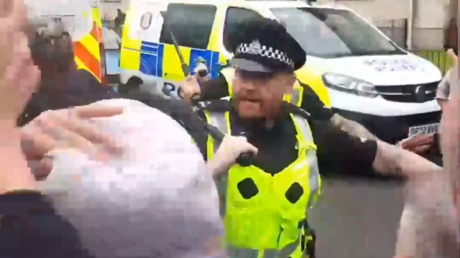
In that shaky, low-resolution footage, you see the sudden, chaotic surge. You see a woman in a puffer jacket being pushed backward by a gloved hand. You see the batons swinging in short, brutal arcs, catching the light of the blue emergency beacons. The soundscape is a chaotic symphony of car horns, screeching feedback from a megaphone, and the high-pitched terror of people realizing that the rules of engagement have changed.
Why does a mother stand her ground against an armed officer?
She does it because her fear for her daughter’s future outweighs her fear of a night in a holding cell. The tactical manuals used by public order specialists assume that crowds act rationally—that if you show enough force, the collective will choose self-preservation and disperse. But these manuals fail to account for moral outrage. You cannot intimidate a community that feels it is already living under a threat worse than a bruised rib.
The police department later issued a statement mentioning "unlawful assembly" and the "necessity of maintaining public order." The words were clean. Sterile. They read like a instruction manual for a washing machine, completely detached from the human wreckage left on the pavement.
The Cost of the Blue Wall
The real damage from that night cannot be scrubbed off the tarmac with a pressure washer.
Every time a baton rises against a citizen protesting a lack of protection, a thread of the societal fabric snaps. It creates a profound, generational cynicism. The teenagers who watched their older brothers get wrestled to the ground by three officers will not call emergency services the next time they see something suspicious. The mothers who were pushed off the sidewalks will no longer see the local constable as a figure of safety.
We often talk about policing by consent as if it is a permanent law of nature. It is not. It is a fragile, conditional agreement. It requires the police to remember that they are merely citizens in uniform, tasked with serving the public, not subduing them.
The light eventually broke over the town the next morning, revealing a street littered with torn cardboard signs, shattered glass, and abandoned shoes. The police cordon had gone. The crowd had drifted home to nurse their bruises and check on their children.
Nothing had been resolved. The perpetrator of the original crime remained at large, the neighborhood remained terrified, and an entire town had just learned a bitter lesson about where they stood in the eyes of the law.
The blue lights eventually stopped flashing. The silence that followed was far more dangerous than the noise.