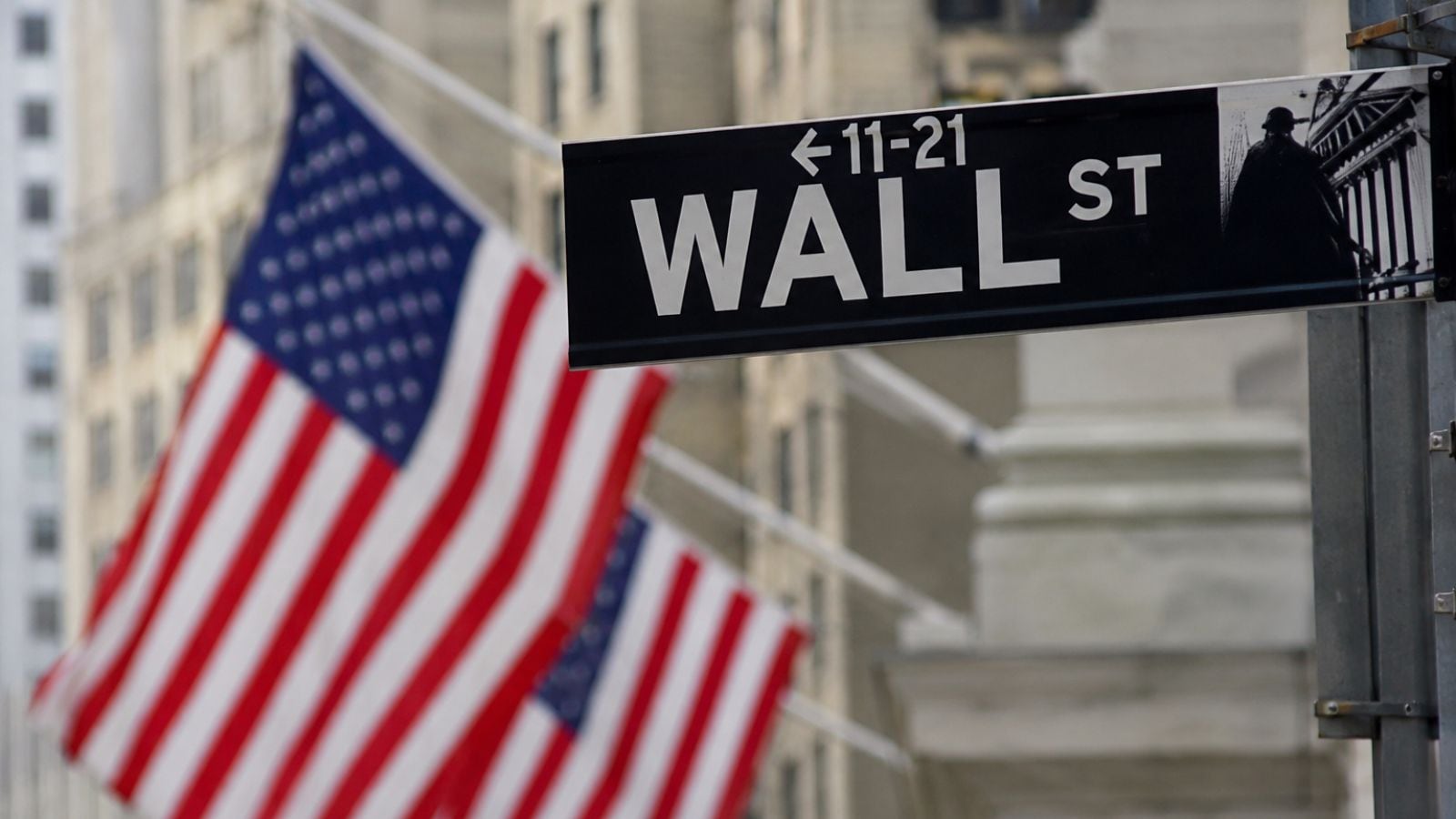
The coffee in Arthur’s mug had gone stone cold by 9:45 AM, yet his hands were sweating.
Let us introduce Arthur as a hypothetical composite—a sixty-two-year-old retired machinist from Ohio who checks his brokerage app twice a day, once with his morning toast and once before the evening news. To Arthur, the stock market is not an abstract mathematical engine of global liquidity. It is the roof over his head, the predictability of his Tuesday grocery runs, and the quiet promise that forty years of standing on concrete floors paid off.
When Arthur glanced at his screen on this particular trading day, he saw a contradiction that made his stomach drop. The Dow Jones Industrial Average was bleeding red, down ninety-nine points. Meanwhile, his grandson’s favorite tech-heavy index, the Nasdaq, was surging upward, pulling the S&P 500 along with it in a dramatic rebound following a brutal tech sell-off.
How can the economy be winning and losing at the exact same second?
If you read standard financial headlines, they will feed you a sterile diet of basis points, sector rotations, and institutional rebalancing. They treat a ninety-nine-point drop in the Dow like a weather report—mildly overcast, chance of showers, carry an umbrella. They miss the terror of the person watching their life savings flicker in real time. They miss the psychological warfare happening inside the digital trading floors of Manhattan and the kitchen tables of the Midwest.
Today, the US stock market did not merely fluctuate. It fractured along a fault line that defines our modern existence.
The Anatomy of a Whiplash
To understand why the Nasdaq and S&P 500 staged a fierce comeback while the Dow Jones stumbled backward by nearly a hundred points, you have to stop thinking of "the market" as a single beast. It is not a monolith. It is a crowded room where two wildly different generations are arguing over what the future is worth.
Think of the market like a massive cargo ship trying to turn around in a narrow canal—a metaphor that captures the sheer violent inertia of trillions of dollars shifting direction at once.
In the days leading up to this session, technology stocks had suffered a punishing sell-off. Investors had panicked. Whispers of overvaluation, stretched artificial intelligence budgets, and stubborn interest rates had sent traders scrambling for the exits. Billions of dollars in paper wealth evaporated in a matter of hours. When tech bleeds, it bleeds loudly, because mega-cap technology companies carry an outsized weight in both the Nasdaq Composite and the S&P 500.
Then came the rebound.
Traders who had sold in a blind panic forty-eight hours earlier suddenly realized they had thrown away the crown jewels of modern capitalism at a discount. Bargain hunters stepped into the breach. Algorithms designed to detect oversold conditions fired millions of buy orders in microseconds. Software giants, semiconductor manufacturers, and cloud computing titans roared back to life. Because the S&P 500 is weighted by market capitalization—meaning the biggest companies move the needle the most—this resurgence in tech dragged the entire benchmark index into green territory.
The Nasdaq, which lives and dies by innovation and growth expectations, didn't just recover; it sprinted.
Yet, across the room, the Dow Jones Industrial Average refused to join the party. Dropping ninety-nine points might sound trivial when the index sits in the tens of thousands, a mere fraction of a percent. Tell that to the person whose portfolio is anchored in traditional industrials, healthcare conglomerates, and legacy financial institutions.
The Dow is an eccentric relic of financial history. Unlike the S&P 500, it is price-weighted, meaning a company with a higher share price exerts more influence over the index than a company with a lower share price, regardless of how big the actual business is. When a handful of old-guard industrial or healthcare stocks catch a cold—perhaps due to a disappointing earnings forecast, rising raw material costs, or a subtle shift in consumer spending—the Dow sneezes.
Today, that sneeze measured ninety-nine points.
The Invisible Stakes Behind the Ticker Tape
I still remember the first time I watched a major market divergence unfold from the inside of a trading desk years ago. The air smelled like stale espresso and ozone from overheating monitors. Nobody was shouting like they do in the movies. The silence was much worse. It was the heavy, suffocating quiet of forty brilliant people staring at numbers that refused to obey their models. One side of the room was printing money on growth stocks; the other side was watching blue-chip stalwarts sink like stones.
That sensory memory always returns when days like today happen. Because behind every tick on a chart, there is a human pulse.
Consider what happens next when the market splits in two like this.
First, doubt creeps into the bloodstream of the everyday investor. When the headlines scream about a tech rebound alongside a Dow decline, the average person feels locked out of an inside joke. You start wondering if you are standing on the wrong side of history. If you hold steady, dividend-paying companies—the kind that make bulldozers, pharmaceuticals, and banking software—a ninety-nine-point drop feels like a quiet rebuke. It whispers that safety is boring, and boring is losing.
Second, a divergence like this exposes the sheer fragility of our collective confidence. Why did tech rebound so violently after a sell-off? Not because the underlying physics of the economy changed overnight. No new factories were built between Tuesday afternoon and Wednesday morning. No miraculous regulatory breakthroughs occurred while Wall Street slept.
What changed was emotion. Fear gave way to greed—specifically, the fear of missing out.
Institutional fund managers live under a brutal tyranny: career risk. If you are a portfolio manager and you miss a massive rally in technology stocks because you were hiding in defensive Dow components, your clients will fire you by the end of the quarter. You cannot afford to sit on the sidelines when the Nasdaq catches fire. So, the moment the selling pressure eased, money flooded back into the exact same names that had been abandoned days earlier.
Meanwhile, the money used to buy those rebounding tech shares had to come from somewhere. Often, it comes from trimming positions in slower, steadier blue-chip stocks. That quiet exodus is what leaves the Dow Jones sagging by ninety-nine points at the closing bell.
Why We Misread the Scoreboard
We have a terrible habit of treating stock indexes like a thermometer for national health. If the numbers are green, we assume Main Street is thriving. If the numbers are red, we brace for a recession.
We got this completely backward.
The stock market is not a reflection of today’s economy; it is a high-stakes betting parlor wagering on what the economy might look like eighteen months from now. And right now, the bettors cannot agree on the script.
Let us look closely at the questions swirling beneath the surface of today’s session, the ones ordinary investors ask themselves in the dark when the financial news channels turn off their graphics.
Why does the S&P 500 follow the Nasdaq instead of the Dow? Because of sheer gravitational pull. Over the past decade, a small handful of massive technology corporations have grown so large that they now dictate the direction of the broader market. When those titans stumble, the S&P 500 falls. When they catch their breath and surge upward, as they did today after the sell-off, the S&P 500 rises with them, even if hundreds of smaller, traditional companies inside the very same index are struggling to tread water.
And what about that ninety-nine-point drop in the Dow? Does it signal an impending crash?
Hardly. In modern percentage terms, ninety-nine points on the Dow is little more than statistical noise—the financial equivalent of a breeze rustling the leaves on an oak tree. Yet, emotionally, the number ninety-nine carries weight. It sits right on the precipice of triple digits. It feels ominous. It triggers our evolutionary wiring to scan the horizon for predators.
Historically, market cycles are defined by these exact moments of tug-of-war. During the late 1990s, technology stocks soared into the stratosphere while traditional manufacturing and industrial stocks languished, creating a chasm between the Nasdaq and the Dow that lasted for years. Conversely, during periods of high inflation or sudden economic tightening, investors flee speculative growth and pile into the dependable cash flows of Dow stalwarts.
Today was a compressed, high-speed replay of that eternal battle. Growth versus value. The promise of tomorrow versus the reality of today.
The Trap of the Daily Scoreboard
If you are sitting where our hypothetical friend Arthur is sitting—staring at a split screen where half your future is glowing emerald green and the other half is bleeding crimson—the worst thing you can do is react to the noise of a single afternoon.
I will be completely honest with you: even after years of studying market mechanics, days like this still unnerve me. There is something deeply unsettling about watching billions of dollars slosh back and forth across the financial system with the casualness of water tipping in a bucket. Anyone who tells you they know with absolute certainty whether today’s tech rebound marks the start of a fresh bull run or merely a brief pause before another leg down is selling you something.
Uncertainty is the permanent rent we pay for participating in wealth creation.
When the Nasdaq and S&P 500 bounce back after a sell-off, it is tempting to chase the momentum. You feel the urge to sell your lagging industrial stocks, abandon the Dow’s sluggish pace, and pile headfirst into whatever silicon-fueled rocket ship is leading the charge today.
Resist that urge. Chasing a rebound after the bounce has already happened is how retail investors consistently buy high and sell low. By the time the evening headlines announce that tech has recovered, the institutional algorithms have already captured the sharpest part of the move.
On the flip side, panicking over a ninety-nine-point dip in the Dow is equally destructive. Legacy companies—the banks, the insurers, the makers of heavy machinery and household staples—do not vanish because their share prices slipped on a Tuesday. They are the slow-burning logs at the bottom of the fire. They do not flare up with the blinding heat of a tech rally, nor do they turn to ash the moment interest rate expectations shift.
Living Inside the Fault Line
The real story of today’s market is not found in the closing numbers. It is found in the tension between two worlds that are struggling to coexist.
We live in an era of breathtaking technological acceleration, where artificial intelligence, automation, and digital infrastructure are rewriting the rules of productivity in real time. That is the engine driving the Nasdaq’s violent rebounds and the S&P 500’s resilience. Investors know, deep in their bones, that the future belongs to the builders of this new architecture. Every time fear pushes tech stocks down, capital rushes back in because nobody dares bet against human ingenuity for long.
At the exact same time, we still live in a physical world made of steel, concrete, shipping containers, and human labor. Those businesses—the backbone of the Dow Jones Industrial Average—face the gritty, unglamorous friction of the real economy. They deal with supply chains, wage negotiations, energy prices, and consumers who are tired of paying too much for groceries. When the Dow drops ninety-nine points, it is reminding Wall Street that you cannot eat software, and you cannot ship cargo through the cloud.
A healthy portfolio—and a calm mind—requires making peace with both truths simultaneously.
If you own only the fast-moving tech leaders, days like the recent sell-off will age you ten years before lunchtime, even if days like today’s rebound make you feel like a genius. If you own only the slow-moving blue chips, days like today will leave you feeling left behind, watching the party through a frosted window while your own yard sits quiet.
True financial survival is built in the overlap. It happens when you stop treating the daily market summary like a verdict on your intelligence and start seeing it for what it actually is: a messy, emotional, endlessly fascinating auction where millions of strangers try to guess the price of tomorrow.
Back in Ohio, the afternoon sun eventually slanted across Arthur’s kitchen table. The closing bell rang in New York at 4:00 PM Eastern Time, freezing the numbers on his screen for the night. The Nasdaq was up. The S&P 500 was green. The Dow was down ninety-nine points.
Arthur looked at his cold mug of coffee, locked his phone, and walked outside to pull the weeds from his tomato beds—leaving Wall Street to argue with itself in the dark.