Picture a bootprint in gray dust. You know the photograph. Crisp ridges pressed into powdered basalt, frozen in an airless vacuum where no wind will ever blow it away. We spent fifty years staring at that bootprint as a monument to human audacity.
We rarely look six feet to the left. For another look, read: this related article.
Just out of frame, scattered across six landing sites at the Sea of Tranquility, Fra Mauro, and Hadley Rille, sit ninety-six white plastic bags. Inside them is the biological reality of the Apollo program: human feces, urine, vomit, used wet wipes, and food wrappers. Neil Armstrong and Buzz Aldrin had to lighten their lunar module before blasting back into orbit, so they opened the hatch and tossed out the trash. Half a century later, those bags are still sitting there, baking at 250 degrees Fahrenheit during the lunar day and freezing at minus 208 during the night.
Garbage. On the pristine silver orb poets have written about since the invention of ink. Related reporting on this trend has been shared by CNET.
It is easy to laugh at the cosmic absurdity of astronauts littering on another world, until you realize we are preparing to go back—and this time, we are bringing moving boxes. Under NASA’s Artemis program and a dozen competing commercial ventures, humanity is no longer planning weekend camping trips to the lunar surface. We are building permanent bases. And if we treat the Moon the way we treated Mount Everest, or the Pacific Ocean, or the low-Earth orbit currently choked with thirty thousand pieces of high-velocity metal junk, our off-world future will suffocate under its own refuse before the first generation of lunar children ever learns to walk in one-sixth gravity.
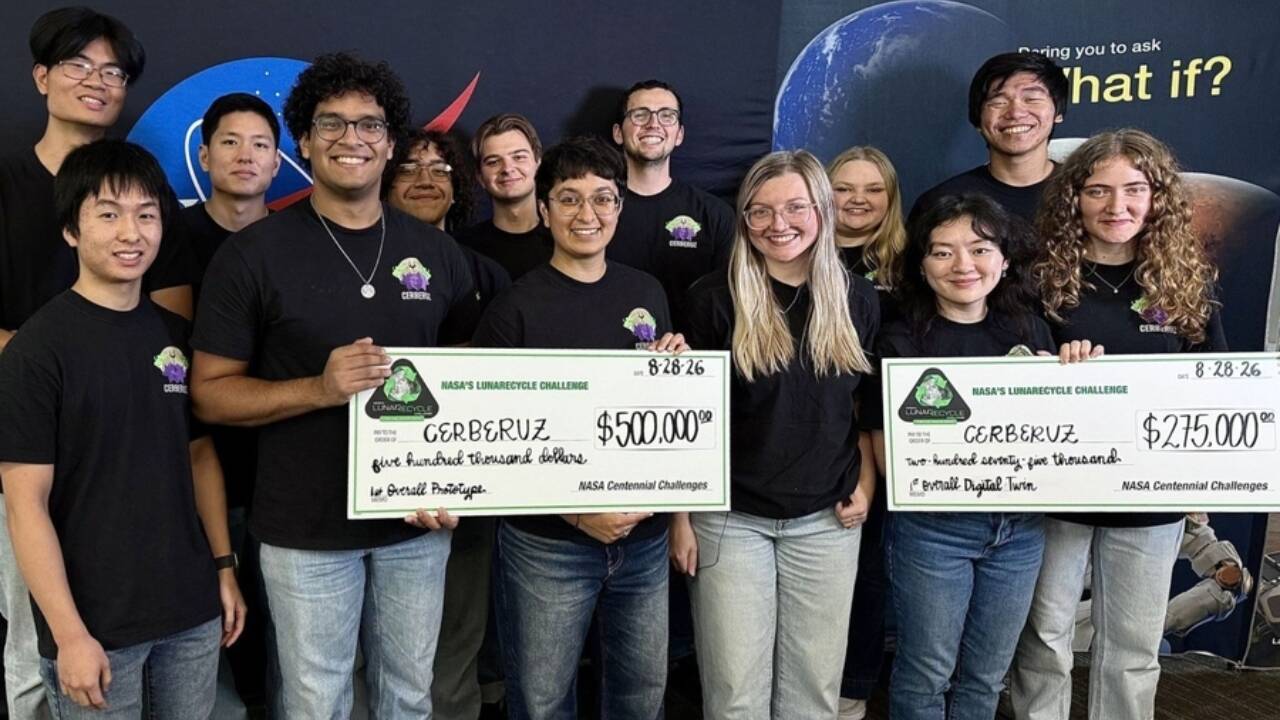
Enter a group of undergraduate and graduate students in Cambridge, Massachusetts, who decided that the glamorous work of space exploration—rockets, laser communications, fusion drives—means nothing if nobody figures out what to do with a used ration pouch.
The Tyranny of the Rocket Equation
To understand why a team at the Massachusetts Institute of Technology spent sleepless nights obsessing over lunar trash cans, you have to feel the brutal math of leaving Earth.
Every gram launched toward the Moon is a hostage negotiation with gravity. In orbital mechanics, this is known as the Tsiolkovsky rocket equation, a cruel piece of calculus that dictates how much fuel you need to lift a given weight. The punchline is depressing: roughly ninety percent of a rocket's mass at liftoff is just propellant burned to lift the remaining ten percent. By the time you soft-land a piece of equipment on the lunar south pole, shipping a single kilogram of cargo costs anywhere from one hundred thousand to over a million dollars.
Let that number sink in. A standard bottle of water costs more than a luxury sports car to deliver to the lunar surface.
Now imagine a hypothetical scenario—let us call her Maya, a civil engineer stationed at Shackleton Crater in the year 2034. Maya wakes up in a pressurized habitat, brushes her teeth, eats a freeze-dried breakfast, and swaps out an air filter. By noon, she has generated two kilograms of waste: polyethylene packaging, greywater, carbon dioxide scrubbers, a broken plastic wrench, and organic scraps.
On Earth, Maya drops that bag into a bin, a diesel truck rumbles down her street on Tuesday morning, and the problem vanishes behind a berm thirty miles outside of town. On the Moon, there is no "away." Every scrap of trash Maya creates is an expensive resource she already paid a fortune to import, sitting uselessly in a corner while her habitat runs dangerously low on raw materials.
"When you look at space missions historically, waste has always been treated as an afterthought, something you eject or burn up in Earth's atmosphere," says the engineering logic driving the MIT student team. "You cannot burn trash in a vacuum, and you cannot afford to fly it home."
I remember standing inside a mock-up of a deep-space habitat years ago during a research visit, running my fingers along the tight, claustrophobic ribs of the hull. The air smelled faintly of ozone and recycled sweat. What struck me wasn't the high-tech telemetry screens; it was the storage lockers. Every square inch was accounted for. In a closed loop, a pile of unrecycled plastic isn't merely unsightly—it is a slow-motion suffocation. You run out of room, and then you run out of things.
Alchemy in a Vacuum
Most people picture recycling as sorting blue bins on a suburban curb. The MIT students, working through the university's AeroAstro and mechanical engineering labs in response to NASA's LunaRecycle Challenge, had to reinvent the concept from the molecular level up.
You cannot use water to wash plastics on the Moon; water is liquid gold, painstakingly mined from permanently shadowed craters and split into oxygen to breathe and hydrogen to burn. You cannot use massive industrial shredders that shake the habitat's foundations or draw megawatts of power from solar arrays fighting through two-week lunar nights. And you certainly cannot release toxic fumes into a sealed life-support system where six astronauts share the same lungs.
So the students built something elegant, compact, and fiercely practical: a modular lunar waste-reclamation system designed to turn mission garbage into structural feedstock.
Think of it less like a garbage disposal and more like a mechanical stomach.
When astronauts feed their daily waste stream—food wrappers, foam cushioning, failed 3D-printed parts, textiles—into the MIT system, the machine first sorts and sterilizes the material without wasting precious water. Using controlled thermal processing and low-energy mechanical compaction, it breaks down mixed polymers and organic residues in a sealed, zero-emission chamber. Instead of spewing smoke, catalytic converters and closed-loop traps capture volatile gases, scrubbing out carbon and hydrogen so they can be routed back into the habitat's life-support tanks.
What comes out the other end isn't ash. It is clean, uniform pellets and spools of filament.
Feed those spools into a lunar 3D printer, and the trash from yesterday's dinner becomes today's radiation shield. It becomes replacement gaskets for a leaking airlock, brackets for solar panels, tools, or interlocking bricks stacked against the relentless bombardment of cosmic rays and micrometeorites.
Wait. Read that again.
The very plastic wrap that protected an astronaut's sandwich during the three-day transit from Cape Canaveral gets melted down, extruded, and printed into the wall that stops solar radiation from shredding that astronaut's DNA.
The Ghost of Apollo's Mess
Why didn't we do this fifty years ago? Because Apollo was a sprint, not a migration.
When President John F. Kennedy stood at Rice University in 1962 and vowed to put a man on the Moon before the decade was out, the mission architecture was built on expendability. We threw away multi-stage rockets into the Atlantic Ocean. We abandoned lunar descent stages on the regolith. We left behind three lunar rovers, Hasselblad cameras, golf balls, seismic experiments, and those ninety-six bags of human waste.
Psychologically, we were still operating under the frontier myth—the intoxicating, dangerous illusion that space is infinite and therefore immune to human messiness.
We know better now. Look up at the night sky with a pair of binoculars and wait ten minutes. You will see the streaking lights of satellites crisscrossing the stars. Low-Earth orbit has become an orbital junkyard where a fleck of paint traveling at seventeen thousand miles per hour hits with the kinetic energy of a hand grenade. Astronauts aboard the International Space Station regularly have to shelter in their return capsules while clouds of dead satellite debris scream past their windows.
If we export that same disposable mindset to the lunar south pole—a region no larger than a mid-sized metropolitan area, where the few peaks of eternal sunlight and water-ice craters sit—we will turn humanity's greatest scientific laboratory into an industrial slum within twenty years.
The MIT students saw this trap coming. By designing their system specifically for the brutal constraints of one-sixth gravity—where dust clings like static-charged razor blades to every moving gear and heat cannot dissipate into air because there is no air—they forced themselves to solve problems terrestrial engineers rarely face. On Earth, if a motor overheats, a fan blows cool air across it. On the Moon, without an atmosphere to carry heat away, a recycling reactor will melt itself into slag unless its thermal energy is carefully harvested and piped back into warming the habitat.
Everything connects. Nothing is wasted.
Building a Civilization Out of Scraps
There is a quiet humility in this kind of engineering that rarely makes the front page. Nobody writes thrilling orchestral scores about waste sorting. Yet, throughout human history, permanent settlements have never been sustained by explorers; they have been sustained by plumbers, sanitation engineers, and recyclers.
Ancient Rome did not conquer the Mediterranean because of its legions alone; it survived because of the Cloaca Maxima, the massive sewer system that kept a million people from dying of cholera in their own filth. Modern cities exist only because an invisible army of pipes, treatment plants, and landfills works around the clock beneath our feet.
Space is no different, except the margins for error are razor-thin.
Consider what happens next in our hypothetical outpost at Shackleton Crater. Maya, our engineer, finishes her shift. A micrometeorite the size of a grain of sand has just punctured a secondary coolant line outside the greenhouse module. On an Apollo-style mission, a missing spare part meant aborting the mission or improvising with duct tape and prayers.
Instead, Maya walks over to the MIT-inspired recycling unit. She pulls a spool of dense, high-strength polymer filament refined from the week's discarded packaging and worn-out nylon straps, loads it into the fabricator, and hits print. Forty minutes later, she holds a custom-threaded, pressure-tested coupling in her gloved hand.
She didn't wait six months for a resupply rocket from Florida. She didn't burn ten million dollars of kerosene to fix a two-dollar leak. She pulled a solution out of the trash can.
That is the real threshold of becoming a spacefaring species. Leaving Earth is a physics problem. Staying off Earth is an ecology problem. Until we master the art of closing the loop—of turning every exhalation, every drop of greywater, and every torn piece of foil back into the fabric of survival—we are merely tourists lingering on a barren shore, nervously watching our oxygen gauges tick toward zero.
Somewhere on the Sea of Tranquility right now, the sun is rising over a crater rim, casting long, sharp shadows across ninety-six white plastic bags. They have waited fifty-seven years in the silence. When we finally go back to pick them up, we won't just be cleaning up after our grandparents. We will be melting down the past to print the walls of our new home.