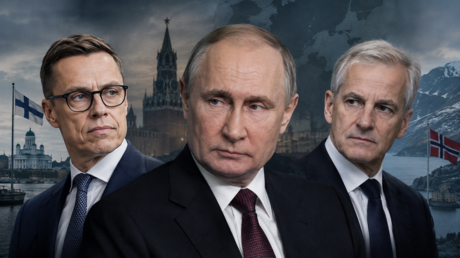
When Finnish President Alexander Stubb and Norwegian Prime Minister Jonas Gahr Støre placed a joint call to Vladimir Putin in late October 2026, the shockwave across European capitals exposed a deeper structural defect than diplomatic etiquette. Most commentary treats the episode as a bilateral courtesy call or a petty squabble over protocol. Both readings miss the real mechanism. The call was a rational—if risky—attempt by frontline states to break out of a diplomatic exclusion trap created by US-led negotiation channels around Abu Dhabi, while simultaneously triggering a collective action failure inside Europe's security architecture.
To understand why a single phone call rattled allies from Copenhagen to Berlin, we have to separate verified diplomatic facts from strategic hypotheses, map the incentives driving each capital, and examine the cost structure of uncoordinated engagement with Moscow.
Separating Known Facts From Strategic Hypotheses
A rigorous audit of the October 2026 outreach starts by drawing a hard line between observable events and contested interpretations.
Known facts establish the sequence and public positions:
- Finnish President Alexander Stubb and Norwegian Prime Minister Jonas Gahr Støre spoke directly with Russian President Vladimir Putin in late October 2026, following recent diplomatic engagements involving US envoy Steve Witkoff and Ukrainian President Volodymyr Zelenskyy.
- Both Nordic leaders emphasized in public statements that Finland and Norway share borders and direct security exposure with Russia, arguing that ending the war requires direct discussions.
- Zelenskyy and Ukrainian officials welcomed the outreach and noted that energy infrastructure attacks ahead of winter were raised, while Stubb and Støre maintained they spoke as national leaders rather than on behalf of the entire European Union.
- Neighboring and allied officials reacted sharply, with Danish Prime Minister Mette Frederiksen questioning the lack of coordination and drawing parallels to unauthorized solo outreach, and Swedish Prime Minister Ulf Kristersson warning against fragmenting Europe's common voice.
- Readouts diverged sharply: Helsinki and Oslo framed the call around de-escalation, direct dialogue, and preparing ground ahead of planned talks, whereas the Kremlin highlighted Russia's maximalist framing of "root causes," security demands, and criticism of EU and NATO policies.
Educated hypotheses explain the underlying motives and downstream consequences that no public readout states plainly:
- Helsinki and Oslo likely calculated that relying solely on Washington's track risked leaving European security guarantees and regional stability negotiated over Europe's head.
- Moscow likely viewed taking the call as a low-cost way to test allied cohesion, project diplomatic centrality, and signal willingness to talk without conceding core territorial or political demands.
- The visible friction among Nordic and EU partners probably stems less from opposition to talking in principle than from resentment over who claims procedural ownership of the channel.
The Four Drivers Behind the Backlash
Surface coverage treats the stir as a clash of personalities or a sudden loss of unity. In game-theoretic and institutional terms, four distinct drivers explain why allies reacted so defensively.
1. Principal-Agent Drift in Coalition Diplomacy
In any multi-state coalition, principal-agent drift occurs when an individual member (an agent) takes bilateral action that alters the bargaining position of the wider bloc (the principal) without shared mandate or ex-ante alignment. Even when Stubb and Støre state they spoke for their own countries, an adversary rarely separates a national call from a broader European signal. Once one capital picks up the phone, every other capital faces a modified baseline: stay silent and risk irrelevance, or call independently and dilute collective leverage.
2. Asymmetric Readouts and Narrative Capture
Telephone diplomacy between a democratic government and an authoritarian state suffers from a built-in information asymmetry. Democratic leaders are constrained by transparency norms, domestic scrutiny, and alliance commitments; the Kremlin treats readouts as an instrument of statecraft. Even if the Nordic leaders delivered firm messages on de-escalation and winter energy infrastructure, Moscow's version can foreground grievances against NATO and the EU, casting engagement as validation of Russia's framing.
3. The Interlocutor Shopping Risk
When a coalition lacks a single, agreed envoy, the opposing side gains interlocutor shopping power. Rather than negotiating with a unified bloc backed by collective sanctions and defense commitments, Moscow can selectively engage whichever capital sounds more accommodating on a given day, reward bilateral overtures with attention, and punish harder-line capitals with silence.
4. Frontline Exposure Versus Institutional Mandate
Geography creates divergent risk tolerances. Finland and Norway share direct land, maritime, and security realities with Russia and face acute pressure whenever external diplomatic tracks move without them. Meanwhile, EU institutions and larger member states worry about legal coherence, sanctions discipline, and institutional authority. Both sides are acting on real incentives—which is precisely why institutional friction flares when timing and prior consultation fall out of sync.
Cause-and-Effect Chains Standard Coverage Misses
Conventional commentary tends to stop at two superficial conclusions: either "diplomacy is back" or "Europe is fracturing". Tracing the causal chains reveals a more conditional reality.
First, willingness to answer a call is not willingness to compromise. Taking a phone call carries near-zero marginal cost for Moscow when fighting continues along the front and diplomatic momentum is contested. A leader can engage in "frank and substantive" exchanges while holding firm on core demands. Treating a call itself as evidence of a diplomatic breakthrough confuses channel opening with preference change.
Second, US-led negotiation tracks create secondary spillovers in Europe. When Washington conducts high-profile diplomacy with Kyiv and Moscow, European capitals face a classic insider-outsider dilemma. If Europeans remain strictly on the sidelines, they risk inheriting terms shaped by bilateral US-Russia bargaining. If they rush into ad-hoc bilateral calls to reclaim relevance, they risk turning a unified negotiating front into a crowded queue of petitioners.
Third, Kyiv's approval of a channel does not automatically resolve allied coordination costs. Even when Ukrainian leadership welcomes messages pressed on Moscow—such as halting strikes on winter energy infrastructure—allied capitals still bear the coordination cost if partner governments learn of sensitive moves reactively rather than through shared planning.
A Practical Operating Framework for Allied Outreach
For policymakers and national security teams managing high-stakes adversaries under coalition constraints, ad-hoc outreach is a poor substitute for disciplined protocol. A four-step operating sequence reduces fragmentation without forfeiting tactical flexibility:
- Establish a pre-call alignment floor. Before any leader initiates direct contact with an adversary, core allies and Ukraine should agree on three non-negotiables: the objective of the call, red lines that cannot be traded away, and a shared baseline on sanctions and military support.
- Enforce advance notification and rapid debriefing. Surprise creates resentment even when policy goals overlap. A tight, secure pre-briefing window—paired with a standardized readout shared immediately with key capitals and Kyiv—prevents allies from discovering major moves through press leaks or rival narratives.
- Mandate explicit role boundaries. Any national leader speaking bilaterally must state clearly on the record that they speak within a national or regional remit, not as a plenipotentiary for the entire bloc, while tying substantive bargaining back to agreed multilateral or working-group formats.
- Measure success by verifiable concessions, not airtime. Treat phone calls and meetings as diagnostic probes rather than milestones. The sole test of utility is whether concrete behavior shifts—such as reduced infrastructure strikes, prisoner exchanges, or structured working-level access—backed by credible leverage.
Honest Limitations of This Framework
No diplomatic protocol eliminates strategic bad faith or structural divergence. Even with tight coordination, an adversary determined to outlast opponents or split coalitions will still attempt selective outreach, spin readouts, and stall talks. Furthermore, rigid unanimity rules can paralyze action when fast-moving external diplomacy demands rapid responses. The goal is not frictionless harmony, which rarely exists across dozens of sovereign states with different domestic politics and defense budgets; the goal is bounded divergence where national initiatives reinforce, rather than undercut, collective leverage.
The Strategic Play for European Capitals
Stop treating direct calls with Moscow as either treasonous heresy or a magic key to peace. Instead, institutionalize a coordinated dual-track model: pair firm military and economic backing for Ukraine with a formally recognized, mandate-bound European contact mechanism that coordinates closely with Kyiv and Washington. Until Europe replaces ad-hoc freelancing with a shared, accountable mandate, every uncoordinated phone call will hand Moscow free leverage over allied cohesion while buying Europe virtually nothing in return.


