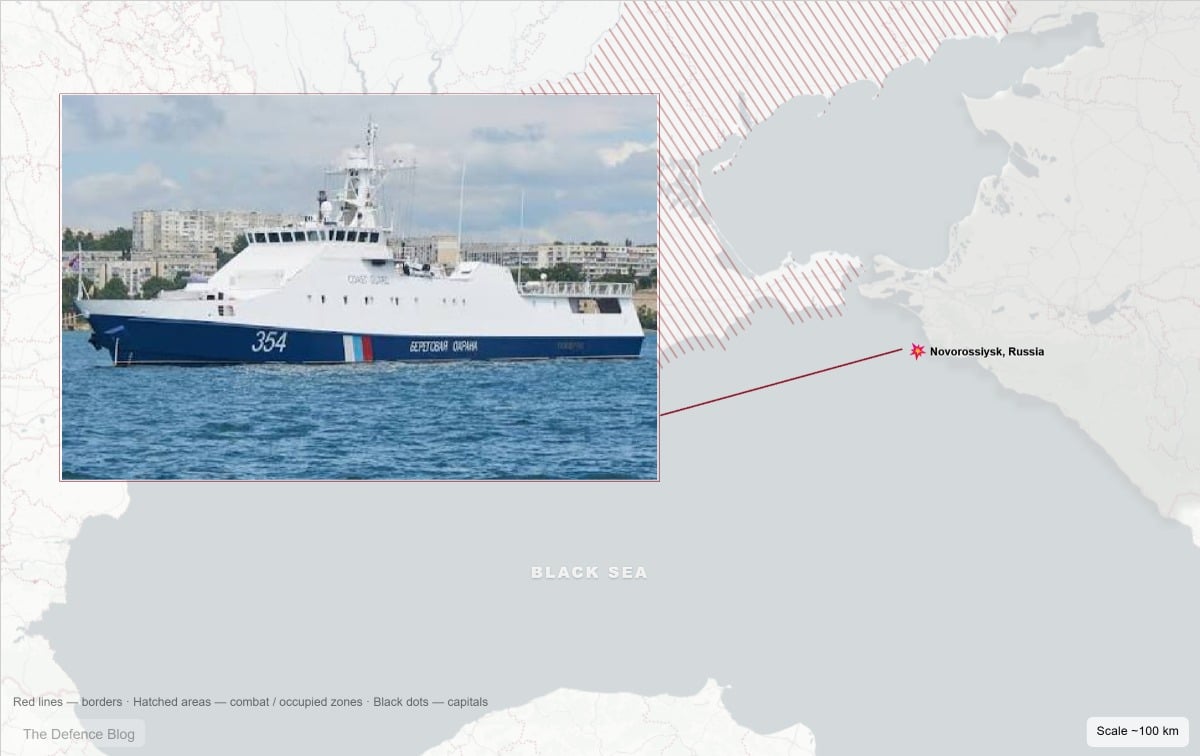
The destruction of the Russian Federal Security Service (FSB) second-rank border patrol ship Izumrud near Novorossiysk establishes a definitive tactical reality: the Russian Federation no longer possesses a secure naval sanctuary within the Black Sea basin. By deploying the Sargan-3000 uncrewed maritime system to sink a 750-ton combatant over 400 kilometers from the active front line, the Armed Forces of Ukraine have demonstrated that geographical displacement no longer mitigates the vulnerability of surface assets. This strike dismantles the conventional assumption that relocating the Black Sea Fleet and auxiliary security elements eastward would preserve operational capability.
To understand the strategic gravity of this kinetic event, the engagement must be systematically analyzed through the lenses of structural asymmetry, technological evolution, and the economic friction of littoral defense. For another view, read: this related article.
The Triad of Deep-Strike Penetration
The successful interdiction at Novorossiysk was not an isolated tactical anomaly, but the execution of a multi-domain penetration framework. For a low-profile uncrewed surface vessel (USV) to successfully engage a combatant equipped with rapid-fire automatic cannon architecture and radar-directed tracking, three distinct operational pillars must converge.
- The Telemetry Corridor: Operating a USV at a range of several hundred kilometers demands a robust, multi-path communication architecture capable of resisting Electronic Warfare (EW) jamming. The Sargan-3000 relies on integrated satellite arrays coupled with secondary line-of-sight backup systems, allowing real-time terminal guidance even within heavily defended littoral environments.
- Littoral Signature Management: The Izumrud possessed a maximum speed of 27 knots and organic surveillance assets, including a helicopter landing pad designed for airborne reconnaissance. To counter this, the USV utilizes a low radar cross-section (RCS) hull composition that sits flush with the waterline. This geometry suppresses thermal and radar visibility, delaying the ship’s crew from establishing a definitive fire-control track until the weapon system enters its terminal kinetic phase.
- Target Selection Geometry: Novorossiysk operates as a highly congested logistical hub, handling both military assets and the Russian "shadow fleet" of commercial tankers. Ukraine exploited this high-density environment to mask the acoustic and radar signatures of the incoming strike craft, effectively utilizing neutral shipping lanes to achieve tactical surprise.
The Economics of Asymmetric Attrition
The loss of the Izumrud underscores a catastrophic cost-imbalance function that favors uncrewed strike platforms over conventional surface hulls. The structural characteristics of the Izumrud represent a significant investment in specialized maritime infrastructure: Further analysis on the subject has been shared by BBC News.
- Displacement and Dimensions: 630 to 750 metric tons; 62.5 meters in length.
- Organic Armament: Standard configurations for this class include an AK-630 30mm rotary cannon and heavy machine gun mounts optimized for close-in defense against asymmetric threats.
- Operational Role: Border patrol, maritime interdiction, and securing critical chokepoints like the Kerch Strait.
The production cost of a modern military patrol vessel of this displacement ranges in the tens of millions of dollars, requiring years for hull fabrication, systems integration, and crew certification. Conversely, an uncrewed system like the Sargan-3000 operates on a cost function orders of magnitude lower.
When a multi-million-dollar asset requiring a specialized crew is permanently removed from the order of battle by a mass-producible, expendable drone, the defensive calculation collapses. Russia cannot replace these hulls at a rate that matches their consumption. Consequently, the attrition cycle systematically reduces the Kremlin’s capacity to project power, enforce blockades, or police its territorial waters.
The Disruption of the Logistical Sanctuary
When Ukraine forced the bulk of Russia’s primary surface combatants out of occupied Sevastopol, the port of Novorossiysk was positioned as the final redoubt for the Black Sea Fleet's logistics, maintenance, and command structures. This latest strike nullifies that sanctuary status.
By extending the threat envelope to Novorossiysk, Ukraine introduces severe friction into Russia's maritime supply lines. Naval commanders are forced to divert limited air defense assets, electronic warfare units, and physical harbor booms from the front lines to defend rear-area ports. Furthermore, the vulnerability of the port forces a compounding dilemma upon Russian logistics: either keep warships docked where they are highly vulnerable to localized USV penetration or deploy them into the open sea where they lack comprehensive umbrella protection from land-based air defenses.
This strategic dilemma extends directly to Russia's economic lifelines. The targeting of naval assets in the immediate vicinity of commercial infrastructure increases the risk profile for merchant shipping. Insurance premiums for vessels operating out of southern Russian ports face upward pressure, and the operational throughput of oil terminals in the region risks disruption due to defensive harbor closures and heightened alert states.
Technical Vulnerabilities of Current Defensive Doctrines
The sinking of the Izumrud reveals critical limitations in standard Russian naval defense doctrines against uncrewed maritime threats. Conventional surface vessels are fundamentally designed to counter symmetrical vectors: anti-ship cruise missiles, submarines, and opposing surface combatants.
The first limitation is the elevation and depression constraints of primary optics and radar systems. Many shipboard tracking systems are unsuited for identifying small objects moving rapidly at sea level, particularly under undulating wave conditions that produce high levels of radar clutter.
The second limitation lies in the human element of fire control. Defending against a terminal USV attack requires instantaneous identification, tracking, and engagement. If a drone is detected only within a 500-meter envelope, a vessel traveling at high speed leaves the crew less than one minute to react, aim, and neutralize the threat. The reported fatalities and injuries among the Izumrud’s crew confirm that the vessel's close-in weapon systems failed to achieve a mission kill before the drone delivered its payload.
The Long-Term Operational Projection
The degradation of Russia's secondary patrol fleet fundamentally alters the balance of power in the Black Sea basin. While large frigates carry the offensive Kalibr cruise missiles, smaller patrol vessels like the Izumrud form the operational spine of daily maritime security, anti-sabotage screening, and search-and-rescue operations.
As these lower-tier security vessels are systematically stripped away, Russia’s primary combatants lose their defensive screening layers. This forces high-value assets to operate with diminished situational awareness and increased exposure to multi-pronged attacks. The shrinking fleet allocation directly impairs Russia's ability to monitor the western and southern corridors of the Black Sea, effectively conceding control of vital shipping lanes back to international commerce backed by Ukrainian asymmetric deterrence.
The operational reality dictates that Russia must now treat every square meter of the Black Sea as a high-threat zone. Future maritime deployments will require continuous, resource-intensive aerial surveillance and defensive patrolling, consuming precious fuel, airframes, and personnel hours merely to maintain a defensive posture. Ukraine’s execution of the Novorossiysk strike proves that structural asymmetry has permanently invalidated traditional naval dominance in the region.