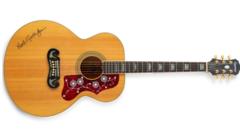
The sale of a signed Oasis guitar for $96,000 transcends simple celebrity memorabilia; it represents a precise intersection of cultural scarcity, verified provenance, and the financialization of nostalgia. To view this transaction as a mere purchase of wood and strings is to ignore the underlying mechanics of the high-end collectibles market. This asset class operates on a liquidity-constrained model where value is driven by three specific variables: historical utility, verifiable chain of custody, and the peak-earnings window of a specific generational cohort.
The Valuation Framework for Musical Artifacts
The $96,000 price point is not an arbitrary figure but a reflection of the utility-to-legacy ratio. In the market for musical instruments, value is bifurcated between the inherent quality of the object and its association with a "defining performance event."
- Inherent Value: The base cost of the instrument (a 1996 Epiphone Riviera or similar model) represents less than 2% of the total transaction price.
- The Signature Premium: Signatures by both Noel and Liam Gallagher function as a physical proof-of-authenticity, acting as a non-fungible marker that ties the physical object to a specific era—in this case, the 1996 peak of Britpop.
- Event Attribution: Because this specific instrument is tied to the "Wonderwall" era, the valuation captures the peak of the band's global commercial influence.
Economic Drivers of the Oasis Premium
The surge in Oasis-related asset pricing coincides with a specific demographic shift. The primary buyers for Britpop memorabilia are individuals who were teenagers or young adults in the mid-1990s and have now reached their peak earning years. This creates a supply-demand imbalance where the fixed supply of original 1990s artifacts meets an expanding pool of high-net-worth capital seeking emotional hedges against inflation.
The Provenance Protocol
Collectibles at this price tier require a rigorous verification structure to maintain their status as an investment-grade asset. The "Wonderwall" guitar carries value because it satisfies the three-step provenance check:
- Origin Documentation: Evidence that the guitar was owned or used by the artist during a documented recording session or tour.
- Visual Confirmation: Photographic or video evidence of the artist with the specific instrument, often identifying unique grain patterns or wear marks.
- Physical Integrity: The preservation of the signatures and the structural state of the guitar, which prevents the "ship of Theseus" problem where repairs eventually replace the original material that touched the artist.
Market Volatility and the Nostalgia Cycle
Investment in celebrity assets carries inherent risks that differ from traditional equities. The value of this guitar is tied to the continued cultural relevance of Oasis. Unlike a Stradivarius, which derives value from acoustic engineering and centuries of pedigree, a 1990s guitar relies on the longevity of a specific pop-culture narrative.
The upcoming Oasis reunion tour functions as a market catalyst. It increases "top-of-mind" awareness, which in turn drives up the floor price for all associated memorabilia. However, this creates a "blow-off top" risk. Once the reunion cycle concludes, liquidity typically dries up, and prices may stagnate or retreat as the market enters a cooling period.
The Scarcity Mechanics of Signed Instruments
A signed guitar is fundamentally different from a signed poster or a gold record. It represents a "primary tool of the trade." The scarcity of guitars actually used by Noel Gallagher in 1996 is finite. While signatures can be obtained on modern instruments, those items lack the historical utility that justifies a near six-figure valuation.
We categorize the rarity of this asset using the Hierarchy of Association:
- Tier 1: Stage-played or studio-recorded instruments used for hit singles (The "Wonderwall" category).
- Tier 2: Backup instruments owned by the artist but never used in a public or recorded capacity.
- Tier 3: Contemporary instruments signed by the artist for charity or fan interactions.
- Tier 4: Authenticated signatures on non-musical items (e.g., setlists, ticket stubs).
The $96,000 sale confirms that the market currently values Tier 1 Oasis assets at a 500% to 1,000% premium over Tier 3 assets.
Structural Bottlenecks in the Collectibles Market
The primary limitation of this asset class is its illiquidity. Unlike stocks, which can be liquidated in seconds, a $96,000 guitar requires a specialized auction house, a verification process, and a global marketing campaign to find a buyer. This creates a "holding cost" that includes insurance, climate-controlled storage, and auction commissions which typically range from 15% to 25%.
To maximize the ROI on an asset like the Oasis guitar, the owner must treat it as a multi-year play. The transaction costs alone mean that the asset must appreciate by at least 30% just for the investor to break even.
Tactical Allocation for Collectors
For those looking to enter the Oasis memorabilia market or similar niche asset classes, the strategy must be clinical:
- Identify the Core Artifact: Focus exclusively on items from the 1994–1996 window. This period represents the band’s cultural zenith and offers the highest floor price.
- Verify the Signature Medium: Signatures on wood (guitar bodies) or plastic (pickguards) are more durable and more valuable than those on paper or fabric.
- Audit the Auction House: Only engage with houses that offer a lifetime guarantee of authenticity. The "premium" paid at a high-end auction is actually a payment for the insurance of provenance.
- Monitor the Reunion Sentiment: Use the 2025-2026 tour dates as a window to either exit a position or wait for the inevitable post-tour dip to enter.
The $96,000 sale is a signal that the Oasis brand has successfully transitioned from "pop culture" to "historical legacy." It is no longer a niche hobby; it is a maturing market where the winners are determined by the rigor of their documentation and the timing of their entry into the nostalgia cycle. Collectors should prioritize instruments with direct studio lineage over generic signed items to ensure long-term value retention as the "reunion hype" eventually normalizes.