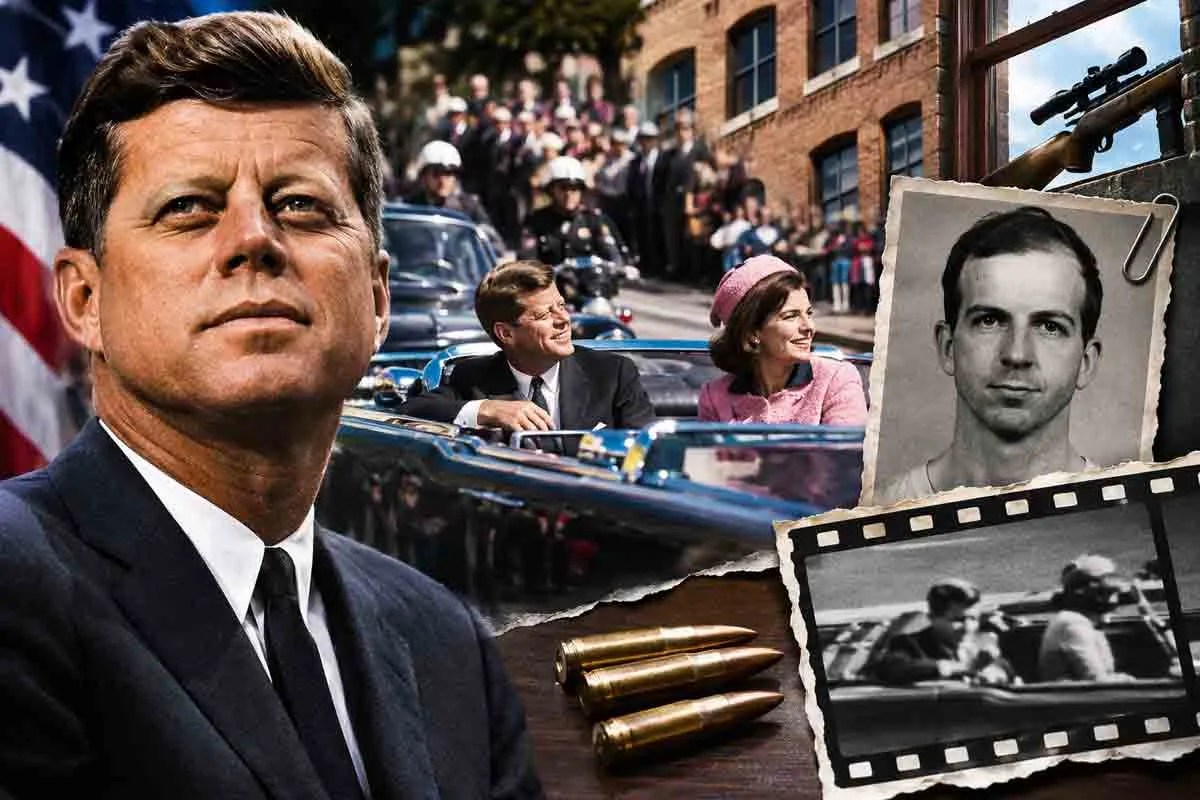
Everyone loves a haunted house. For over six decades, headlines built around a presidential motorcade, three bullets, and "unsolved questions" have kept the John F. Kennedy assassination locked inside a permanent hall of mirrors. One motorcade. Three shots. Decades of outrage, finger-pointing, and midnight speculation.
It makes for riveting copy. It is also intellectually lazy. Meanwhile, you can read similar stories here: Inside the Secret Drone War Over Sinaloa and the Sovereignty Trap.
When a competitor frames November 22, 1963, primarily as a stack of unanswered riddles, they are feeding the exact addiction that keeps people arguing in circles rather than understanding power. Ask who pulled a second trigger, and you get a lifetime subscription to circular debates. Ask why a country's security architecture, political incentives, and institutional reflexes behaved the way they did before, during, and after Dealey Plaza, and the entire picture shifts.
The real shock isn't that every loose end hasn't been tied with a neat ribbon. The real shock is how comfortable people remain with comforting illusions when uncomfortable mechanics are sitting right in front of them. To understand the bigger picture, check out the excellent analysis by Al Jazeera.
The "Unsolved Questions" Trap
Conventional coverage treats history like a locked-room mystery novel where the fun comes from guessing the butler. A motorcade rolls through Dallas. Shots ring out. Suddenly, every missing detail becomes proof of a grand master plan—or every inconvenient fact gets swept under a rug to protect an official narrative.
Here is the flaw in both extremes. Conspiracy hunters often treat any discrepancy in witness memory, camera angle, or bureaucratic paperwork as evidence of omnipotent coordination. Official-story loyalists often treat any critique of institutional sloppiness as treasonous nonsense. Both sides fall for the same cognitive shortcut: assuming competence and intention where confusion, turf wars, and human error routinely live.
Let's define what actually separates historical rigor from rumor-mongering. Forensic evidence consists of physical artifacts, ballistics, medical findings, and contemporaneous records tested against physics and chain-of-custody rules. Speculative inference is filling gaps in those records with motives that haven't been proven. Confusing the two turns real investigative questions into folklore.
I have spent years watching smart organizations, newsrooms, and investigative teams burn massive amounts of time and credibility chasing ghosts because they started with a dramatic hook instead of a falsifiable hypothesis. When you build a story around "unsolved questions," you reward guesswork over discipline. You train readers to confuse lack of total certainty with proof of whatever theory excites them most.
| Approach to the JFK Case | Primary Habit | Biggest Blind Spot |
|---|---|---|
| Endless "Mystery" Framing | Stacks unanswered questions and dramatic anomalies | Treats every gap in memory or paperwork as proof of a hidden plot |
| Rigid Institutional Faith | Defends official conclusions wholesale | Underestimates bureaucratic turf wars, early missteps, and secrecy habits |
| Mechanics-First Analysis | Examines security failures, incentives, and record-keeping | Offers fewer neat villains and less theatrical closure |
What People Actually Ask—And Why the Premise Often Breaks
Search feeds around any major historical shock are predictable. People type the same questions over and over because the headlines nudge them toward the wrong framing.
Was there a second shooter? Asking this first puts the cart before the horse. Ballistics, acoustics, and trajectory analyses have been debated for decades precisely because eyewitnesses in chaos perceive sound, direction, and timing differently, and acoustic recordings from that day have faced fierce technical challenges. Starting with "second shooter or lone gunman" locks you into a binary cage. A sharper question is: What exact physical and documentary evidence holds up under independent scrutiny, and where does the record genuinely run out?
Why are some government files still redacted or delayed? People hear "classified records" and immediately picture a smoking gun sitting inside a vault. In reality, intelligence and security agencies routinely hoard material for decades to protect sources, methods, third-party relationships, or institutional embarrassment. Secrecy often protects reputations and bureaucracies just as much as it hides a master plot—and sometimes it hides embarrassing oversights nobody wants on display.
Did Lee Harvey Oswald act alone? That question sounds simple until you realize it smuggles in an assumption that all non-solo scenarios are equal. There is a massive difference between a lone actor, a lone actor with local help or encouragement, and a vast multi-agency operation. Lumping every non-lone scenario into one bucket is lazy thinking. Serious history demands grading claims by the quality of the evidence behind them, not by how cinematic they sound.
Security Failures Don't Need a Mastermind
One of the hardest pills for modern audiences to swallow is how fragile high-stakes operations look up close. We like to imagine governments and security services operating like clockwork machines. In real life, they are sprawling human institutions full of ego, miscommunication, and blind spots.
Consider the setting itself: an open-top limousine moving slowly through a crowd-lined street in a politically charged city. Advance planning, route choices, crowd control, and protective protocols all involve human judgment calls made under pressure. When something goes catastrophic happens in an open environment, you don't need a fictional super-villain to explain why security fell short. Complacency, routine, and split-second human reaction times do plenty of heavy lifting on their own.
Historians and investigators who study high-profile political violence—from figures like Gerald Posner and Vincent Bugliosi on the prosecutorial/lone-gunman side to critics and researchers like Sylvia Meagher, Peter Dale Scott, and the House Select Committee on Assassinations—have clashed fiercely for decades. What unites the serious work across those divides is a sober respect for how messy real evidence is compared to tidy movie scripts.
Imagine a scenario where a major modern event goes sideways—say, a high-profile public figure is attacked despite layers of security. Within an hour, dozens of witnesses give conflicting accounts of where the sound came from, social media clips circulate out of context, and officials scramble to piece together timelines. Nobody needs a secret cabal to create instant confusion. Chaos is the default setting of a crisis.
Why "Three Bullets" Becomes a Shortcut
Framing the day around "three bullets" is a classic media hook because three is a clean, memorable number. Yet reducing a complex sequence of events to a numerical catchphrase flattens everything around it: the political temperature of 1963, Cold War tensions, domestic unrest, law enforcement rivalries in Dallas, and the immediate shockwave that hit Washington.
When writers rely on punchy tally lines like "one motorcade, three bullets," they signal to the reader that spectacle comes first. That is fine if you are writing a thriller trailer. It is terrible if you want to understand how a society processes trauma and why trust in institutions erodes over generations.
The Cost of Chasing Ghosts Instead of Systems
Let's be honest about the downside of taking a contrarian, systems-first stance on a topic this emotional. If you push back against sensational "unsolved mystery" framing, some readers will accuse you of being cold, dismissive, or overly neat. Others will assume you are carrying water for officialdom just because you refuse to treat every rumor as gospel.
That is a real cost in engagement and popularity. Mystery sells. Nuance takes work. Calling out sloppy reasoning doesn't give readers the rush of a dramatic reveal, and admitting where evidence is incomplete or contested feels less satisfying than declaring total victory for a pet theory.
Even so, chasing ghosts carries a much heavier price. When people treat history primarily as an endless riddle, they miss how power actually operates. They focus on whispers in the shadows while ignoring visible incentives, institutional habits, and the plain truth that large organizations often cover up their own clumsiness just as fiercely as anything else.
How to Read History Without Getting Played
If you want to cut through the noise—whether you are reading about November 22, 1963, or any modern headline built on outrage and mystery—change how you evaluate claims.
- Separate the hook from the evidence. Notice when a headline uses dramatic numbers or "unsolved" framing to pull you in, and ask what verifiable facts actually back up each claim.
- Map incentives before inventing masterminds. Ask who had what to gain, who had what to lose, and who simply wanted to avoid blame when things went wrong.
- Demand proportional proof. Extraordinary claims require extraordinary documentation, not a chain of "what ifs" strung together across decades.
- Watch out for false binaries. Most real-world events aren't a clean choice between a cartoon villain and a spotless bureaucracy. Look for friction, missteps, and overlapping motives.
Stop treating history like a parlor game where the loudest theory wins. Look at the mechanics, respect the limits of the record, and keep your eyes open.