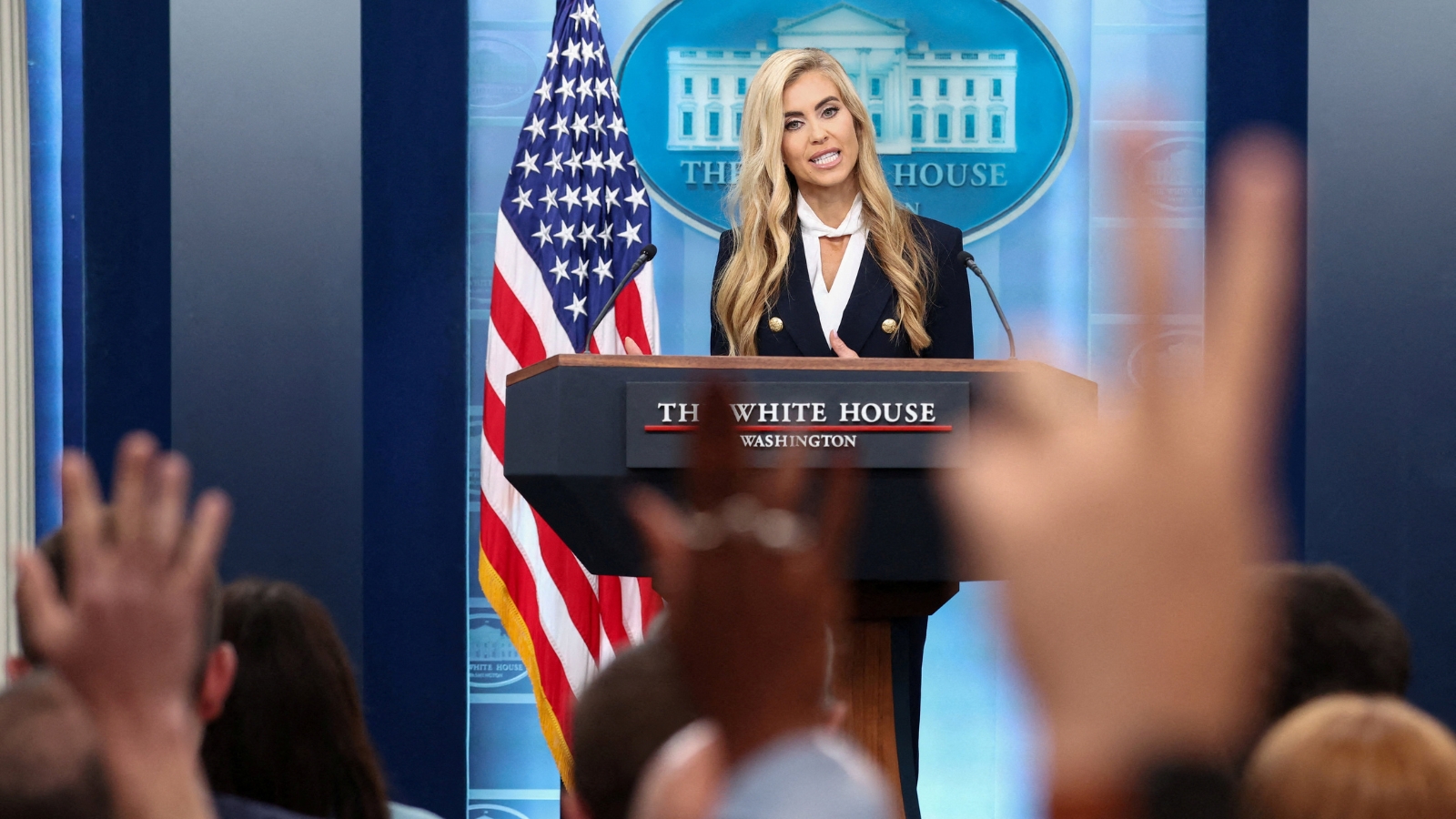
Fluorescent lights hum over the James S. Brady Press Briefing Room, casting a sterile glow onto rows of expectant notebooks and glowing camera lenses. The air smells faintly of wool coats, stale coffee, and the sharp metallic tang of tension that always hangs over Washington before a high-stakes afternoon.
A new voice steps up to the podium. Katie Zacharia has just stepped into the role of White House press secretary, succeeding Karoline Leavitt in October 2026. Fifteen minutes into her first briefing, a reporter asks a question that every working parent in America has heard in one form or another: how do you balance a grueling national post with raising four children?
She tries to explain how her husband is stepping up at home so she does not miss evenings with her kids. Then, right in front of the cameras, the words tangle on her tongue.
"So my president ... uh excuse me, my husband is out here ..."
Silence. Then a nervous laugh. "That's a good one," she adds, trying to shrug off the collision of two worlds that rarely sit side by side without friction.
To a casual viewer scrolling past a clip, it looks like a harmless verbal stumble—the kind of slip anyone makes when adrenaline spikes and sleep runs thin. Yet within days, her tenure as White House press secretary ended after just five days, making it the shortest in U.S. history. That fleeting mix-up between "president" and "husband" became a mirror for something much deeper than a bad fifteen minutes at a microphone. It exposed how easily loyalty, domestic life, and public authority blur when someone is thrust into the brightest spotlight on earth.
When Private Devotion Collides With Public Duty
Consider what happens when a person spends years in one rhythm and suddenly has to sprint in another. Katie Zacharia came into the role after years of raising four children born between 2014 and 2020, alongside a background in law and political commentary. Her husband, Tyler Zacharia, works as a film producer and executive. Moving from family life in California into the relentless machinery of Washington is not a gentle commute; it is an earthquake.
When you talk about your spouse and your boss all day in the same breath, your brain can trip over the wire. A Freudian slip—a spoken mistake that reveals an underlying preoccupation—does not always mean someone has a secret plot. Often, it simply shows where their mental energy is stretched thin.
Let us use a brief metaphor to picture the strain. Think of the mind like a stage with two spotlights: one pointed at the living room where bedtime stories happen, and another blazing down on a podium where every syllable is dissected by reporters, cable hosts, and political rivals. When both lights are turned up to maximum at the exact same second, the actor can easily walk toward the wrong mark.
I have sat in rooms where a single misplaced word turned a routine afternoon into a storm. You feel your stomach drop before the sound even finishes leaving your mouth. You want to rewind time by three seconds, pull the sentence back into your chest, and start clean. At a White House podium, there is no rewind button. Every pause is recorded. Every wince is replayed.
The Invisible Stakes Behind the Podium
A press briefing is never just a chat about schedules and family dinners. Behind the scenes, real decisions with heavy consequences are moving at speed—including announcements like the administration asking Kimberly Guilfoyle to resign as ambassador to Greece amid swirling controversy, and questions around foreign policy and midterm rallies.
When a spokesperson stumbles over a personal detail while handling major political news, critics do not treat it as an isolated joke. They treat it as a test of readiness. Suddenly, questions about legal credentials, preparation, and how a newcomer handles pressure crowd into the frame.
To make the human stakes concrete, let us trace a hypothetical scenario involving two parents—say, Maya and Daniel—who do not work in politics at all. Maya takes a demanding regional job that requires late nights and constant travel. On her second week, exhausted and juggling school pickup times with a client call, she calls her husband by her manager's name during a tense team meeting. Her coworkers chuckle, maybe a little too knowingly. Nothing catastrophic happened in that second, yet Maya goes home feeling exposed, wondering whether people now see her as distracted rather than capable.
Scale that feeling up to Pennsylvania Avenue, add national television cameras, and multiply the scrutiny by a thousand. That is the invisible weight pressing down on anyone trying to hold together family promises and high-pressure public duty at the same time.
Why Words Matter More Under Pressure
Language is supposed to serve clarity. Under intense stress, language becomes a fault line.
In high-stakes communication, audiences listen for two things at once: competence and authenticity. If a speaker sounds robotic, people call them rehearsed and cold. If a speaker sounds rattled or overly casual, critics call them unprepared. Walking that tightrope takes practice, calm nerves, and deep familiarity with the room.
- The spotlight magnifies small cracks: A minor verbal mix-up at a kitchen table fades in five minutes; at a televised briefing, it becomes a headline within five.
- Role confusion erodes authority: Calling a spouse "my president" unintentionally signals how deeply political identity and personal life have intertwined.
- Preparation cannot be outsourced: Even strong convictions and genuine warmth need steady command of facts, pacing, and pushback when the questions turn sharp.
I will admit something candidly: watching someone get swallowed whole by a moment they clearly did not expect is uncomfortable, even when you disagree with their politics. Most of us know the sting of biting off more than we can chew, of realizing mid-sentence that the room has shifted against us, and of wishing we had waited until we were truly ready.
What Five Days Tells Us About Modern Spectacle
History loves a sharp contrast. For decades, White House press secretaries have sparred with reporters over policy, war, budgets, and scandals—roles that often stretched across years. By contrast, a five-day stint—shorter even than Anthony Scaramucci's famous eleven-day run as communications director in 2017—turns a political appointment into a flash of lightning.
Why does a five-day rise and fall grip people so tightly? Because it captures the speed of modern media. A story can ignite in a single afternoon, gather momentum across social feeds and cable panels, and burn out before the week even ends.
Yet beneath the viral clips and punchlines sits a timeless tension that every household negotiates quietly: how much of ourselves we give to ambition, and how much we protect for the people waiting for us at home. Ambition asks for late hours, thick skin, and constant readiness. Family asks for presence, warmth, and an undivided mind.
Sometimes a single slip of the tongue tells the whole truth of that tug-of-war. One word for the office, one word for home, spoken in the same breath under the brightest lights in the country—leaving a quiet echo long after the podium stands empty.