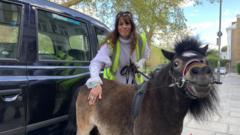
Animal-Assisted Interventions (AAI) frequently rely on qualitative metrics—such as patient mood elevation and perceived stress reduction—to justify their operational footprint. However, evaluating these interventions through a strict logistical and physiological framework reveals a stark contrast between standard canine-centric models and the deployment of miniature therapy horses (Equus caballus). While public attention gravitates toward the novelty of a miniature horse utilizing urban infrastructure, the true analytical value lies in comparing the animal's unique physiological mechanics, specialized training constraints, and the complex supply chain required to transport a hoofed mammal within metropolitan environments.
Understanding this system requires breaking down the intervention into three core variables: physiological variance, urban transit logistics, and the biomechanical feedback loop established between the patient and the animal.
The Physiological and Longevity Matrix: Equine vs. Canine
The selection of miniature horses over domestic dogs for high-frequency therapeutic environments is fundamentally an asset-lifecycle decision. The operational utility of a standard therapy canine peaks between years two and eight, yielding an active service window of approximately six years. Miniature horses present a drastically different depreciation curve.
- Lifespan and Service Velocity: Miniature horses routinely live between 30 and 35 years. Their active service capability spans from age three to roughly age 25. This yields a 22-year operational window—nearly four times that of a canine asset.
- Amortization of Training Capital: The upfront resource allocation required to train a certified therapy animal includes hundreds of hours of desensitization to tactile, auditory, and visual stimuli. In a canine model, this capital expenditure must be reinvested every six to eight years. In an equine model, the initial training capital is amortized over more than two decades, drastically reducing the long-term cost per intervention hour.
- Allergenic Disruption Profiles: Dog dander contains specific proteins (Can f 1 through Can f 6) that trigger high rates of allergic responses in indoor clinical settings. Equine dander profiles differ significantly, presenting a viable alternative for healthcare facilities that must maintain strict environmental controls for immunocompromised or highly sensitive patient populations.
The Micro-Logistics of Urban Transit and Transit Friction
The primary operational bottleneck for miniature therapy horses is the transit phase. Unlike service dogs, which integrate seamlessly into standard vehicular seating arrangements, a miniature horse—even one standing under 34 inches at the withers and weighing between 150 to 250 pounds—requires specific modifications to standard transit protocols.
When deployment relies on urban ride-share infrastructure or commercial taxis rather than dedicated trailers, the operational friction increases exponentially.
[Vehicle Selection: High-Clearance Hybrid/SUV]
                       │
                       ▼
         [Cargo Area Modification]
  (Rubberized Matting + Polyethylene Barriers)
                       │
                       ▼
       [Animal Onboarding: Manual Load]
                       │
                       ▼
     [Transit Phase: Active Stabilization]
  (Counteracting Kinetic Inertia & Centrifugal Force)
This process introduces a specific cost function governing urban equine deployment:
$$C_{total} = C_{base} + C_{prep} + C_{risk_premium} + C_{depreciation}$$
Where:
- $C_{base}$ represents the standard distance-and-time fare of the urban transit asset.
- $C_{prep}$ is the quantified time spent installing protective, non-porous barriers and high-traction rubberized matting within the vehicle's cargo area to prevent structural damage from hooves.
- $C_{risk_premium}$ accounts for the increased probability of driver cancellation due to asset-liability concerns, requiring over-scheduling or premium platform utilization.
- $C_{depreciation}$ calculates the physical toll of transit-induced stress on the animal, which directly impacts its post-transit intervention efficacy.
The physics of transit present another constraint. A canine can easily shift its center of gravity lower during sudden braking or cornering. An equine asset possesses a higher center of mass and a rigid skeletal structure. To mitigate kinetic inertia during transit, the vehicle must be operated at lower acceleration and deceleration thresholds, extending transit times and dictating precise route planning that avoids high-density traffic bottlenecks or poor road topography.
Biomechanical and Cognitive Feedback Loops in Patient Interaction
The therapeutic efficacy of a miniature horse cannot be attributed to mere novelty; it is driven by distinct biomechanical and evolutionary psychological mechanisms that separate prey animals from predators.
The Prey-Predator Dichotomy in Emotional Mirroring
Canines are apex predators. Their social interactions are rooted in pack dynamics, eye contact, and performance-based validation. Equines are herd-based prey animals. Their survival mechanism depends on hyper-vigilance and an acute sensitivity to micro-shifts in environmental tension, heart rate, and cortisol levels within their immediate vicinity.
When a miniature horse enters a clinical environment, its autonomic nervous system acts as a bio-feedback mirror for the patient. High-stress patients emit chemical and physical indicators (increased heart rate, shallow respiration, elevated cortisol). An equine asset perceives these indicators instantly and alters its stance and muscle tension. To achieve a calm state with the animal, the patient must consciously or unconsciously regulate their own physiological output. This creates a direct, measurable loop of co-regulation that is distinct from the predatory-comfort loop offered by canines.
Tactile Feedback and Proprioceptive Input
The physical surface area of a miniature horse offers varied sensory input that stimulates cognitive pathways in neurodivergent patients or individuals recovering from cerebrovascular accidents.
- The Coat and Mane Texture Contrast: The coarse texture of the guard hairs combined with the softer undercoat provides distinct tactile discrimination exercises.
- The Hoof Structure: The solid, unyielding nature of the hoof capsule offers a stark tactile contrast to soft tissue, used by therapists to ground patients experiencing acute dissociation or panic responses.
- The Olfactory Signature: Equine scent profiles are dominated by plant-based metabolites rather than the meat-based fatty acid secretions common to carnivores, inducing different olfactory-evoked neural responses in the human limbic system.
Sanitation Protocols and Environmental Biosecurity
Deploying a livestock asset into sterile or highly regulated healthcare environments requires a rigorous sanitation protocol to eliminate zoonotic transmission pathways and maintain facility biosecurity. The primary risks include the introduction of Salmonella, Campylobacter, and various dermatophytes.
To reduce these risks to near-zero thresholds, a multi-tiered sanitation matrix must be enforced prior to cross-contamination zones:
| Phase | Target Area | Protocol Details | Expected Outcome |
|---|---|---|---|
| Phase 1: Hoof Sanitation | Hoof Wall, Sole, and Frog | Mechanical debris removal followed by application of a broad-spectrum, non-corrosive disinfectant solution (e.g., chlorhexidine gluconate). | Complete elimination of organic matter capable of harboring anaerobic bacteria or environmental pathogens. |
| Phase 2: Coat Decontamination | Full Body Surface | Vacuum grooming to remove dander, followed by the application of antimicrobial coat conditioners that bind dust particles. | Minimization of airborne particulate matter within closed ventilation loops. |
| Phase 3: Waste Containment | Distal Gastrointestinal Tract | Attachment of a specialized, form-fitting equine diaper system lined with super-absorbent polymer cores. | 100% containment of solid and liquid waste during indoor operational windows. |
The secondary risk factor involves mechanical damage to commercial flooring. Polished terrazzo, vinyl composition tile (VCT), and hardwood surfaces present a low-coefficient of friction for a natural equine hoof, risking slipping injuries to the animal and structural scarring to the property.
The mitigation strategy demands the use of synthetic, high-traction hoof boots constructed from polyurethane or ballistic nylon. These boots serve a dual purpose: they distribute the animal’s weight evenly to eliminate point-load damage to delicate floors, and they provide the necessary grip to prevent muscle strain in the horse's hocks and stifles during indoor navigation.
Institutional Limitations and Strategic Vulnerabilities
Despite the clear longevity advantages and distinct psychological mechanics, the scalability of miniature horse interventions is constrained by structural bottlenecks that do not apply to canine programs.
The first limitation is spatial requirement. A miniature horse cannot climb standard staircases, utilize narrow elevators safely, or navigate tight, acute-angle corridors designed for human foot traffic. This limits their operational footprint to ground-floor facilities, wide-corridor rehabilitation wings, or outdoor institutional spaces.
The second limitation lies in regulatory and legal classifications. While the Americans with Disabilities Act (ADA) explicitly contains provisions recognizing trained miniature horses as service animals under specific criteria, individual state healthcare codes and private facility insurance policies often categorize them strictly as livestock. This regulatory friction requires significant administrative overhead to clear legal hurdles prior to deployment, making spontaneous or short-notice interventions highly impractical.
The final constraint is handler resource intensity. A canine handler can easily manage an asset while multitasking or managing patient documentation. An equine handler must maintain continuous, active management of the animal’s head position, stance, and environmental field of vision. Because horses possess a nearly 350-degree monocular vision field with a distinct blind spot directly in front of their nose and behind their hindquarters, the handler must constantly manage the approach angles of patients to prevent startle reflexes.
Optimal Deployment Architecture
To maximize the return on allocation for these specialized assets, institutions must move away from treating them as generalized novelty visits and instead integrate them into highly structured, targeted therapeutic tracks.
The optimal deployment strategy involves three distinct steps:
- Target Patient Selection: Restrict equine interventions to long-term neurological rehabilitation units, profound post-traumatic stress disorder (PTSD) clinics, or non-verbal pediatric wards where the prey-animal co-regulation loop yields the highest therapeutic leverage.
- Logistical Corridor Auditing: Prior to deployment, map the exact physical route from the vehicle drop-off zone to the intervention space. The route must feature zero stairs, a minimum corridor width of five feet, non-slip surface coverage, and immediate access to a secure, outdoor waste-disposal zone.
- Transit Asset Specialization: Discontinue the reliance on ad-hoc urban ride-share options. Implement a dedicated, low-emissions utility vehicle equipped with a pneumatic lowering ramp and a reinforced, integrated containment cell. This removes transit-readiness friction, eliminates driver cancellation variables, and stabilizes the animal’s core body temperature and heart rate prior to arrival at the medical facility.