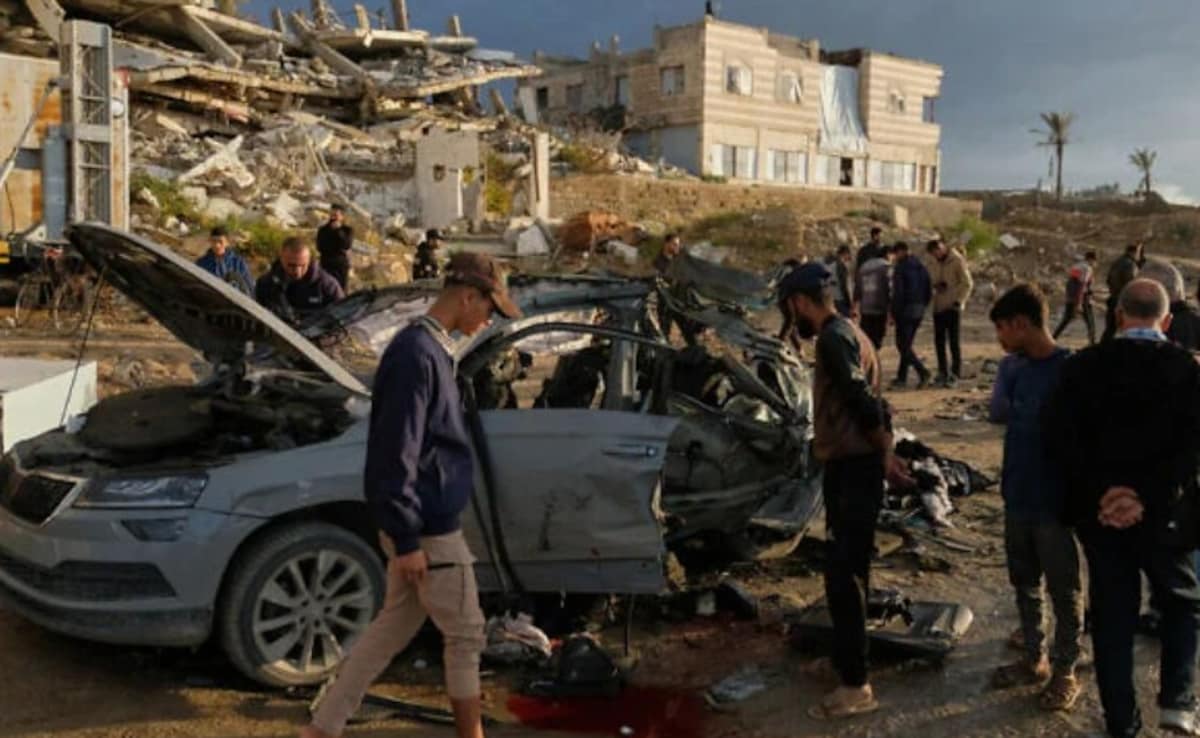
The shift in Israeli military rhetoric from "containing" threats to "achieving historic casualty rates" signals a fundamental transition in the doctrine of asymmetric warfare. When the Chief of Staff of the Israel Defense Forces (IDF), Lieutenant General Herzi Halevi, references the 1967 Six-Day War, he is not merely citing a historical milestone; he is invoking a specific operational model characterized by high-tempo, multi-front dominance and the rapid degradation of enemy combat effectiveness. This strategy seeks to solve the "attrition trap" inherent in urban insurgencies by applying a level of kinetic force designed to collapse the command-and-control structures of non-state actors before international political pressure forces a ceasefire.
The Triad of Operational Attrition
To understand the current military trajectory, one must decompose the IDF’s strategy into three distinct operational pillars. These pillars function as a feedback loop where the success of one accelerates the efficiency of the others.
- Mass-Scale Interdiction: This involves the systematic identification and neutralization of middle-management combatants. By targeting the rank-and-file leadership—the company and battalion commanders—the IDF aims to create a "vacuum of agency" where the remaining fighters are unable to coordinate multi-unit maneuvers.
- Structural Degradation: This is the physical destruction of the "enabling environment." In an urban theater, this refers to subterranean networks, weapons caches, and reinforced firing positions. The IDF's current approach treats the urban fabric not as a static battlefield, but as a three-dimensional logistical puzzle that must be dismantled to deny the enemy any sanctuary.
- Psychological Overmatch: This is the intended output of high casualty rates. By referencing 1967, the military command communicates to both the domestic population and the regional adversaries that the previous constraints on force application have been removed. The goal is to alter the adversary's cost-benefit calculus regarding continued resistance.
The 1967 Benchmark: Why Scale Matters
The reference to 1967 is a quantitative target as much as a qualitative one. During the Six-Day War, the IDF achieved a decisive victory through speed, surprise, and a disproportionate kill ratio that rendered the opposing conventional armies incapable of offensive operations within 144 hours. Applying this logic to a non-conventional, asymmetric conflict in 2024–2026 creates several unique mechanical challenges.
In 1967, the targets were identifiable armored divisions and airfields. In the current theater, the "targets" are integrated into civilian infrastructure. To achieve "1967-level" results, the military must increase its target-generation speed. This is currently being facilitated by AI-driven intelligence platforms that aggregate SIGINT (signals intelligence) and IMINT (imagery intelligence) to identify combatants in real-time. The risk of this "industrialized" targeting is a potential increase in collateral damage, which serves as the primary friction point between military objectives and diplomatic longevity.
The Cost Function of High-Intensity Kinetic Operations
Military success in this context is often measured by the "Ratio of Degradation." If the IDF can neutralize combatants faster than the adversary can recruit, train, and deploy them, they achieve a net gain in security. However, this equation ignores the "political friction coefficient."
- Human Capital Depletion: The loss of experienced fighters creates a steep learning curve for the adversary. When elite units are decimated, the remaining force lacks the tactical discipline to execute complex ambushes, leading to a breakdown in operational effectiveness.
- Intelligence Saturation: High-intensity operations force the enemy to communicate more frequently, which increases their electronic signature. Every radio transmission or digital ping becomes a data point for IDF SIGINT units, leading to a geometric increase in target acquisition.
- The Law of Diminishing Tactical Returns: There is a point where increasing kinetic force no longer yields proportional security gains. Once the primary infrastructure is destroyed, the remaining combatants shift to "cell-based" insurgency, which is harder to target with heavy ordinance and requires a transition to low-intensity, high-risk infantry patrols.
Subterranean Complexity and the Geometric Defense
The primary obstacle to achieving a 1967-style decisive victory is the tunnel infrastructure. Unlike the open deserts of the Sinai, the current battlefield is an inverted mountain range.
The IDF's response to this is "Vertical Envelopment." This involves seizing the surface while simultaneously using specialized engineering units to flood, collapse, or clear the layers beneath. This creates a dual-front pressure: the enemy cannot retreat upward to escape the air-to-ground strikes, and they cannot remain underground as their oxygen, power, and escape routes are systematically severed. The rhetoric of "killing like 1967" implies a willingness to neutralize these tunnels regardless of their proximity to protected civilian sites, a significant departure from previous "surgical" doctrines.
The Logistics of Sustained High-Intensity Conflict
Maintaining the tempo required for this strategy places an immense strain on the military-industrial complex.
- Munition Burn Rates: High-intensity kinetic operations consume precision-guided munitions (PGMs) at a rate that often exceeds domestic production capacities. This necessitates a robust logistical bridge with the United States, creating a strategic dependency that limits total operational autonomy.
- Personnel Fatigue: Transitioning from a reserve-based defensive posture to a sustained "1967-style" offensive requires rotating thousands of troops through high-stress urban environments. The economic cost of prolonged mobilization—the "Reserve Tax"—drains the national GDP as high-tech workers and professionals are pulled from the workforce.
- Information Warfare Asymmetry: While the IDF may be winning the kinetic battle (physical destruction), they face a deficit in the "narrative battle." In 1967, the lack of real-time global connectivity allowed the IDF to present a fait accompli to the world. Today, every kinetic strike is broadcast instantly, allowing the adversary to leverage international law and public opinion to stall military momentum.
Strategic Pivot: From Attrition to Displacement
The core of Halevi's statement suggests that the IDF is no longer interested in a "mowing the grass" strategy—the periodic degradation of enemy capabilities. Instead, the focus has shifted to "rooting the grass."
This requires a total restructuring of the security architecture. The military intends to create "buffer zones" and "security corridors" that physically separate the adversary from the Israeli border. This isn't just about killing combatants; it's about redefining the geography of the conflict. By destroying the structural capacity for an adversary to exist as a governing or military entity near the border, the IDF seeks to replace constant vigilance with a permanent physical barrier of "no-man's land."
The Risk of Strategic Overreach
The limitation of a "kinetic-first" doctrine is that it often lacks a "governance-second" component. History shows that military vacuums are rarely left empty. If the IDF succeeds in the 1967-style destruction of the current adversary, they face the "Day After" dilemma:
- Who administers the territory? A defeated population without a governing structure becomes a fertile ground for even more radicalized, decentralized factions.
- The Insurgency Pivot: As conventional military structures are destroyed, the adversary typically pivots to a long-term guerrilla insurgency. Kinetic force is highly effective against battalions but less so against individuals with improvised explosive devices (IEDs) hidden in rubble.
- Diplomatic Isolation: The pursuit of 1967-style kill ratios in a 2026 media environment risks severing ties with regional partners (such as the Abraham Accords signatories) who cannot politically afford to be seen as complicit in high-casualty operations.
Operational Recommendation: The Precision-Persistence Model
To bridge the gap between military goals and political reality, the IDF command must transition from "High-Volume Kinetics" to a "Precision-Persistence" model. This involves:
- Hyper-Localized Intelligence: Moving away from broad structural strikes toward "micro-targeting" of specific logistical nodes—fuel, electricity, and water filtration—that the insurgency needs to survive underground.
- Modular Occupation: Instead of a total territorial sweep, the military should utilize "inkblot" tactics—securing small, manageable sectors and establishing local governance before moving to the next. This prevents the "vacuum effect."
- Technological Integration of the Border: Implementing autonomous sensor-to-shooter arrays that reduce the need for a massive permanent troop presence, thereby mitigating the economic drain of mobilization.
The military command's current path is one of high-risk, high-reward. By aiming for a historical level of destruction, they are betting that the resulting "strategic shock" will provide years, if not decades, of quiet. However, the durability of this peace depends not on the number of combatants killed, but on the ability of the state to convert military dominance into a sustainable political equilibrium. The "1967" model is a hammer; the current challenge is that the battlefield is no longer just a nail—it is a complex, living ecosystem that requires a scalpel as much as a blunt instrument.