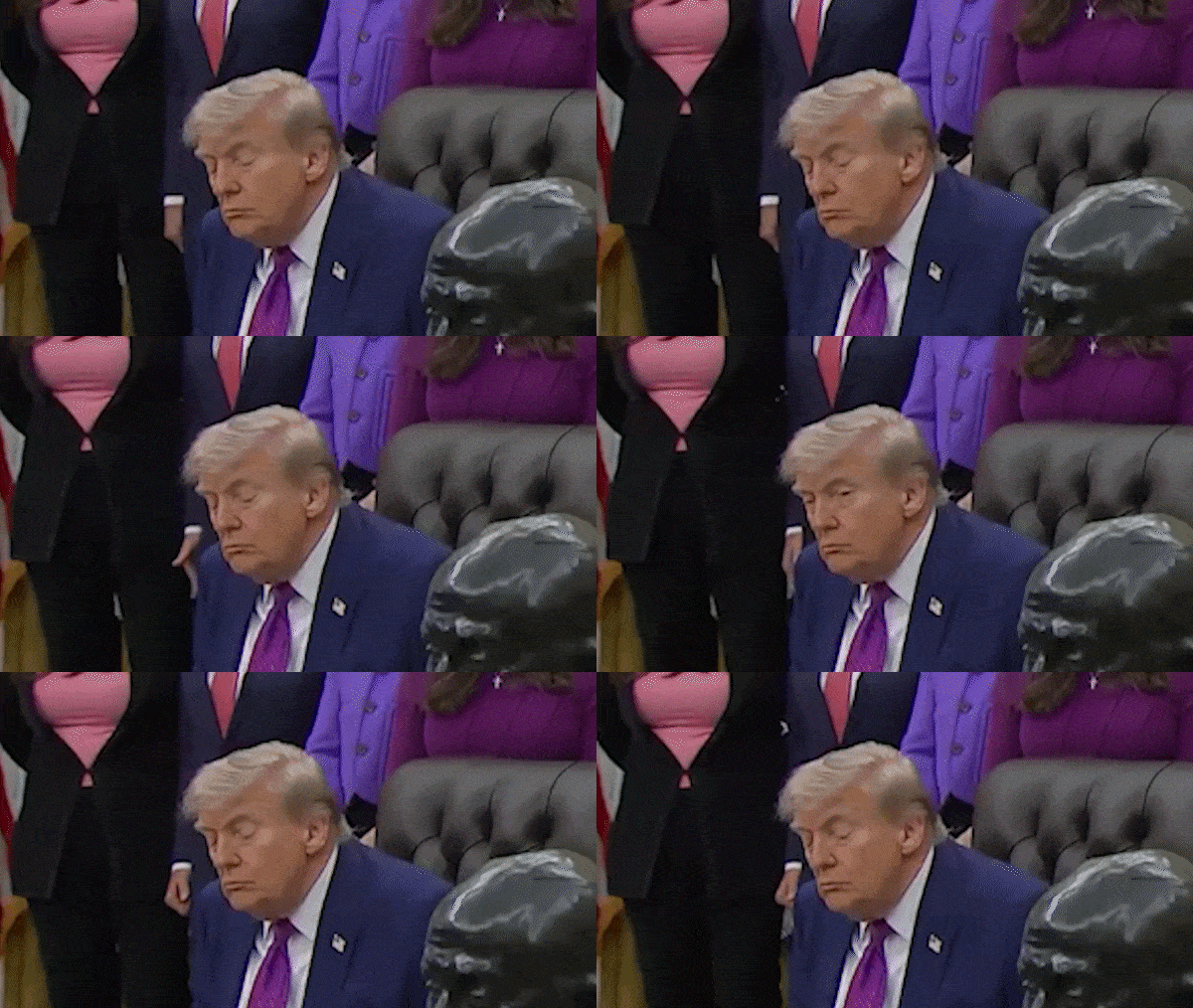
The White House finds itself in a familiar, defensive crouch this week, fighting a battle not over policy or legislation, but over the physical mechanics of Donald Trump’s eyelids. Following a high-stakes meeting where cameras caught the former president with his eyes closed for an extended duration, the administration’s communications team launched into a frantic damage control operation. They didn’t just offer a rebuttal; they insisted, with an almost anatomical precision, that he was merely "blinking" or looking down at notes. This isn’t just a dispute over a nap. It is a window into a political machine that views any hint of physical frailty as a terminal threat to the brand.
At the heart of the controversy is a simple, biological reality that clashes with a carefully curated image of tireless energy. When the footage hit social media, it went viral not because people care about the science of REM cycles, but because it fed into a long-standing narrative about the aging process of world leaders. The White House reaction was immediate and sharp. By choosing to litigate the difference between a long blink and a short sleep, they inadvertently elevated a minor observation into a national news cycle.
The Anatomy of a Denial
Modern political communication operates on the principle that an unanswered accusation becomes a fact. In this instance, the "accusation" was a silent video clip. The rapid-fire response from the press office suggests a pre-existing anxiety about how the public perceives the president’s stamina. When a spokesperson stands at a podium and describes the specific cadence of a man’s blinking patterns, the goal isn't just to correct the record. The goal is to shut down a line of questioning that leads directly to the one topic every incumbent fears: the inevitable march of time.
Denials of this nature often backfire. They follow the "Streisand Effect," where the very act of trying to hide or suppress a piece of information makes it infinitely more visible. By engaging with the "sleeping" narrative so aggressively, the White House ensured that every major network would play the clip on a loop, inviting millions of amateur forensic analysts to decide for themselves if the president’s chin was dipping toward his chest.
Why Physicality Defines the Narrative
We live in a visual-first political culture. A candidate can have the most detailed white paper in history on tax reform, but if they trip on a flight of stairs or lose focus during a briefing, that becomes the defining image of their tenure. This obsession with physical vitality is a relic of the television age that has been magnified tenfold by the era of short-form video.
Every movement is scrutinized. Every pause is measured. For Trump, who has built his entire persona around the idea of being a high-energy disruptor, the suggestion that he might be succumbing to the exhaustion of the job is a direct hit to his core value proposition. His supporters don't just vote for his policies; they vote for the perceived strength he projects. If that strength is questioned, the foundation of his appeal begins to show cracks.
The War of Perspectives
To understand the intensity of this denial, one must look at the broader context of the 2024 campaign. Both major parties have turned the aging process into a weapon. We see a constant stream of "low-light" reels designed to show cognitive or physical decline in opponents. This has created an environment where a momentary lapse in focus is treated with the same severity as a major policy blunder.
Critics argue that these snapshots are often taken out of context. A person looking down to read a briefing note can look like they are nodding off if the camera angle is tight enough. Conversely, supporters of the "he was asleep" theory point to the length of the pause and the lack of movement in the surrounding muscles of the face. It becomes a Rorschach test for the American public. You see what your political leanings want you to see.
The High Stakes of the Briefing Room
Behind the scenes, the communications staff isn't just worried about the voters. They are worried about the donors and the party elite. These groups look for signs of stability. A president who appears to be drifting off in a meeting with foreign dignitaries or business leaders sends a signal of disengagement. Even if the "blink" was just a blink, the fact that it was ambiguous enough to cause a stir suggests a vulnerability in the way the president is being managed and presented.
The White House’s fury isn’t directed at the facts; it is directed at the perception. They are fighting for control of a story that is inherently uncontrollable. Once a video is in the wild, the official transcript matters very little. The public trusts their eyes more than they trust a press secretary's explanation of a "prolonged downward glance."
The Pattern of Defense
This isn’t the first time an administration has had to defend a leader’s health, and it won't be the last. However, the tone of this particular defense is notable for its aggression. There is a sense of "thou protesteth too much" in the way the denials were issued. Usually, a simple "the president was reviewing his notes" would suffice. Instead, we saw a multi-pronged attack on the journalists who reported the observation, accusing them of bad faith and visual manipulation.
This strategy serves a dual purpose. It fires up the base by casting the media as the "enemy of the people" once again, and it creates enough noise to drown out the original clip. It’s a classic diversionary tactic. If you can’t win the argument about whether his eyes were closed, you win the argument about whether the media is being fair.
Managing the Unmanageable
The reality of aging in the public eye is that there is no winning move. The schedule of a president is grueling. It involves constant travel, back-to-back meetings, and the perpetual weight of global responsibility. Anyone, regardless of age, would be tired. But in the theater of politics, admitting exhaustion is seen as an admission of defeat.
Staffers spend hours choreographing every entrance and exit. They choose lighting that minimizes shadows and podium heights that encourage an upright posture. They are, in essence, stage managers for a long-running play where the lead actor isn't allowed to have a bad night. When the choreography fails, as it did in this meeting, the stage managers have to rush out and swear that the stumble was actually a scripted dance move.
The Impact on Global Perception
Beyond domestic politics, these moments are watched closely by adversaries and allies alike. Diplomacy is a game of subtle cues. If a leader appears disconnected, it changes the power dynamic in the room. This is likely why the White House was so quick to shut the story down. They cannot afford to let the "sleepy" label stick in the minds of international partners who are deciding whether to commit to long-term agreements or security pacts.
Strength, in the geopolitical sense, is often a matter of appearances. A leader who is perceived to be failing physically is seen as a leader who may be losing their grip on their own government. This leads to instability and can embolden rivals to test boundaries they would otherwise respect.
The Mechanical Reality of Politics
We are entering a phase of the campaign where the substance of the debate will be increasingly overshadowed by the optics of the candidates. This "blinking" episode is just the opening salvo. We should expect more high-definition captures of every stumble, stutter, and sigh.
The White House can deny the footage all they want, but they are fighting against the most powerful force in modern life: the digital record. You can tell people they didn't see what they saw, but in an age of instant replay and zoom functions, that is a losing battle. The strategy moving forward will likely involve even more tightly controlled environments, fewer "open" meetings, and a desperate attempt to keep the candidate in a state of perpetual motion.
The defense of the blink wasn't about a single meeting. It was a declaration of war against the narrative of decline. Whether that war can be won with words alone remains to be seen, but the intensity of the fight shows exactly how much the administration thinks is at stake. The eyes of the world are watching, and they are looking for much more than just a blink.
Stop looking for a deeper meaning in the denial and start looking at the desperation behind it.