Forty miles off the coast of Oahu, the water stops looking like the postcards.
Near the shoreline, the Pacific is a bright, forgiving turquoise, churned up by white sand and shallow coral reefs. Out in the open ocean, beyond the continental shelf where the floor drops away into miles of pitch-black abyss, the water turns a shade of blue so deep and absolute it looks almost like ink. Sailors have navigated by that color for thousands of years. To a trained eye, the hue of the sea is a vital sign, as legible as a pulse on a wrist.
Look closer at a bucket of that ink-dark water today, however, and you will find something that does not belong to the geological history of the Earth. Suspended beneath the surface, invisible to the naked eye from the deck of a boat, is a drifting, sunlit fog of synthetic confetti.
Microplastics.
We have spent the last decade learning to dread what these microscopic shards of degraded bottles, synthetic fleece, and tire dust do to the stomachs of seabirds and the placentas of unborn children. We know they are everywhere, from the Mariana Trench to the peak of Mount Everest. Yet a growing body of optical oceanography points to a consequence so vast, and so strangely intimate, that it sounds like science fiction.
The Pacific Ocean is changing color. Not because of a sudden chemical spill or a Hollywood-style ecological collapse, but because trillions of tiny plastic fragments are altering the fundamental physics of how sunlight interacts with the sea.
The Illusion of Blue
To understand how a piece of broken shopping bag smaller than a sesame seed can repaint the largest body of water on Earth, you first have to accept a small lie your eyes tell you every time you look at the coast.
Water is not actually blue. Not in a glass, and not in a swimming pool. Pure water is transparent, though it has a very slight tendency to absorb the long, warm wavelengths of light—reds, oranges, and yellows—while allowing the short, energetic blue wavelengths to bounce back toward your retina. In the open ocean, where the water is miles deep and largely empty of sediment, that tiny preference compounds until the entire surface glows cobalt.
When the color of the sea shifts, it is almost always because something else is floating in it.
For billions of years, that "something else" was alive. Phytoplankton, the microscopic, drifting plants that form the base of the marine food web, pack their cells with chlorophyll. Chlorophyll absorbs blue and red light to fuel photosynthesis, reflecting green light back into space. When satellite sensors operated by NASA or the European Space Agency pass over a patch of ocean and see it turning from deep blue to a vibrant emerald, marine biologists celebrate. Green means life. Green means a spring bloom is underway, feeding krill, whales, and the fisheries that sustain three billion people.
Now, picture a hypothetical oceanographer—let’s call her Elena—sitting in a windowless lab in Honolulu, staring at years of satellite spectrometry data from the North Pacific Subtropical Gyre.
For months, Elena notices a faint, stubborn anomaly in the light bouncing off the water between Hawaii and California. The ocean isn't turning green. It isn't turning brown with river mud. Instead, the light signature is brightening in ways that defy traditional biological models. When she compares the satellite readings with physical water samples towed from the same coordinates, the culprit isn't a surge in healthy algae. It is a dense, suspended cloud of polyethylene and polypropylene fibers, worn down by waves and ultraviolet radiation until they are smaller than a grain of salt.
A Fog Beneath the Waves
Think of what happens when sunlight hits a clean glass window versus a window dusted with fine white flour.
Clean glass lets the light pass straight through into the room. Flour scatters the light in every direction, turning the pane milky and opaque. In the open Pacific, microplastics act just like that dusting of flour.
Because plastic polymers have a different refractive index than seawater—meaning light bends at a sharper angle when it hits a speck of nylon than when it hits a water molecule—these particles scatter incoming sunlight back toward the sky before it can penetrate the depths. Scientists call this backscattering.
When billions of plastic fragments accumulate in the upper few meters of the ocean, they create an optical veil. The water begins to look slightly brighter, slightly milkier, shifting away from the pure, deep blue of an empty sea toward a paler, hazier spectrum. You wouldn't notice it standing on a pier in Santa Monica with your morning coffee. Human eyes are terrible at detecting gradual shifts in luminance across vast horizons.
Satellites, however, see everything.
That is where the real problem lies. Our entire modern system for monitoring the health of the planet relies on reading the color of the ocean from orbit. Every day, orbital sensors measure subtle variations in blue and green light to calculate how much carbon dioxide the oceans are absorbing, where fish stocks are migrating, and whether climate change is starving the marine ecosystem of nutrients.
When microplastics alter the water's light signature, they essentially spoof the instruments. A patch of ocean choked with synthetic fibers can scatter light in a way that mimics the optical footprint of a phytoplankton bloom, or masks a genuine collapse in marine life underneath. We are trying to take the temperature of a feverish planet while someone holds a lighter under the thermometer.
When Sunlight Cannot Reach the Garden
The distortion isn't just a headache for scientists looking down from space; it is a crisis for the organisms living underneath.
Consider what happens next when that optical veil thickens. If sunlight is bouncing off floating plastic fragments in the top ten feet of the ocean, that light never reaches the water fifty or a hundred feet below.
Phytoplankton are essentially underwater farmers that need steady sunlight to survive. When microplastics scatter and absorb incoming solar radiation, they shrink the euphotic zone—the sunlit upper layer of the sea where photosynthesis is possible. Even a slight dimming of the underwater world forces microscopic algae to work harder for less energy.
I remember standing on the deck of a research vessel off the Baja peninsula a few years back, watching a crew haul up a fine-mesh neuston net after a twenty-minute tow. From the rail, the Pacific looked pristine, glittering like hammered silver under the afternoon sun. When the crew emptied the cod-end of the net into a glass jar, the water inside looked like cloudy chicken broth, thick with jagged white flecks, blue filaments, and translucent pellets. Holding that jar up to the sky, it was impossible not to feel a quiet, creeping dread. Every single fleck in that jar was acting like a microscopic parasol, stealing a fraction of a photon from the living things below.
And the interference runs deeper than shade.
Recent laboratory studies have shown that microplastics don't just float passively among phytoplankton; they physically stick to them. Tiny, rough-edged plastic particles can clump onto algal cells, weighing them down so they sink out of the sunlit zone prematurely, or damaging their cell walls. At the same time, tiny marine grazers like copepods—the crucial middlemen that eat phytoplankton and get eaten by baby salmon and herring—mistake brightly colored microplastics for food.
When a copepod fills its gut with indigestible polystyrene instead of nutrient-rich algae, two things happen. First, the animal starves on a full stomach. Second, its fecal pellets—which normally sink rapidly to the ocean floor, locking away carbon for centuries—become buoyant with trapped plastic. Instead of sinking, the waste floats, rotting near the surface and releasing carbon right back into the atmosphere.
A subtle change in color at the surface is, in truth, a symptom of a broken carbon pump below.
The Archive of Our Convenience
Why is the Pacific bearing the brunt of this optical transformation? Look at a map of global currents, and the answer becomes painfully obvious.
The Pacific is ringed by some of the fastest-growing coastal economies and largest manufacturing hubs on Earth. Vast rotating currents—known as gyres—act like slow-motion whirlpools, sweeping debris from the coasts of Asia and the Americas into immense convergence zones. The most famous of these, the Great Pacific Garbage Patch, is often imagined as a solid island of trash you could walk across.
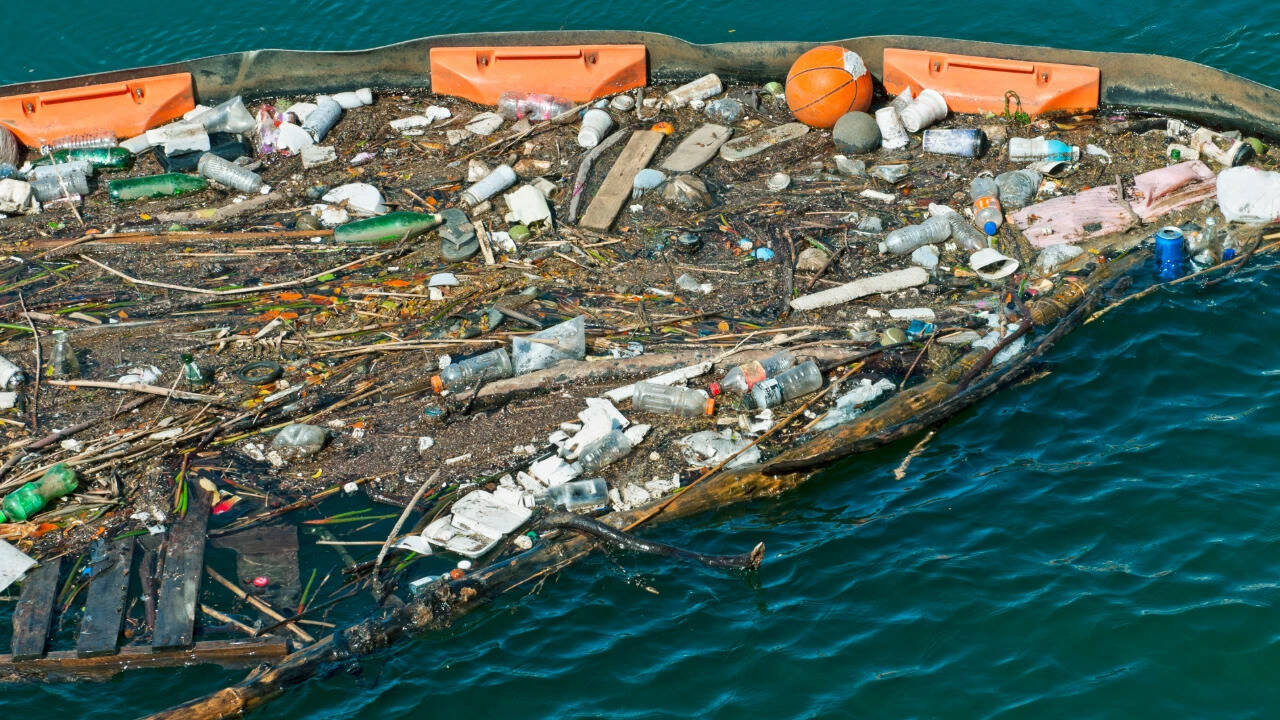
It isn't. If you sailed straight through the middle of it, you might only see the occasional floating buoy, tangled fishing net, or sun-bleached detergent bottle. The real mass of the garbage patch is an underwater smog of trillions of microplastic particles, churned endlessly by waves and baked brittle by the sun.
Every synthetic shirt washed in a suburban laundry room sheds hundreds of thousands of microscopic polyester fibers that slip through wastewater treatment plants and flow down rivers to the sea. Every mile driven on a coastal highway grinds tiny flecks of synthetic rubber off car tires, which wash into storm drains with the first rain.
We built a civilization around materials engineered never to break down, and then we treated the ocean as an infinite sink. It is unsettling to realize that the plastic fork used for ten minutes at a takeout lunch in 1998 is still out there right now, fractured into ten thousand invisible shards, scattering the afternoon light off the coast of Hawaii.
Honesty requires admitting what we still don't know. Oceanographers are fiercely debating just how fast this optical shift is accelerating, and how much of the ocean's changing hue comes from plastics versus warming water temperatures, which also alter phytoplankton communities. Separating the signal of plastic from the signal of climate change is one of the hardest puzzles in modern environmental science. There are moments when the sheer scale of the problem feels paralyzing—like trying to filter salt out of the sea with a teaspoon.
Clearing the Water
Yet the history of environmental recovery offers a quiet, stubborn counterargument to despair.
In the 1970s, coastal waters across North America and Europe were choked with industrial phosphates and raw sewage, turning bays and estuaries into dead zones stained dark with toxic algae. When governments banned phosphate detergents and invested in modern water treatment, the water cleared within a single generation. In the 1980s, when scientists discovered that chlorofluorocarbons were tearing a hole in the ozone layer, global treaties phased out the chemicals, and the atmosphere began to heal.
Microplastics are harder because they are woven into the fabric of modern daily life, literally and figuratively. Cleaning up the open Pacific with giant nets is largely a fantasy; skimming the surface for microplastics catches far too much delicate marine life while barely denting the trillions of particles suspended deeper down.
The real solution happens on land, long before a single shard reaches the surf.
It starts with turning off the tap at the source. Simple, inexpensive microfiber filters installed on commercial and household washing machines can capture up to ninety percent of synthetic lint before it ever enters the sewer system. Redesigning storm-water bioswales along highways with specific soil and plant mixtures can trap tire dust before it washes into watersheds. And at the industrial level, shifting away from single-use packaging toward truly biodegradable polymers—materials that marine microbes can actually digest into harmless water and carbon dioxide—cuts off the future supply of oceanic fog.
Stand on a cliff overlooking the Pacific at dusk, and the ocean still looks timeless. Waves roll in from the horizon in long, rhythmic swells, breaking into white foam against dark volcanic rock. To the human eye, nothing has changed since the first Polynesians navigated these waters by the stars and the swell.
The water remembers everything we put into it. Somewhere out beyond the horizon, miles from shore, the afternoon sun hits a million invisible fragments of yesterday's convenience, scattering a pale, unnatural light back into the sky.