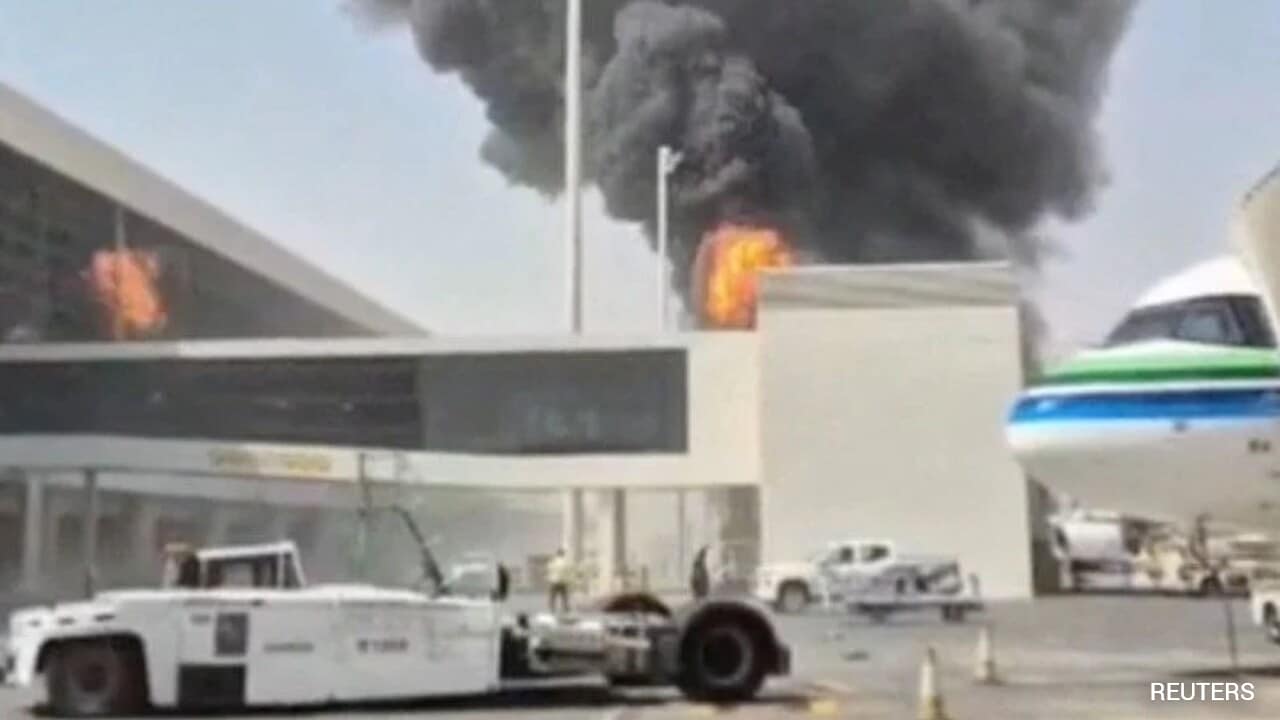
Every time a projectile pierces the airspace of the Arabian Peninsula and grazes a civilian transport hub like King Khalid International Airport, the international media rushes to publish the exact same panicked script. Headlines scream about terminals on fire, evacuation orders, and crumbling air defenses.
The lazy consensus is that these isolated impacts represent a sudden, catastrophic failure of modern military technology. Analysts sit thousands of miles away in comfortable studios, shaking their heads at the supposed impotence of Patriot batteries and warning that commercial aviation in the Gulf is hanging by a thread. Don't miss our previous article on this related article.
They have it completely backwards.
I have watched defense budgets burn and security architectures buckle under real-world stress. The danger is not that missile interceptors fail to achieve a one-hundred percent success rate. The true crisis is the financial and operational asymmetry of modern aerial warfare, and nobody wants to talk about the math. If you want more about the background of this, The Washington Post offers an in-depth summary.
To understand why the standard reporting is fundamentally flawed, you have to look at cost per engagement. Firing a multi-million-dollar interceptor missile to swat down a low-cost, mass-produced projectile is a slow-motion economic bleeding strategy. The attackers do not need to punch through the defense grid every single time to win. They simply need to force a continuous economic drain while causing enough collateral disruption to spook foreign carriers and paralyze regional supply chains.
When a missile or drone fragments over a passenger terminal, the physical damage to concrete and steel is often secondary to the psychological shockwave. Insurance premiums spike. Flight paths shift. Regional carriers absorb millions in unexpected operational delays. Yet, mainstream reports treat each event as a localized tactical movie scene rather than a sustained economic attrition campaign.
Consider the mechanics of the defense shield. Modern missile defense systems are marvels of engineering, but they operate under strict mathematical constraints. When multiple vectors approach simultaneously, prioritization protocols kick in. High-value strategic assets take precedence over peripheral terminal structures. Shrapnel from a successfully intercepted projectile falling onto a tarmac is logged by sensationalist outlets as a direct hit, muddying the technical reality and feeding a narrative of systemic collapse.
This manufactured panic serves a specific purpose for regional actors, but it blinds the public to the actual shifts happening on the ground. Air defense commanders are not fighting a localized skirmish; they are engaged in a brutal math problem where every defensive launch costs an exorbitant sum, while the offensive payload costs a fraction of a percent by comparison.
If you want to understand how regional aviation survives this era, stop looking at the smoke rising near the runways. Start looking at the supply chain logistics of interceptor stock and the quiet technological pivot toward directed-energy and laser-based point defense systems. The conventional wisdom focuses on the dramatic explosions because nuance does not generate clicks. But the real war is being fought in corporate boardrooms, logistics depots, and defense ministry ledger books long before the sirens ever start wailing in Riyadh.