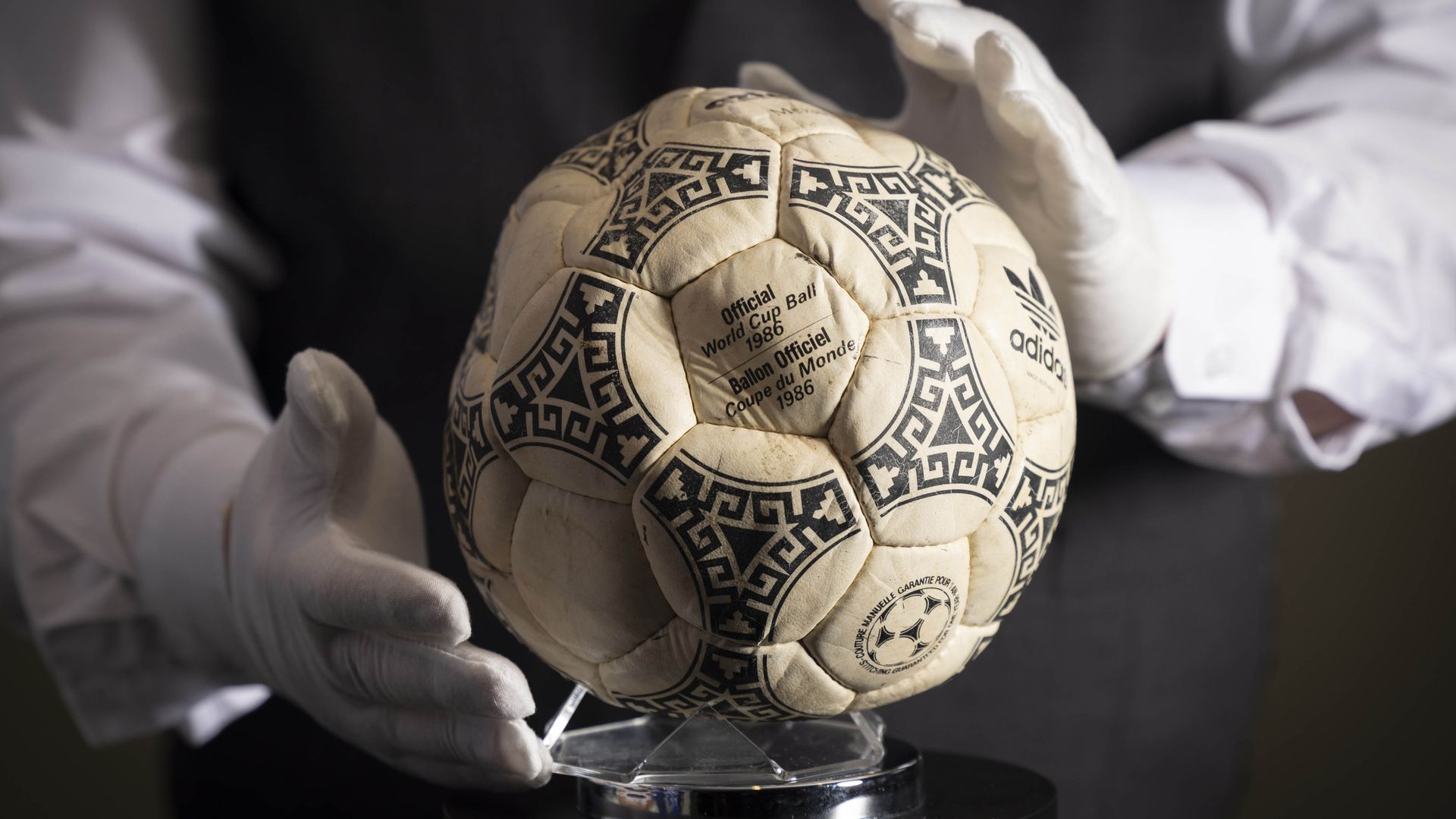
The sports memorabilia market is built on a collective hallucination. When Ali Bin Nasser auctioned off the exact match ball from Argentina versus England in the 1986 World Cup for two million pounds, the headlines screamed about history. Nostalgia pundits swooned over the physical artifact of a cheat code manifested in leather. They talked about the cultural gravity, the sheer audacity of Diego Maradona punching the ball past Peter Shilton, and the subsequent solo run of the century that redeemed the villainy ten minutes later.
They missed the entire point. Don't forget to check out our recent post on this related article.
Buying a piece of sports history for seven figures is not an investment in culture. It is a monument to financial illiteracy disguised as passion. If you evaluate that sale through the cold lens of asset valuation, liquidity, and actual utility, spending millions on a sphere of inflated pigskin is economic self-sabotage.
Let us dismantle the romanticism holding this market together. If you want more about the context here, The Athletic offers an informative summary.
The Liquidity Trap of Unique Artifacts
Memorabilia enthusiasts love to throw around the word investment. They point to historical appreciation charts and act like a piece of leather touched by a dead icon functions like blue-chip equity or commercial real estate. It does not.
Liquidity defines an asset. If you need cash tomorrow, you cannot slice off a panel of the 1986 match ball and sell it to pay your tax bill. You are entirely beholden to a hyper-niche pool of eccentric billionaires who happen to care about 1980s association football at the exact moment you are forced to sell.
Imagine a scenario where the ultra-high-net-worth demographic shifts its spending preferences toward digital assets, private space travel, or contemporary biotech startups over the next decade. Your two-million-pound ball does not generate a dividend. It does not rent out space. It sits in a climate-controlled glass case costing you insurance premiums while its target buyer demographic ages out of existence.
Real assets produce cash flow. Nostalgia objects produce anxiety wrapped in varnish.
The Authenticity Mirage and the Problem of Proof
Let us talk about the provenance problem that auction houses whisper about behind closed doors. Ali Bin Nasser held onto that ball for thirty-six years. He was the referee of the match. His claim to ownership rested entirely on his word and the visual continuity of television broadcasts from a stadium in Mexico City.
Ask yourself: how do you definitively prove that a specific, unmarked Adidas Azteca ball is the exact sphere Maradona punched into the net, rather than one of the dozen alternate match balls used during the fixture?
You rely on forensic testing, micro-traces of pitch rubber, and the authority of authentication agencies. But authentication in sports memorabilia is a closed loop of subjective opinions dressed up as science. When a multi-million-pound valuation depends entirely on the say-so of third-party graders who profit from higher valuations, the conflict of interest is staggering.
I have watched collectors blow fortunes on items with paper trails thinner than cigarette paper because the story was too good to check. The market rewards the narrative, not the empirical reality. When you buy the narrative, you are paying a massive premium for a ghost story.
The Scarcity Fallacy in Mass-Produced Goods
Economics teaches us that value stems from genuine scarcity meeting utility. A Picasso original is scarce because Pablo painted it with his own hands, and no one else can replicate his unique physical brushstrokes.
A match ball is a mass-produced industrial product manufactured by a sporting goods company. Thousands of identical balls rolled off assembly lines in the mid-1980s. The only thing making this specific ball valuable is an arbitrary historical accident: Maradona happened to punch it with his left hand while referee Bin Nasser happened to fail to spot it.
If you strip away the human drama of the ninety minutes, the object itself is worthless. You are paying two million pounds for the invisible ghost of a referee's blunder. That is not collecting; that is paying ransom to a memory.
What Intelligent Wealth Actually Looks Like
If you want to spend two million pounds, put it into something that compounds. Buy fractional shares of cash-flowing infrastructure. Invest in early-stage companies solving structural energy constraints. Fund a water purification plant in a developing market.
Those allocations change the material conditions of the planet. They create jobs, yield returns, and survive market corrections because they solve actual human problems.
A leather ball sitting in a dark room does none of that. It is a monument to static wealth, a dead asset frozen in time.
Leave the million-pound pigskin to the speculators who confuse owning a story with owning value. Let them pay the insurance, let them chase the fleeting attention of a fickle market, and let them explain to their accountants why their retirement fund smells like old leather and ozone.
True wealth isn't hiding in a display case. It is working.

.jpeg?width=1200&auto=webp&trim=181%2C0%2C181%2C0)