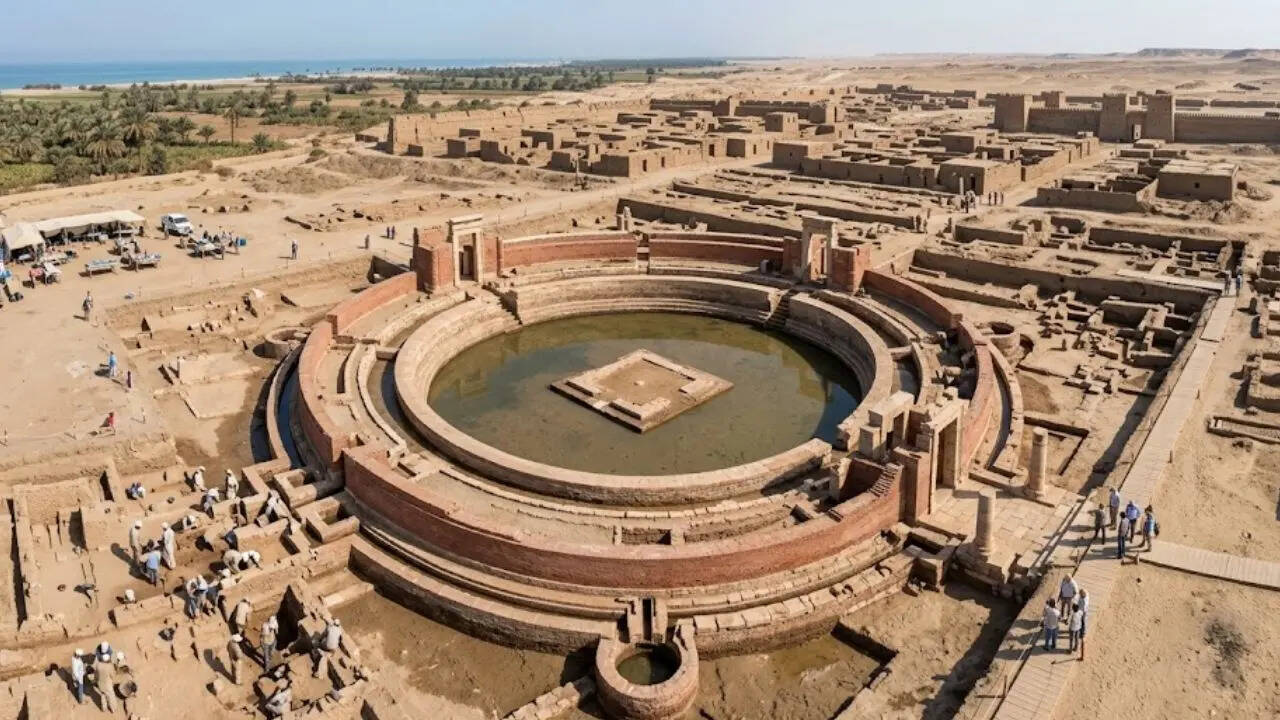
Archaeologists love a good narrative. They find a pile of rocks in a circle, attach the word temple, and immediately spin a yarn about spiritual devotion and water worship. The recent discovery of a round structure in Pelusium is the latest victim of this academic theater. The mainstream consensus claims this site offers a window into how ancient Egyptians reverently worshipped the Nile.
They are wrong. They are not just wrong; they are ignoring the cold, hard mechanics of ancient civil engineering to satisfy a desperate need for mystical significance.
The Myth of Sacred Architecture
The assumption that every circular stone foundation in the Levant or Egypt served a liturgical purpose is an embarrassment to the field. I have walked the sites from Giza to the Sinai. I have watched teams excavate structures and immediately label them shrines because they lack the imagination to consider utility.
Imagine a scenario where you are a civil engineer in a frontier port city like Pelusium, roughly two millennia ago. You are facing an infrastructure nightmare. You need a centralized collection point for gravity-fed irrigation or a reinforced base for a grain silo that needs to deflect wind from the Mediterranean. You build a circle because, structurally, it handles pressure better than a square.
The archaeologists find your ruins two thousand years later and announce that you were performing rituals for the river gods.
It is lazy. It is comfortable. It sells tickets to museums.
Engineering Over Theology
Let’s talk about the physics of the site. Pelusium was a tactical chokepoint. It was a military and commercial powerhouse. The inhabitants were not staring at the water and chanting; they were calculating trade volumes and defensive perimeters.
When researchers claim this round temple shows a specific reverence for Nile water, they are ignoring the regional hydraulic necessity of the era. The circular design is a dead giveaway for a structural load-bearing function, likely tied to a cistern or a filtration system for imported goods. The Egyptians were masters of fluid dynamics long before they were ever associated with the specific types of religious iconography researchers are trying to force onto these stones.
Calling this a temple is a massive overreach. If you find a fire hydrant in New York, you don't call it a shrine to the god of municipal water. You acknowledge it performs a job. We need to stop romanticizing ancient utility as religious ecstasy.
The Bias of the Excavator
I have seen digs where the head of the project decided on the site's function before the first trench was even cleared. It is human nature. We want to believe the ancients were more connected, more spiritual, and more mysterious than we are. It validates our own existential boredom.
The academic community protects this bias. If you want funding, you write papers about spiritual evolution and societal shifts. You do not write papers about how a circular foundation was actually a highly efficient pressure-ring for a grain storage facility.
The industry is addicted to the "temple" narrative because it keeps the public interested. But it robs us of the truth: the ancient world was built by pragmatists, not mystics.
Dismantling the Worship Narrative
"People ask: Did the Egyptians use this space for rituals?"
The question itself is flawed. It assumes the space had to be one or the other. We treat the ancient mind as if it were incapable of multitasking. A structure can be a central hub for water management and also house a statue. That does not mean the primary intent of the architecture was religious worship. It means someone put a statue in an office.
If we look at the spatial distribution of the findings in Pelusium, we see a focus on defensive and commercial alignment. The orientation of the structure matches the trade routes, not the sunrise or seasonal river flooding. When you stop looking for magic and start looking for logistics, the "temple" starts to look like a warehouse.
The Cost of Academic Folklore
What happens when we misidentify these sites? We warp our understanding of how these people actually lived. We teach students that the defining characteristic of the Egyptian experience was a constant, shimmering obsession with the divine. We ignore the grit, the corruption, the supply chain management, and the architectural brilliance that defined their survival.
I have sat in meetings where colleagues dismissed structural analysis in favor of "cultural context." That is code for "we don't have enough evidence, so let’s make it sound poetic."
It is time to stop accepting the narrative that every unusual shape is a sanctuary. Demand the structural survey. Ask for the load-bearing calculations. Look at the proximity to trade routes.
History is not a fairy tale. It is an engineering log. The sooner we start reading it that way, the sooner we will stop being surprised by the reality of our past.
Don't buy the temple hype. Look at the masonry, look at the geography, and follow the water. You will find a bustling, hyper-rational port city that cared more about its survival than its prayers. Stop looking for gods in the mud. Look for the machines they built to keep the world turning.