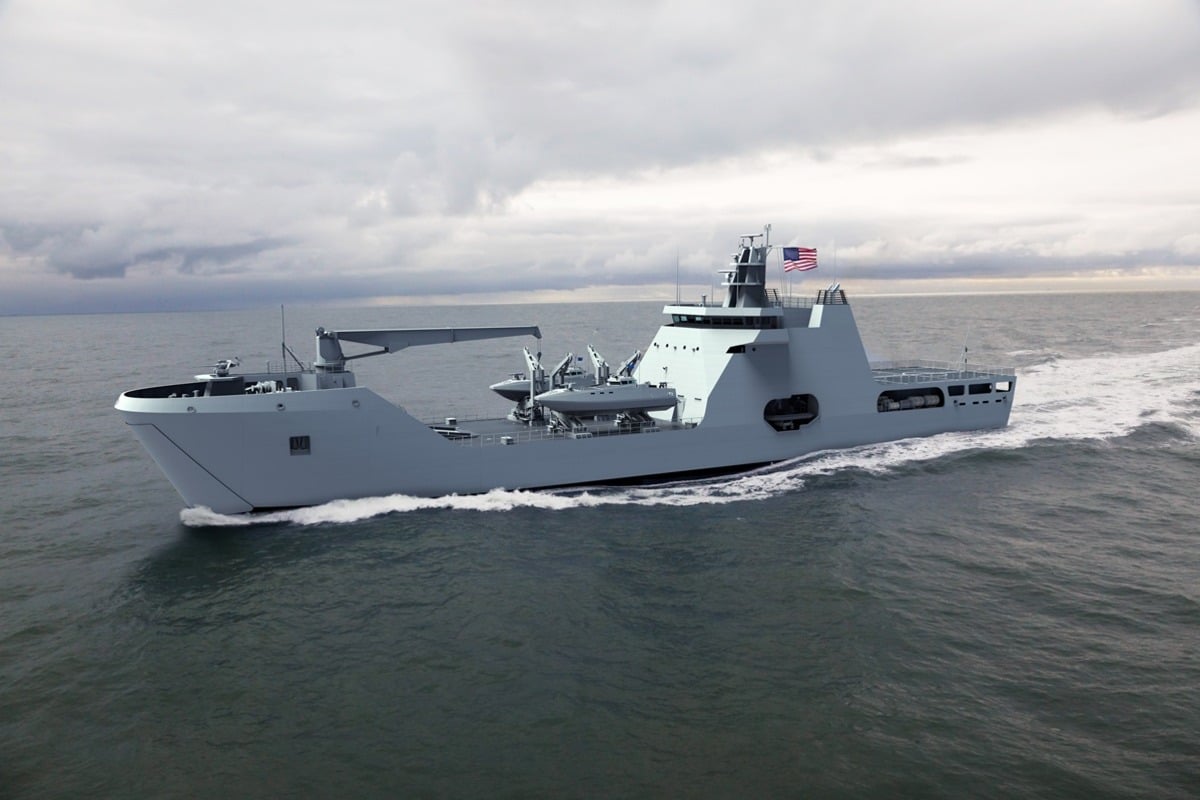
The headlines are celebrating a defense procurement victory. The U.S. Navy just locked in a $2.2 billion deal to build a new fleet of Medium Landing Ships (LSM). The defense press is echoing the official Pentagon line: these ships will allow the Marine Corps to hop from island to island in the Western Pacific, hiding in plain sight, distributing anti-ship missiles, and deterring conflict.
It is a beautiful theory. It is also an expensive fantasy. Meanwhile, you can read related stories here: The Red Ink of Leh Nullah (And Why It Matters).
The defense establishment is stuck in 1944. They are throwing billions at a legacy concept of amphibious warfare that ignores the reality of modern precision strike networks. By the time these landing ships slide into the water, they will not be agile assets. They will be slow, poorly armed targets operating inside the lethal envelope of Chinese anti-ship ballistic missiles.
We are not purchasing a strategic advantage. We are purchasing a multi-billion-dollar liability. To see the bigger picture, check out the recent report by The New York Times.
The Myth of the Low-Signature Landing Ship
The core justification for the LSM program is low signature. The narrative claims that because these ships are smaller than traditional amphibious giants like the San Antonio-class LPDs, they will blend in with commercial maritime traffic.
This argument falls apart under basic scrutiny.
Commercial ships do not travel in tactical formations. They do not suddenly veer toward remote, unpopulated islands to offload military hardware. More importantly, they transmit continuous Automatic Identification System (AIS) data. A military vessel trying to hide by turning off its AIS sticks out to modern satellite constellations like a flare in a dark room.
Between synthetic aperture radar (SAR), optical imaging satellites, and signals intelligence networks, space is no longer a place where a 300-foot military ship can hide. China's People's Liberation Army (PLA) has spent two decades building a reconnaissance-strike complex specifically designed to find and fix targets in the First Island Chain. Thinking an LSM can casually cruise through these waters undetected ignores how modern sensing works.
I have watched defense contractors pitch these "stealth by size" concepts for years. They work great in a PowerPoint presentation to a congressional committee. They fail miserably when subjected to real-world electronic warfare and satellite tracking.
Under-Armed, Over-Exposed, and Out-Ginned
Let us look at the design trade-offs made to keep these ships cheap. To get the price tag down, the Navy stripped the LSM of meaningful self-defense systems.
These ships are slated to carry minimal armament—essentially light machine guns and perhaps a Phalanx Close-In Weapon System (CIWS) or a rolling airframe missile launcher if budget permits. They lack the deep missile magazines, advanced radars, and multi-layered air defense systems found on destroyers.
The strategic plan asks Marine Littoral Regiments to ride these vessels into contested zones. Consider the mathematical reality of a saturation attack in the South China Sea:
- The Threat: A single coastal missile battery or an H-6J bomber squadron fires a volley of YJ-12 supersonic anti-ship missiles.
- The Defense: An LSM has zero ability to intercept these at long range. It relies entirely on soft-kill chaff or a last-second point defense system.
- The Outcome: The ship is overwhelmed.
If a $2.2 billion program requires a $2 billion Arleigh Burke-class destroyer to escort it everywhere it goes just to survive, you have not created a flexible, distributed asset. You have created a luxury security escort requirement that drains hulls away from the main fleet.
The Mobile Long-Range Precision Strike Fallacy
The entire concept of operations rests on using these ships to deploy the Navy Marine Expeditionary Ship Interdiction System (NMESIS). The idea is to park a truck-mounted Naval Strike Missile on a remote island, fire at enemy ships, and then pack up and move.
This misunderstanding of logistics is painful.
Moving an amphibious force onto a beach, even with a shallow-draft vessel, is a slow, loud process. It is not an agile maneuver. The moment an NMESIS battery fires from an island, its position is compromised. In a world of high-revisit satellite coverage and long-range drones, the counter-battery fire will be swift.
How do the Marines escape? They have to drive back to the beach, wait for the LSM to lower its ramp, drive onto the ship, and steam away at a blistering 14 knots. A 14-knot ship trying to escape modern loitering munitions and cruise missiles is a static target.
We are building a fleet designed for a static, predictable battlefield that no longer exists.
The Unconventional Alternative: What We Should Buy Instead
If the goal is to deny sea control to an adversary, we must stop building large, easily targetable platforms that carry small amounts of firepower. We need to invert the cost-exchange ratio.
Instead of spending $2.2 billion on a handful of vulnerable landing ships, that capital should be diverted into two distinct, high-leverage areas:
1. Extra-Large Unmanned Undersea Vehicles (XLUUVs)
The subsurface domain remains the only area where Western forces maintain a distinct stealth advantage. Autonomous platforms like the Boeing Orca can transit contested waters completely undetected by satellite networks or land-based radar. They can lay mines, deploy sensors, and launch torpedoes without risking a single marine's life.
2. Low-Cost, Semi-Autonomous Commercial Barges
If we must move assets via the surface, we should use true civilian vessels in massive quantities. A fleet of hundreds of small, converted commercial supply boats or modular barges carrying containerized missile launchers creates a genuine targeting dilemma. If an adversary has to waste a $5 million ballistic missile to sink a $10 million unmanned barge carrying dummy cargo, the economic and kinetic calculus shifts in our favor.
Dismantling the Defense Procurement Trap
The persistence of the LSM program is not driven by tactical utility. It is driven by institutional inertia and the defense industry's obsession with large hull construction. Shipyards want large, predictable multi-year contracts to maintain their workforces. The Navy wants to hit its arbitrary ship-count goals to satisfy congressional metrics.
We are measuring naval power by the number of hulls rather than the lethality and survivability of the network.
Investing billions into a ship class that cannot defend itself, cannot hide, and cannot escape is a structural failure of imagination. It protects shipyard jobs and bureaucratic turf at the expense of actual combat capability.
Stop buying twentieth-century targets for twenty-first-century warfare. Cancel the remaining tranches of the LSM program, take the loss on the initial design phase, and reallocate every single remaining dollar to undersea autonomy and massed, low-cost strike containers. The next conflict will not be won by the side with the prettiest amphibious ships; it will be won by the side that makes itself impossible to target.