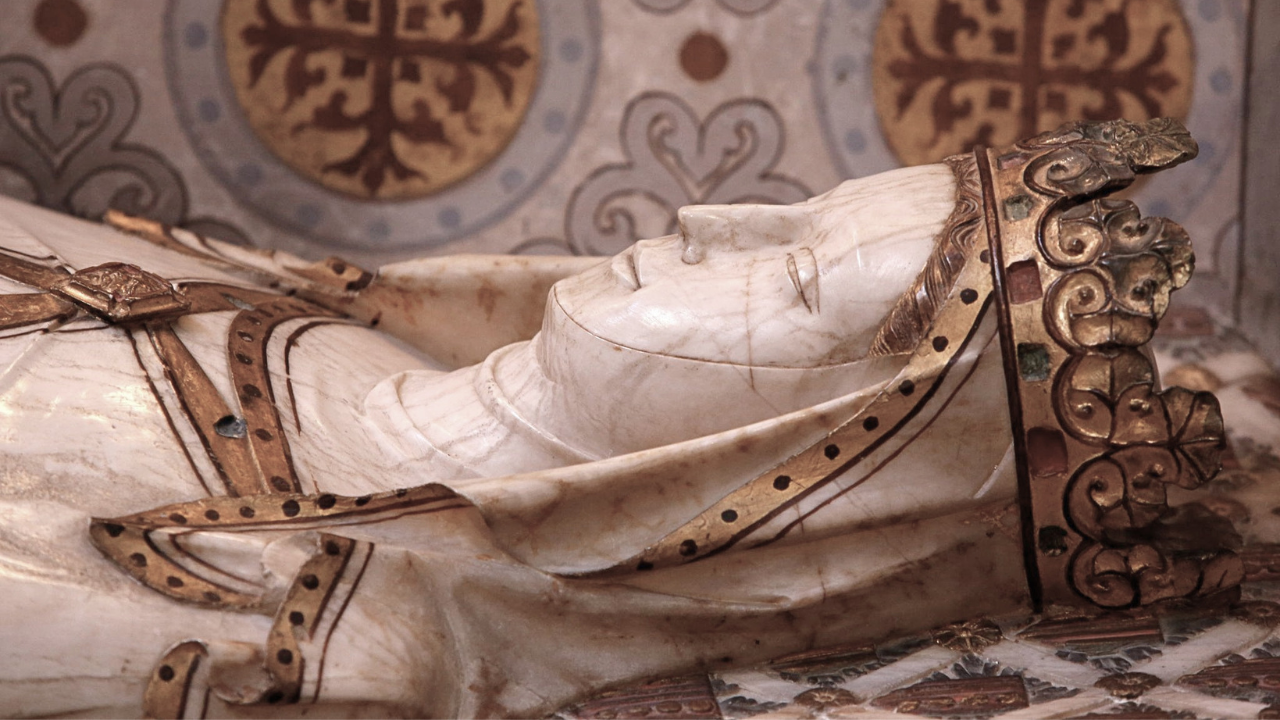
History loves to bury powerful women in the footnotes. For seven centuries, historians thought they had Queen Elisenda of Montcada completely figured out. She was the fourth wife of King James II of Aragon, a pious widow who retired to a quiet life of prayer inside Barcelona's Royal Monastery of Santa Maria de Pedralbes. Her two-sided stone monument in the monastery wall seemed to tell the whole story. One side showed her in full royal regalia; the other showed her dressed as a humble penitent. Case closed.
Except history is rarely that neat.
To mark the 700th anniversary of the monastery's founding, a team of archaeologists, physical anthropologists, and geneticists did something radical. They actually opened eight historic 14th-century graves, including the resting place of the queen herself. What they found inside didn't just humanize a legendary ruler. It completely upended what we thought we knew about medieval elite life, revealing a chaotic reality of hidden bodies, brutal violence, and a community of physically imposing women who held real power.
The Shock Inside the Sarcophagus
If you expect a medieval queen to be buried like a movie character with a golden crown and jewels, you don't know Elisenda. When the research team, led by chief curator Anna Castellano-Tresserra, opened her tomb, they found a simple wooden box tucked into a corner of the stone structure.
Elisenda chose to be buried in an austere monastic habit. She wanted to look like a simple nun, but her wealth still managed to bleed through the fabric of time. Mixed with the dust of her bones, scientists recovered fragments of high-end silk woven with precious metallic thread. They also found traces of rosemary and myrtle. These aromatic plants weren't just decorative; they were part of a complex 14th-century funerary ritual designed to mask the smell of decay and offer a final, fragrant send-off to a sovereign.
The physical analysis of her bones shattered the fragile, passive image often painted of medieval noblewomen. Elisenda wasn't delicate. She stood between 1.61 and 1.66 meters tall, roughly 5 feet 4 inches. That doesn't sound massive today, but back then, the average woman scraped by at just 1.53 meters. Elisenda and her female relatives were noticeably tall, physically robust, and well-nourished.
But her height came with a literal pain in the back. The skeleton showed severe osteoarthritis and clear signs of Diffuse Idiopathic Skeletal Hyperostosis (DISH). This condition causes progressive ossification of the spinal ligaments. Basically, her spine was slowly turning to bone, locking her upper body into a state of severe stiffness and constant pain during her final years. She died around the age of 70, outliving her husband by nearly four decades.
Beyond the Queen: The True Power Structure of Pedralbes
You can't understand Elisenda's tomb without understanding her actual life. When James II died in 1327, Elisenda didn't lock herself away to weep. She built a palace right next to the monastery and ran an empire from her living room. She served as a regent and a queen-lieutenant when her husband was away, and as a widow, she used her immense wealth to turn Pedralbes into an elite financial and political powerhouse.
For centuries, the architectural assumption was that her tomb cut straight through the wall separating the church and the cloister, creating a single window between her secular and religious lives. The excavation proved that's completely wrong. The monument actually consists of two entirely separate burial chambers divided by an internal partition wall. It was a deliberate, highly engineered illusion designed to keep her dual identity alive after death.
The Neighbors Nobody Expected
The biggest shocks didn't come from Elisenda's bones, though. They came from the neighboring graves that were supposed to belong to her inner circle. Medieval tombs are notorious for being reused, but the sheer chaos inside these stone boxes stunned the archaeological team.
Take the tomb traditionally attributed to the knight Artau de Foces. You'd expect armor, weapons, or at least a male skeleton. Instead, archaeologists found zero adult male remains. The tomb held five people: two adult women and three children. In an incredible twist of preservation, one of the women still had a long, intact ponytail attached to her skull after 700 years.
Then things got genuinely dark.
When the team opened the grave of Francesca Saportella, the monastery's second abbess and the queen's niece, they expected to find one holy woman. They found at least nine bodies crammed into the space over different eras. Among the bones were the mummified torso of a young woman with a 20- to 23-week-old fetus still preserved inside her birth canal.
Even more disturbing were the skulls of four men found in the exact same abbess's tomb. Every single one of them bore severe stab wounds inflicted by bladed weapons.
What were stabbed men doing in the locked tomb of a medieval abbess? Why was a pregnant woman buried in a strictly cloistered convent? This wasn't a peaceful sanctuary; it was a repository for the casualties of a violent, messy century.
Rethinking the Medieval Matriarchy
The ongoing study, which will run through 2027, is using paleogenomics and DNA extraction to figure out exactly who these extra bodies were and how they were related to the queen. Right now, the data tells us that the monastery wasn't just a place for prayer. It was a fortress where powerful women managed immense estates, protected family legacies, and apparently handled some very grim secrets.
If you ever find yourself in Barcelona, don't just look at the famous Gaudi buildings. Head up to the Pedralbes neighborhood and stand in front of Elisenda's tomb. Look past the carved marble lions and the stone angels. Remember that you're looking at the resting place of a woman who was physically larger, politically sharper, and far more complex than the quiet, pious caricature history tried to leave behind.
Skip the generic tour guides on this one. Look up the published architectural and anthropological updates from the Culture Institute of Barcelona directly if you want the raw data. The era of assuming medieval queens were just political ornaments is officially over.