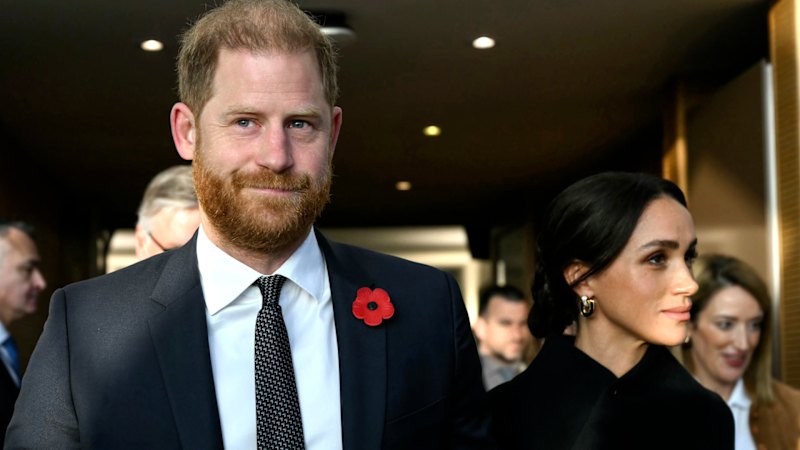
They walked into the European Parliament in Brussels holding hands, and the internet immediately lost its mind over a gesture they've been doing in public for years. Honestly, if you've watched the Duke and Duchess of Sussex at any event since their 2017 engagement announcement, seeing their fingers laced together isn't exactly breaking news. Yet the moment cameras caught Harry and Meghan arriving at the EU Parliament in Brussels holding hands, comment sections split into two predictable camps. One side saw a calculated, performative PR stunt designed to look like a royal tour without the actual royal mandate. The other saw an unshakeable partnership standing united in a formal political arena.
Both sides are missing the bigger picture.
When you look closely at what happens when non-working royals step into major institutional spaces like the European Parliament, the hand-holding isn't an accident, and it isn't just romance. It's a deliberate departure from the strict behavioral playbook that governs the British Royal Family. If you want to understand why this specific appearance in Brussels generated so much friction, you have to look at the intersection of royal protocol, modern political optics, and how Prince Harry and Meghan Markle have built their post-royal brand.
Why Holding Hands in Brussels Sparked Such a Loud Reaction
In the world of British royal protocol, public displays of affection aren't strictly banned by some dusty medieval law, despite what tabloid headlines claim. Queen Elizabeth II set the standard through decades of precedent rather than written rules. Working royals on official duty represent the Crown, not themselves. Keeping physical contact to a minimum keeps the focus on the institution, the host country, and the charitable or diplomatic cause at hand.
That's why you rarely saw Prince William and Catherine holding hands during official engagements, especially in formal political settings. They're operating as extensions of the state.
Harry and Meghan stepped back from senior royal duties in 2020, which means they no longer answer to Buckingham Palace's communications office or follow the unwritten rules of royal etiquette. Still, the public muscle memory is strong. When people see a British prince walking into a major European institution like the EU Parliament, they subconsciously judge him by royal standards. Seeing him hold his wife's hand in a venue associated with stiff suits, diplomatic handshakes, and formal protocol creates immediate visual friction.
It's a clash of two different worlds. You have the hyper-formal atmosphere of Brussels—a city built on bureaucracy and diplomatic caution—colliding with a couple who lean heavily into American-style personal branding and emotional openness.
The Real Reason Harry and Meghan Were at the EU Parliament
Let's strip away the body language gossip for a second. People don't just wander into the European Parliament in Brussels for a casual photo op. Security is tight, schedules are packed months in advance, and access requires formal invitations from Members of the European Parliament (MEPs), parliamentary committees, or affiliated policy groups.
Whenever Harry and Meghan appear in spaces like the United Nations in New York or the EU institutions in Brussels, their agenda almost always tracks back to the core pillars of their Archewell Foundation. Over the past few years, they've focused heavily on a few specific policy areas:
- Online safety and digital harm: Both Harry and Meghan have spoken repeatedly about the impact of social media algorithms on youth mental health, misinformation, and online harassment. The European Union happens to be the global heavyweight in tech regulation, having passed landmark legislation like the Digital Services Act (DSA). If you care about holding tech platforms accountable, Brussels is where the actual rules get written.
- Global vaccine equity and health access: Through previous partnerships with organizations like Global Citizen, they've lobbied European leaders to waive intellectual property protections and increase vaccine distribution to lower-income nations.
- Gender equality and paid family leave: Meghan has consistently used her platform to advocate for structural support for working parents, a topic that regularly sits on the legislative agenda in European policy circles.
Showing up in Brussels isn't about pretending to be working royals. It's about lobbying. In Washington, D.C., and Brussels, high-profile figures use their celebrity to get meetings with lawmakers who might otherwise ignore a standard policy brief. The cameras follow them through the doors, which gives the MEPs they're meeting a massive spike in media visibility. In exchange, Harry and Meghan get legitimacy as serious advocates rather than just former royals living in California.
It's a straightforward trade. Everyone in that building knows how the game works.
Breaking Down the Body Language Experts and Royal Watchers
Every time photos drop of Harry and Meghan holding hands, a small army of media commentators rushes to dissect the angle of their wrists and the tension in their shoulders. I've spent years watching how celebrity and political PR teams manage these exact moments, and most of the armchair psychology you read online is pure projection.
When people walk into a high-pressure environment with dozens of camera shutters clicking in their faces, they grab onto whatever anchors them. For Harry, who has been vocal about the anxiety triggered by the sound of camera flashes, physical contact with Meghan acts as a grounding mechanism. You can see it in the way he often places a hand on her lower back or keeps his fingers interlocked with hers when navigating crowded hallways.
At the same time, it's impossible to separate personal habit from public messaging. In public relations, consistency builds a recognizable brand identity. Think about how politicians use visual cues:
- Barack and Michelle Obama made fist bumps and casual affection a signature part of their public image, signaling modernity and relatability.
- Traditional European royals use posture, distance, and formal waves to project stability and continuity.
- Harry and Meghan use physical closeness to signal that they're a unified front against outside criticism.
When you see Harry and Meghan arrive at the EU Parliament in Brussels holding hands, you're seeing a habit that happens to align with their core narrative: us against the world. Whether it's instinctive or intentional—and honestly, it's probably a mix of both—it accomplishes the exact same thing. It ensures the photos stand out from every other gray-suit political arrival in Brussels that day.
The Blurred Line Between Royal Diplomacy and Celebrity Advocacy
Here's where the criticism actually has some teeth. Even if you support their charitable causes, the optics of a British prince conducting high-level meetings in Brussels creates a weird diplomatic gray area.
Because of Brexit, the relationship between the United Kingdom and the European Union remains politically sensitive. Official visits by members of the British Royal Family to EU countries are carefully choreographed by the UK Foreign, Commonwealth & Development Office (FCDO) to support British foreign policy goals. Every handshake, speech, and outfit is vetted so the monarchy stays strictly neutral.
Harry and Meghan aren't bound by the FCDO. They operate as private citizens. Yet to the average person scrolling through their news feed, the distinction between a "private visit by the Duke of Sussex" and an "official royal visit" gets fuzzy fast.
When they walk into the EU Parliament, they bring the residual prestige of the British monarchy with them, even though they no longer represent the British government. Critics argue this creates a "half-in, half-out" dynamic—using royal titles and the global fascination that comes with them to gain access to political power, without carrying the constitutional responsibilities or oversight that actual working royals endure.
Supporters counter that Harry didn't ask to be born into the institution, and he has every right to use his platform to push for positive change in areas like online safety and mental health. Both points are true at the same time. That tension is precisely why every public move they make turns into a debate.
What You Can Learn From How Their Brussels Appearance Was Covered
If you follow political media or royal news closely, pay attention to how different outlets frame the exact same set of photographs from Brussels. It's a masterclass in how editorial bias works in real time.
Look at the headlines and photo captions across different publications:
- Tabloid and royalist outlets almost always lead with the physical gesture—the hand-holding, the outfits, the perceived breach of protocol. By focusing on the personal dynamics, they subtly frame the visit as a vanity exercise or a celebrity stunt rather than a policy meeting.
- Policy and international news outlets focus on who they met inside the building, what legislation was discussed, and how their foundation's goals intersect with EU regulations. In those stories, the arrival photos are just standard visual filler.
- Social media commentators freeze single frames to argue over who is leading whom through the doorway, turning a two-second walk down a corridor into a referendum on their marriage.
The next time you see a viral clip or photo set of a high-profile figure arriving at a political venue, take thirty seconds to look past the arrival shot. Check the official schedule of the institution they're visiting. Look up the specific committee members or lawmakers they sat down with. In Brussels, the European Parliament publishes public registries of official meetings, committee agendas, and visiting delegations. That paper trail will always tell you infinitely more about why someone showed up than a photo of them walking through the front doors ever will.