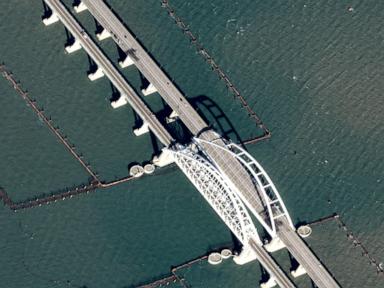
Most headlines about the November 2026 attacks on Russia's Kerch Bridge missed the real story. Everyone focused on the dramatic collapse of the highway arch. They missed how a methodical, four-day campaign systematically dismantled Moscow's multi-layered air defenses and choked off maritime transit between the Sea of Azov and the Black Sea.
Three strikes in four days changed the math for Russian logistics in Crimea. On November 16, Ukrainian drones deformed the road arch. Less than 24 hours later, a massive barrage of Neptune, Ruta, and FP-5 Flamingo missiles dropped a roughly 750-foot section of the roadway straight into the strait. Then, just after midnight on November 19, a third strike slammed directly into the railway bridge, halting train traffic and leaving Moscow scrambling to keep a single track operational.
If you're trying to understand what actually happened in the Kerch Strait this month—and why Russia's claims that everything is "operating as usual" don't hold up under satellite scrutiny—you need to look past the viral explosion videos.
How Ukraine Pulled Off Three Strikes in Four Days
For years, military analysts called the Kerch Bridge the most heavily defended piece of infrastructure on earth. Pantsir systems, S-400 batteries, radar barges, and underwater booms surrounded the 12-mile crossing. You don't just lob a few drones at a target like that and hope for the best.
The November operation wasn't a lucky break. President Volodymyr Zelenskyy confirmed the strikes represented the seventh phase of an operation that had been running for weeks. Before a single missile touched the bridge's steel arches, Ukrainian Unmanned Systems Forces spent months systematically hunting and blinding Crimea's air defense network.
Once those radars went dark, Kyiv executed a textbook combined-arms saturation attack across three distinct waves:
- Wave One (November 16, 2:00 a.m.): Ukrainian drones targeted the crossing to test response times and soften structural integrity. Open-source intelligence cited by Meduza showed the road arch listing up to 15 degrees out of shape. Russia shut the bridge down, patched the surface, and reopened alternating lanes hours later.
- Wave Two (November 17, Midnight): This was the knockout blow to vehicle transit. Ukraine fired roughly 15 missiles and drones in a coordinated effort involving the Navy, Ground Forces Rocket Forces, Unmanned Systems Forces, and the Security Service of Ukraine (SBU). SBU Special Group "Alpha" used Palianytsia missile-drones against the roadway, while Neptune, FP-5 Flamingo, and seven European-made Destinus Ruta cruise missiles hammered the spans. Destinus Da Vinci drones flew alongside them specifically to suppress remaining air defenses. The road arch and the deck beneath it collapsed completely.
- Wave Three (November 19, Midnight): With vehicle traffic dead, Ukraine pivoted to the railway. Ukrainian Navy Neptune systems struck near the railway arch and tracks, scorching the metal structure and forcing Crimean occupation head Sergey Aksyonov to suspend all rail transit for emergency assessments.
Here's a detail most casual observers overlooked. According to reporting from The Times, Ukrainian operators ran this entire complex, multi-branch strike without relying on Starlink. They built their own real-time video and radio relay network to guide the weapons home. That kind of electronic independence means Russia can't simply jam commercial satellite frequencies to save its bridges anymore.
Why the Third Strike on the Rail Bridge Matters Most
Cars and trucks make great television when they plunge into the water, but modern armies run on steel rails. A single military freight train carries the equivalent of dozens of heavy cargo trucks. You can't supply an entire occupying force across southern Ukraine with passenger vans.
When the November 19 strike halted rail traffic, it hit the exact artery Moscow desperately needed to keep open. By November 20 and 21, Russia's Ministry of Transport admitted trains were restricted to just one of the two parallel rail tracks while crews worked on repairs. Deputy Prime Minister Andrei Nikitin claimed on November 21 that rail service was running normally again, yet the ministry's own behavior told a different story.
On November 24, the Russian Ministry of Transport quietly updated its official Telegram route graphics. Five days earlier, their graphic showed both the road and rail spans intact. The new version erased the road bridge entirely, leaving only the rail span. Even Moscow's state bureaucrats couldn't pretend the highway still existed.
Satellite imagery released by the UK Ministry of Defence on November 27 confirmed the grim reality on the ground. Scorch marks blackened the railway section near the arch, and while one track appeared structurally intact enough to handle limited loads, heavy military rail throughput faces severe bottlenecks. You can't run two-way heavy armor shipments at full speed over a single damaged track sitting next to a collapsed steel arch.
The Hidden Chokepoint Nobody Is Talking About
Everyone talks about trucks and trains going over the Kerch Bridge. Almost nobody talks about the ships going under it.
When Ukraine dropped that 750-foot section of the road bridge and its massive steel arch on November 17, the debris didn't vanish. Thousands of tons of twisted steel and concrete fell directly into the main shipping channel of the Kerch Strait.
British military intelligence highlighted this exact consequence in their November 27 assessment. The collapsed arch physically blocks maritime traffic. Vessels stationed in the Sea of Azov cannot conduct direct transit into the Black Sea until Russian salvage crews clear the sunken wreckage from the waterway.
Think about what that means. With a single operation, Ukraine didn't just sever a highway and cripple a railway. They effectively corked the Sea of Azov. Clearing a collapsed steel arch from a narrow, current-swept strait while operating within range of Ukrainian Neptune missiles and sea drones isn't a weekend cleanup job. It's a logistical nightmare.
Does Losing the Kerch Bridge Actually Starve Crimea
Let's be honest and look at the counterarguments, because hype doesn't win wars. If you read breathless social media threads claiming Russian troops in Crimea will run out of bullets next Tuesday, you're getting bad analysis.
Emily Ferris, a Senior Associate Fellow at the Royal United Services Institute (RUSI), published a sharp assessment on November 24 arguing that while the bridge destruction is politically humiliating for Vladimir Putin, its immediate logistical impact is largely contained. Why? Because Russia saw this coming.
Over the past two years, Moscow poured massive resources into building alternative supply lines—specifically the "Azov Ring," a network of upgraded highways and newly laid rail tracks running along the northern coast of the Sea of Azov through occupied Mariupol, Berdyansk, and Melitopol. Russia has already shifted a huge portion of its military freight onto this overland corridor.
Still, "contained" doesn't mean "painless." Forcing all road traffic and heavy logistics onto the Azov Ring creates three massive headaches for Russian commanders:
- Compressed Target Zones: When your supply trucks travel across the Kerch Bridge, they're safe until they reach the peninsula. When they travel the Azov land bridge, they sit inside a narrow coastal strip well within range of Ukrainian FPV drones, artillery, and strike aircraft.
- Slower Turnaround Times: Single-track rail operation across the Kerch Strait plus longer overland trucking routes adds days to resupply cycles for southern fronts.
- Zero Margin for Error: Crimea's civilian population of over two million people still needs food, fuel, and medicine. With the road span gone, military convoys and civilian supply trucks now compete for the exact same overland roads.
The Political Timing Behind the Barrage
Wars aren't fought in a vacuum, and Kyiv didn't pick mid-November by accident.
A Ukrainian military source told The Guardian that the November 16–19 strikes were deliberately timed to humiliate Putin right before his high-stakes diplomatic meetings in Shenzhen, China, alongside Xi Jinping and Donald Trump during the APEC summit. Putin personally drove a truck across the Kerch Bridge when it opened in 2018. To the Kremlin, that concrete-and-steel span was physical proof that Crimea belonged to Russia forever.
Watching that symbol collapse on live satellite feeds the same week Putin sat down with world leaders sent a blunt message. Kyiv wanted to prove it still holds lethal leverage, especially as diplomatic discussions around potential peace frameworks gain momentum.
Moscow responded the only way it knows how—by escalating strikes against Ukrainian bridges. Data from the Armed Conflict Location & Event Data (ACLED) monitor shows Russian drone strikes on bridges in Kyiv surged to record highs in October and November 2026, including hits on three bridges crossing the Dnipro River between November 16 and 20 alone. Zelenskyy noted on November 21 that Russian forces had struck Ukrainian bridges 109 times prior to this latest Kerch operation.
How to Track What Happens Next in the Kerch Strait
Russian transport officials admitted it's "too early" to announce a timeline for rebuilding the collapsed road span. Given that the massive steel arch was custom-fabricated and cannot be swapped out with standard highway girders, vehicle traffic across the strait is likely dead for the foreseeable future.
If you want to cut through state propaganda and follow how this actually impacts the war over the coming weeks, watch three specific indicators rather than official press releases:
- Monitor UK Defence Intelligence and Maxar/Planet Labs satellite updates: Look specifically at the waterway beneath the collapsed road arch. Until you see heavy crane barges actively dismantling and lifting steel trusses out of the shipping lane, Russia's Sea of Azov naval logistics remain bottled up.
- Watch strike frequency along the Mariupol–Melitopol highway: Now that Russian logistics are funneled onto the Azov Ring land corridor, track reports from the Institute for the Study of War (ISW) for increased Ukrainian drone and missile interdiction along those coastal rail hubs.
- Track Crimean fuel prices and ferry queues: Whenever rail capacity across the Kerch Bridge drops below threshold levels, civilian gasoline shortages and multi-day ferry backlogs at Port Kavkaz appear within two to three weeks. Those local economic signals will tell you far more about the health of the remaining railway track than any statement from the Kremlin.