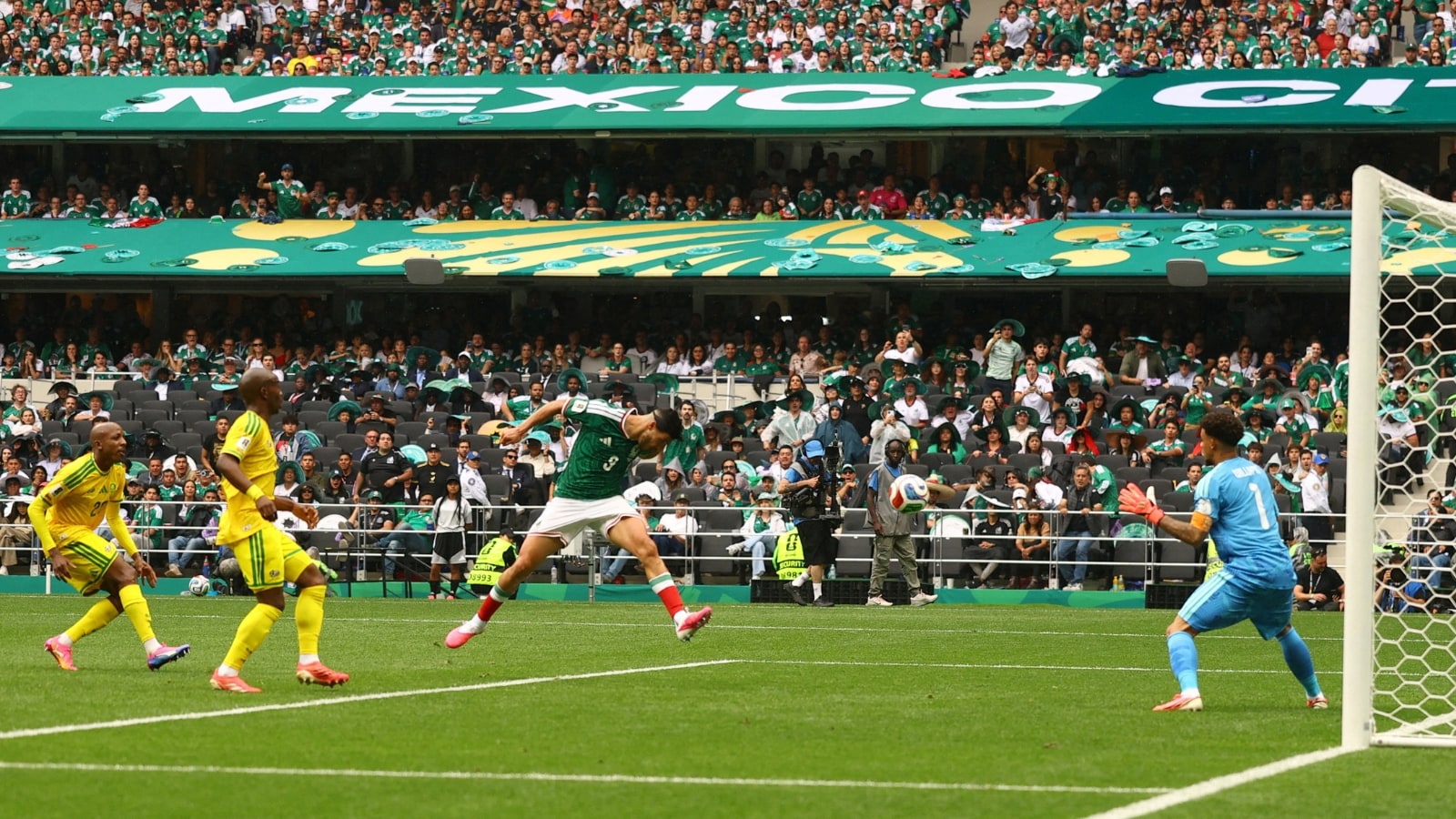
The ball floated in from the right wing, spinning perfectly over the South African defense. For a split second, eighty thousand people inside the Estadio Azteca held their breath. Then came the contact. A powerful, unhesitating header that slammed into the back of the net.
As the stadium erupted into complete chaos, Raul Jimenez didn't run to the cameras. He didn't bust out a choreographed dance. Instead, the 35-year-old striker dropped down, pointed his fingers directly at the sky, and let the tears flow.
If you only watch football every four years, you probably saw a veteran player celebrating a standard 2-0 win for Mexico in their 2026 World Cup opener. You might have noticed the thick black protective band wrapped around his head and thought it was just some quirky gear. But for anyone who has followed the sport closely over the last six years, that header wasn't just a goal. It was a moment that defied medical science, shattered psychological barriers, and closed a agonizing loop of personal tragedy.
The Night Football Didn't Matter anymore
To understand why those tears at the Azteca were so heavy, you have to look back to November 29, 2020. Jimenez was playing for Wolverhampton Wanderers against Arsenal at the Emirates Stadium. He was in the absolute form of his life, a elite Premier League forward targeted by Europe's biggest clubs.
Then came a corner kick. A sickening, hollow thud echoed through the empty pandemic-era stadium as Jimenez clashed heads with Arsenal defender David Luiz.
Jimenez didn't move. He lay unconscious on the grass for minutes while medical staff rushed the pitch with oxygen masks and stretchers. In the stands and on television, family members and teammates watched in horror, not wondering if his career was over, but wondering if he was going to survive the night.
The diagnosis was grim: a fractured skull and traumatic brain injury. Emergency surgery was required immediately to relieve the pressure building up inside his brain. Doctors later explicitly told Jimenez that surviving the impact, let alone escaping without permanent neurological damage, was a literal miracle.
Relearning How to Hurt Yourself
Most athletes deal with torn ligaments or broken bones. You rehab, you strengthen the muscle, you get back out there. A fractured skull is an entirely different beast. It changes the way your brain processes fear.
When Jimenez finally returned to competitive football nine months later in 2021, he was physically cleared, but the mental hurdles were massive. Imagine your job requires you to launch your head at high-velocity leather balls surrounded by flying elbows and boots, when that exact action almost killed you.
The black headgear became his permanent armor. Yet, the goals didn't flow like they used to. His final years at Wolves were a grueling struggle for form. When he moved to Fulham in 2023, many pundits openly wrote him off. They claimed the old, fearless Jimenez was gone forever, replaced by a cautious shadow of a once-great striker.
But giving up wasn't an option. Slowly, grittily, he rebuilt his confidence in West London. He adapted his game, moving away from relying purely on raw athleticism to using elite positioning and veteran intelligence.
A Deeper Grief Hidden Behind the Defiance
The struggle to reclaim his spot in the Mexican national team was just as brutal. Before this match against South Africa, Jimenez had played in three separate World Cups (2014, 2018, and 2022). He made six total appearances, all of them off the bench. He had never started a World Cup game, and he had never scored a goal on the world stage.
The 2022 tournament in Qatar was a disaster for El Tri, exiting in the group stage while a struggling Jimenez failed to make an impact. Fast forward to 2026. A home World Cup in Mexico City. Javier Aguirre trusted him with the starting nod.
But the pressure leading up to June 11 wasn't just about football. In March of this year, Jimenez lost his biggest supporter. His father, Raul Jimenez Vega, passed away at the age of 62.
When Jimenez scored for Fulham against Burnley just days after the tragedy, he openly wept on the pitch. The motivation heading into this tournament had completely shifted. He wasn't just playing to prove the doubters wrong anymore; he was playing to honor the man who had guided him through the darkest days of his hospital recovery.
Why the Azteca Goal Changes Everything
When Roberto Alvarado delivered that cross in the 66th minute, Jimenez didn't flinch. He didn't protect his head. He attacked the ball with the exact same ferocity that made him a star a lifetime ago.
Scoring your first-ever World Cup goal at age 35 is already a historic feat. Doing it in front of 80,000 of your own fans at the historic Azteca is stuff from a movie script. But doing it with a header—the precise action that fractured his skull six years ago—is a level of poetic justice that sport rarely grants.
"I read an interview where he said this has to be his World Cup," Mexico manager Javier Aguirre stated after the match. "He had always been in someone else's shadow, but today he is a starter for this team, and he has truly earned it."
Julian Quinones put Mexico ahead early in the 9th minute, but it was Jimenez's goal that killed off the South African threat and set the tone for El Tri's tournament. The victory puts Mexico in a prime position to control Group A, but the psychological boost for the squad is arguably more valuable than the three points.
If you are looking for practical takeaways from Jimenez’s journey, it’s that peak performance isn't a straight line. True resilience isn’t about pretending the trauma never happened; it’s about adjusting your strategy, wearing the protective gear, and stepping back into the box anyway. Mexico's tournament run is just beginning, and with a fearless Jimenez leading the line, El Tri looks dangerous.