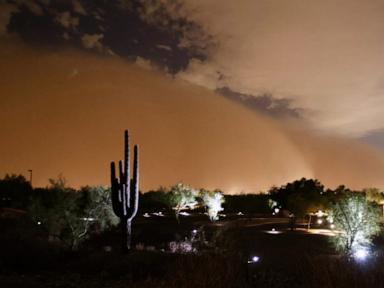
Two major haboob dust storms striking Phoenix within a single operational week is not a random anomaly; it is the physical manifestation of highly specific thermodynamic thresholds being breached repeatedly in an arid urban basin. When multi-thousand-foot walls of particulate matter swallow metropolitan infrastructure, public discourse typically defaults to visual descriptors and superficial disruption metrics. This framing fails to account for the actual physical machinery driving the events. A rigorous examination requires deconstructing the meteorological preconditions, the fluid dynamics of density currents, and the specific urban-atmospheric feedback loops that amplify the severity of these dust events.
The Thermodynamic Setup of the Sonoran Basin
Arid metropolitan environments function as massive thermal engines. During the peak of summer, intense solar radiation bakes the desert floor, creating superheated boundary layers of air. When regional moisture profiles shift slightly, convective instability rises sharply.
The immediate precursor to a haboob is a mature thunderstorm, or a cluster of storms, operating miles away from the urban center. As precipitation falls through dry air beneath the storm cloud, it evaporates rapidly. This phase change absorbs latent heat from the surrounding air, creating a pocket of dense, negatively buoyant air that plummets toward the surface.
Upon impact with the desert floor, this descending column of air spreads outward in all directions, forming a cold pool. The leading edge of this expanding cold pool is a density current—an underwater-style gravity current operating in an atmospheric medium. As the rushing wedge of cold air encounters loose, dry alluvial soils characteristic of the Sonoran Desert, it scours the topsoil, lifting millions of tons of particulate matter into the vertical column.
The Phoenix metropolitan grid sits in a broad, flat valley surrounded by mountain ranges. This topography acts as a natural funnel. When density currents sweep off the surrounding high terrain or distant desert expanses, the basin morphology channels and accelerates the winds, concentrating the dust wall into a dense, forward-moving front before it hits urban structures.
Fluid Dynamics of the Dust Front
To understand why a haboob reduces visibility to near zero within seconds, one must analyze the interface between the advancing cold pool and the ambient warm air. The boundary of a haboob is marked by an arcus cloud or a massive wall of dust known as a shelf wall.
The mechanics of this boundary layer rely on Kelvin-Helmholtz instabilities. As the fast-moving, dense air undercuts the warm, stationary air, turbulent mixing occurs at the interface. This turbulence acts as an efficient vertical transport mechanism, lifting fine particulate matter, primarily PM10 and PM2.5 fractions, thousands of feet into the troposphere.
Particle size distribution dictates the behavior of the dust wall. Heavier sands drop out of suspension relatively quickly once the forward momentum of the gust front slows, but fine silt and clay particles remain suspended for hours via mechanical turbulence. This creates a stratified atmospheric column where the surface layer experiences blinding particle concentrations, while the upper boundary of the dust wall maintains a sharp, turbulent crest.
The wind velocities associated with these events frequently exceed 50 to 60 miles per hour in localized gusts. This kinetic energy exerts immense lateral force on urban infrastructure, power distribution networks, and transportation corridors. The transition from calm thermal conditions to severe wind shear occurs over a temporal window of less than three minutes, denying traditional municipal warning systems adequate reaction time for preventative grid management.
Urban Heat Island Amplification and Surface Friction
The severity of a Phoenix haboob is not solely a product of natural meteorology; it is significantly modified by the urban environment itself. The Phoenix metropolitan area is one of the most pronounced urban heat islands in North America. Extensive asphalt, concrete, and structural density retain daytime heat long after sundown, maintaining an elevated thermal gradient compared to the surrounding undisturbed desert.
When an incoming density current collides with the urban heat island, the interaction is complex. The extreme surface roughness created by high-rise buildings and suburban sprawl increases mechanical turbulence. This roughness breaks up the laminar flow of the lowest layers of the density current, causing eddies that drive particulate matter deeper into street canyons and localized air intakes.
Furthermore, surrounding agricultural and disturbed desert lands play a primary role in sediment supply. Decades of land-use changes, construction grading, and irrigation practices alter the crust strength of regional soils. When these crusts are broken by human activity or prolonged drought, the threshold wind velocity required to mobilize the soil drops significantly. Consequently, a moderate convective storm that might have raised minimal dust a century ago now triggers a high-opacity haboob due to the abundance of anthropogenic loose particulate matter in the surrounding wind corridors.
Systemic Vulnerabilities in Infrastructure
The operational impact of consecutive high-intensity dust storms exposes distinct failure points across urban utility and transportation networks. These vulnerabilities stem from the mismatch between traditional engineering design standards and the specific physical properties of windborne desert silt.
Power distribution infrastructure suffers from two distinct failure mechanisms during a haboob. First, high-velocity winds compromise physical assets through direct structural loading on utility poles and overhead lines, compounded by flying debris and falling palm fronds. Second, and more insidiously, fine alkaline dust coats high-voltage insulators on transmission towers. When this dry dust layer is subsequently exposed to the light moisture of a trailing thunderstorm, it forms a conductive sludge. This conductive bridge permits current leakage across the insulator, resulting in flashovers, localized transformer explosions, and widespread electrical outages independent of physical wind damage.
Transportation networks experience immediate capacity collapse due to optical degradation. Human visual acuity relies on contrast; a dense haboob reduces visual contrast to zero, rendering standard highway speeds lethal. Drivers react by executing panic braking on high-speed freeways, which reliably triggers multi-vehicle pileups. Automated traffic signal systems, designed to optimize flow based on vehicle actuation loops, fail to adjust dynamically for macro-level visibility drops, exacerbating congestion bottlenecks in the immediate wake of the storm front.
Public health infrastructure absorbs a delayed shock wave following each event. Inhaling high concentrations of coarse and fine particulate matter triggers acute inflammatory responses in the respiratory tract. Emergency room admissions for asthma exacerbations, chronic obstructive pulmonary disease, and Valley Fever—a fungal infection caused by spores liberated from the soil by high winds—spike systematically within 48 hours of a major haboob event. The economic cost of these health impacts is distributed across emergency medical services, lost workforce productivity, and chronic care management.
Strategic Operational Protocol for Arid Infrastructure
Mitigating the risks posed by recurrent high-intensity dust storms requires shifting from reactive emergency response to predictive infrastructure hardening. Municipalities and utility operators must implement structural adjustments based on the physical realities of density currents.
Utility networks require the systemic deployment of silicone-composite insulators and hydrophobic coatings on transmission hardware to prevent flashovers caused by dust-moisture interaction. Subsurface placement of critical distribution lines in high-growth corridors eliminates wind-load vulnerabilities entirely.
Transportation agencies must transition away from static speed limits during dust events toward dynamic, automated corridor management. This involves deploying high-density particulate sensors and automated visibility meters tied directly to variable message signs and automated speed restriction protocols, removing human decision-making lag during zero-visibility transitions.
Land management frameworks in the peripheral zones of the metropolitan basin must enforce rigorous dust-palliative standards on fallowed agricultural land and active construction sites. Stabilizing the localized sediment supply at the source remains the single most effective leverage point for reducing the opacity and particulate density of future convective storms before they reach urban boundaries.