Standard human physiological models dictate that survival in the Mount Everest "death zone"—altitudes exceeding 8,000 meters—is bounded by a strict temporal limit of 16 to 24 hours without supplemental oxygen. Beyond this window, cellular hypoxia, acute cerebral edema, and systemic metabolic collapse typically result in mortality.
The survival of Nepali climbing guide Dawa Sherpa, who spent six days isolated on the upper reaches of Everest before descending unsupported to Base Camp, challenges conventional parameters of human endurance. To evaluate how an individual can survive nearly a week exposed to extreme hypobaric hypoxia, sub-zero temperatures, and acute deprivation of food and water, we must analyze the interaction between unique metabolic adaptations and the micro-environmental mechanics of high-altitude exposure.
The Triad of High Altitude Deprivation
To understand the mechanisms of this survival anomaly, the operational environment must be broken down into three critical vectors: barometric pressure collapse, thermodynamic stress, and metabolic depletion.
1. Hypobaric Hypoxia and Cellular Efficiency
At the edge of the death zone, the effective oxygen percentage remains 21%, but the barometric pressure drops to roughly one-third of sea-level value (approximately 300 hPa). This drastic reduction in atmospheric pressure destroys the pressure gradient required for oxygen to pass through the alveolar membrane in the human lung into the bloodstream.
- The Standard Vector: For an unacclimatized individual, this causes immediate loss of consciousness within minutes due to brain hypoxia.
- The Adaptation Vector: Elite high-altitude practitioners, particularly native populations of the Himalayan region, possess distinct genetic adaptations. These include altered nitric oxide pathways that maintain microvascular blood flow, higher capillary density, and a metabolic shift that favors glucose oxidation over fatty acid oxidation. Glucose oxidation requires less oxygen per unit of adenosine triphosphate (ATP) produced, allowing cells to sustain basic functions under extreme oxygen deficits.
2. Thermodynamic Regulation in Sub Zero Micro Climates
Ambient temperatures above 7,900 meters routinely drop below -30°C, aggravated by high-velocity winds that accelerate convective heat loss. Survival over an extended duration requires minimizing the surface-area-to-volume ratio and identifying or creating a micro-climatic shelter, such as a shallow bergschrund or a snow depression shielded from the wind.
When core temperature drops, the body initiates shivering thermogenesis, which increases metabolic rate up to fivefold to produce heat. However, this process consumes glycogen stores rapidly. Once glycogen is exhausted, the body enters a state of profound hypothermia, slowing metabolic demand. In rare survival scenarios, a controlled, non-fatal hypothermic state can reduce the brain’s oxygen requirements, protecting neurological structures from ischemic damage.
3. Total Fluid and Caloric Deprivation
The human body can survive weeks without caloric intake via autophagic breakdown of adipose and muscle tissue. The immediate threat is dehydration. At high altitudes, fluid loss is exponentially accelerated by two mechanisms:
- Hyperventilation-Induced Respiratory Evaporation: To compensate for low oxygen levels, the respiratory rate increases. The ambient air is exceptionally dry, and every exhalation strips moisture from the respiratory tract.
- Cold-Induced Diuresis: Peripheral vasoconstriction shunts blood to the core, signaling the kidneys that fluid volume is too high, which prompts increased urine output despite full-body dehydration.
Without access to a heat source to melt snow, a prolonged survival window requires the body to limit physical exertion, thereby reducing the respiratory rate and conserving systemic moisture.
The Mechanics of the Unsupported Descent
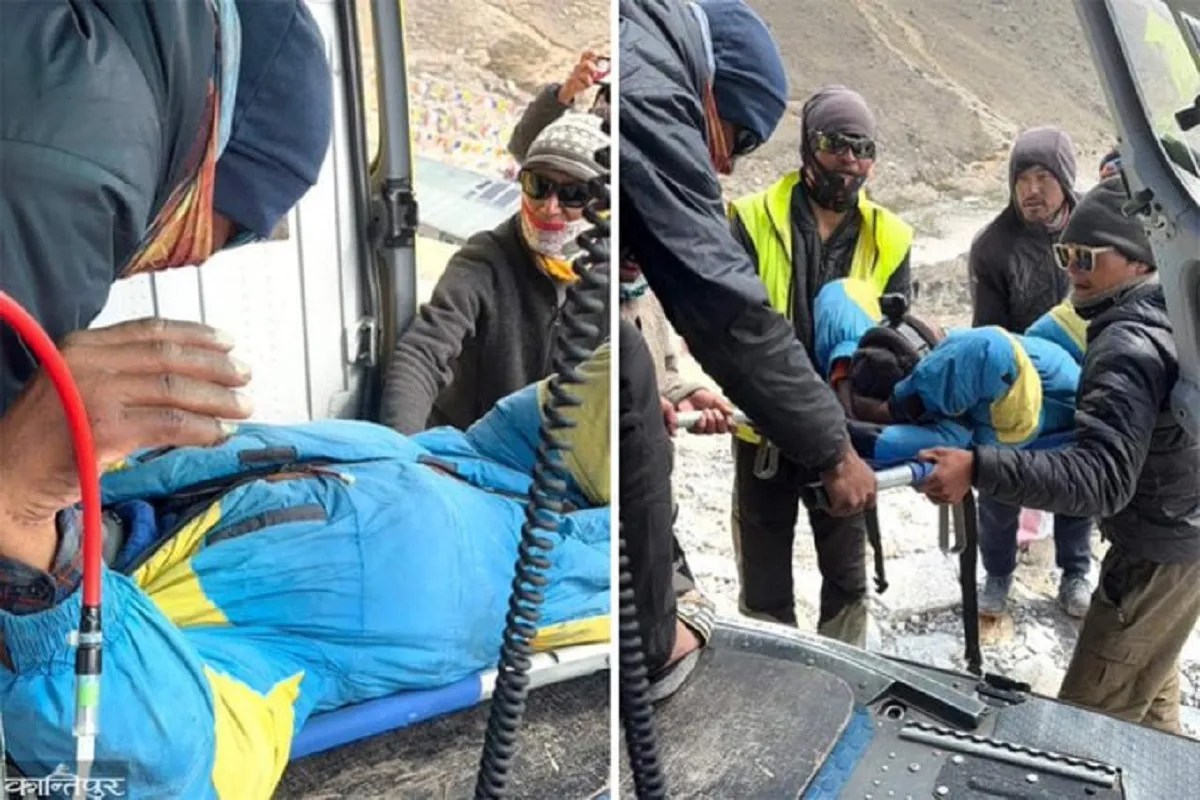
Dawa Sherpa was discovered crawling near Crampon Point by a Sagarmatha Pollution Control Committee (SPCC) team, having descended through the Khumbu Icefall alone. This descent reveals a highly structured execution of basic motor patterns under cognitive impairment.
During prolonged hypoxia, the brain undergoes severe executive dysfunction, loss of spatial awareness, and hallucinations, often manifesting as High Altitude Cerebral Edema (HACE). Navigating technical terrain like the Khumbu Icefall requires precise balance and rope management. By early June, end-of-season environmental shifts mean that fixed ladders and safety lines are frequently dismantled or compromised.
[Systemic Hypoxia] ---> [Prioritization of Core Organs] ---> [Peripheral Vasoconstriction]
                                                                     |
[Unsupported Descent via Crawling] <--- [Loss of Bipedal Locomotion] <--- [Severe Frostbite in Extremities]
The transition from bipedal walking to crawling is a tactical adaptation to systemic failure. Crawling lowers the center of gravity, eliminates the balance requirements disrupted by cerebellar hypoxia, and distributes body weight across a larger surface area, mitigating the risk of falling through fragile snow bridges or into hidden crevasses. Furthermore, peripheral vasoconstriction shunts remaining warm blood exclusively to the heart and brain, leaving the fingers and toes to freeze. This structural sacrifice keeps the neurological system functional enough to direct downward movement.
Operational Failures in High Altitude Search and Rescue
The incident highlights a critical systemic bottleneck in commercial mountaineering operations: the latency period between a reported missing climber and the deployment of an active search and rescue (SAR) framework.
Dawa Sherpa went missing on May 29 near Camp III after separating from a client during a difficult descent. Reports indicate a significant delay occurred before an organized search team was deployed. The logistical friction of high-altitude rescue involves several fixed constraints:
- Helicopter Ceiling Limits: Aerial searches via helicopter are severely constrained by air density. Above 7,000 meters, rotors generate drastically less lift, limiting flight windows to early morning hours when the air is coldest and densest. Landing is rarely possible; pilots must perform hover-rescues or use long-line operations, which are highly sensitive to wind shear.
- Ground Crew Resource Scarcity: By late May and early June, the majority of expedition agencies have evacuated their high camps. The human resource pool capable of ascending back into the death zone for a rescue operation is nearly non-existent.
- The False Mortality Presumption: In commercial mountaineering, when an individual remains unaccounted for in the death zone beyond a 48-hour window, the probability of survival is statistically near zero. This leads to an immediate shift from rescue to body recovery planning, lowering the urgency and risk tolerance of remaining teams. Dawa Sherpa’s survival was discovered not by an active SAR deployment, but by a routine environmental cleanup crew working the lower sections of the mountain.
Protocol Shifts for High Altitude Operations
Relying on biological anomalies is an unsustainable framework for high-altitude expedition management. To mitigate tracking failures and reduce response latency, the commercial guiding industry must transition from passive monitoring to active, automated tracking systems.
The implementation of lightweight, satellite-linked telemetry units integrated into a climber's down suit is the first necessary step. These units must transmit automated, real-time geographic coordinates and basic biometrics (heart rate and oxygen saturation) directly to a centralized base camp dashboard. If a device stops moving or registers an acute drop in vitals while separated from the main team tracker, it should trigger an automated alert protocol.
The second operational requirement is the mandatory deployment of standby rescue drones capable of operating in low-density airflows. While human rescue teams face severe physiological limits, high-performance drones can execute immediate thermal imaging sweeps over the last known coordinates of a missing climber, bypassing the flight delays caused by helicopter limitations. This replaces speculative search patterns with precise coordinate targets for ground teams.