The dense canopy of the eastern Democratic Republic of Congo does not just block the sun. It swallows sound, tracks, and secrets. When an invisible killer moves beneath these trees, the silence it leaves behind is not peace. It is terror.
Public health officials call them "blind spots." It sounds like a driving hazard, a minor inconvenience you can check with a quick glance over your shoulder. But in the context of an Ebola outbreak, a blind spot is a black hole. It is a village cut off by mudslides, an area controlled by armed militia, or a community that has learned through decades of exploitation to hide its sick from outsiders.
When the World Health Organization warns that we might be missing the true scale of an outbreak, they are not talking about a rounding error in a spreadsheet. They are talking about human beings dying in the dark.
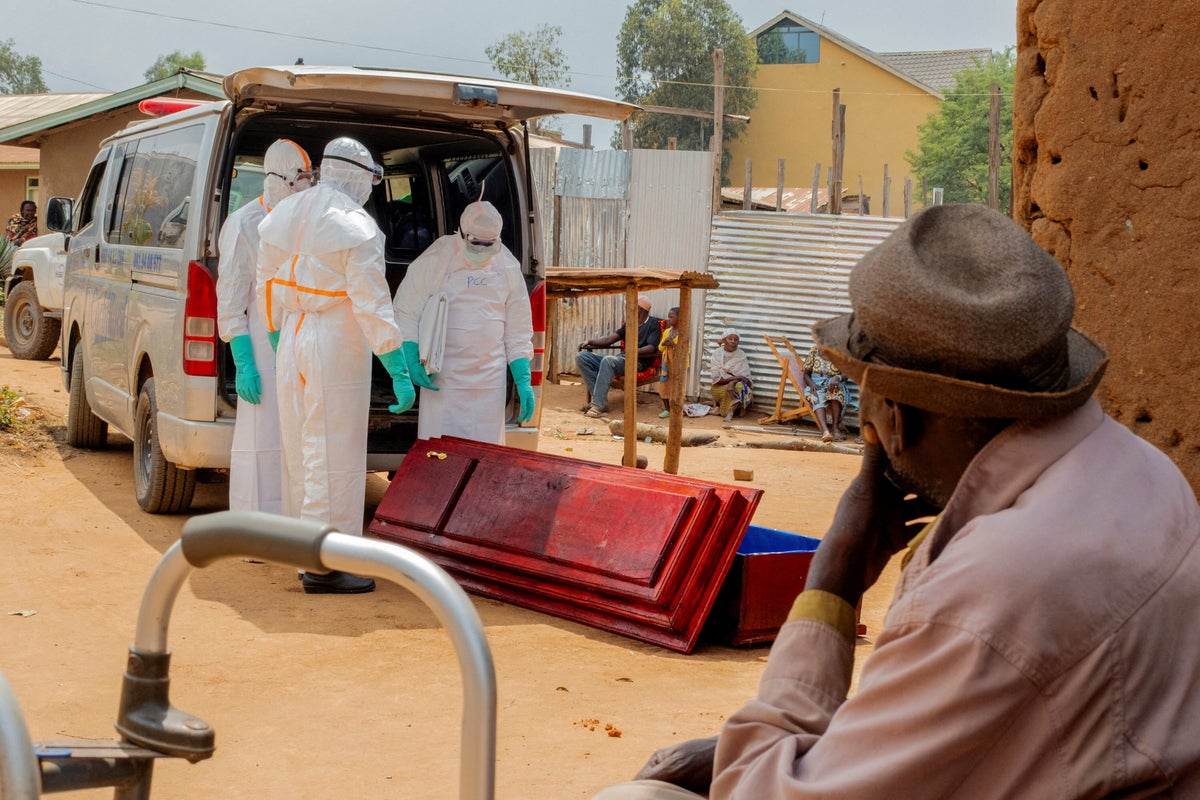
Consider a hypothetical woman named Marie. She lives in a small settlement just forty miles from the major health hubs of Butembo. Forty miles should be an hour's drive. Here, it is a treacherous, two-day journey across territory fractured by conflict. When Marie’s fever spikes, she does not think of global health directives. She thinks of survival. If she goes to a clinic, will she be isolated from her children? Will strangers in white plastic suits take her away, never to return? She stays home. Her family tends to her.
And just like that, the virus finds its next foothold, entirely off the grid.
The Illusion of the Curve
Every evening, the data updates. Graphs rise and fall. epidemiologists study the charts, looking for the peak, waiting for the downward slope that signals victory.
But a graph only measures what it can see.
When response teams cannot enter a region due to gunfire or deep-seated community mistrust, the numbers on the chart drop. To an untrained eye, it looks like progress. The line goes down. The panic subsides. In reality, the drop in cases often means the virus has simply slipped its leash. It has broken through the perimeter of surveillance and entered the blind spots.
Tracking Ebola is less like practicing medicine and more like fighting a war against an enemy that can disguise itself as the common flu until it is too late. The early symptoms—fever, headache, muscle pain—are indistinguishable from malaria, which is ubiquitous in the region. By the time the hallmark hemorrhaging begins, the chain of transmission has already spider-webbed through a household, a church, or a marketplace.
If you test ten people and five are positive, you have a crisis. If you can only reach two of those people because the road is blocked by an active militia skirmish, your data tells you the crisis is shrinking. The danger of a blind spot is that it breeds a false sense of security. It convinces decision-makers to reallocate resources elsewhere, right when the fire is gathering strength in the brush.
The Geography of Mistrust
To understand why the maps go blank, you have to look beyond the biology of the filovirus. You have to look at the history written into the soil.
The eastern Congo has been a theater of conflict for a generation. Dozens of armed groups operate in the forests, vying for control of resources, land, and power. For the people living here, the arrival of well-funded international aid workers can feel less like a rescue mission and more like another foreign intervention.
Think about the optics through the eyes of a local villager. For years, your children have suffered from preventable diseases, malnutrition, and the constant threat of violence. No one came. Then, a terrifying disease emerges that threatens the global north, and suddenly, millions of dollars in equipment, armored vehicles, and foreign experts descend on your town. They care intensely about this one specific disease, but the moment a patient tests negative for Ebola, they are often sent back to the same poverty and peril they came from.
This disparity creates a deep, burning cynicism. It makes the rumors grow.
- "The white suits are stealing organs."
- "The virus was brought here to wipe us out."
- "The isolation centers are where people go to die."
These are not the delusions of ignorant people. They are the defense mechanisms of a traumatized population. When trust breaks down completely, communities stop reporting cases. They bury their dead at night, in secret, honoring traditional customs that involve washing the body—a ritual that acts as a super-spreader event for a virus carried in bodily fluids.
The blind spot expands. Not because the geography is impassable, but because the psychological gap between the responders and the responded-to has become an abyss.
Shifting the Lens
How do you illuminate the dark spaces on the map? You do not do it with more drones, better satellite imagery, or heavier military escorts for medical convoys.
You do it by listening.
The real heroes of these outbreaks are rarely the people whose names appear on global press releases. They are the local motorcycle taxi drivers who risk their lives to transport equipment. They are the community elders who use their moral authority to convince a skeptical village to let a vaccination team enter. They are the local nurses who operate underfunded clinics with nothing but latex gloves and immense courage.
When the response shifts from a top-down military operation to a localized, empathetic partnership, the blind spots begin to shrink.
Consider what happens when a response team stops demanding compliance and starts asking questions. What does your community need? How can we honor your dead while keeping the living safe? When a treatment center replaces its opaque plastic walls with transparent sheeting, allowing families to see their loved ones inside, the terror begins to thaw. The rumors lose their oxygen.
But this work is slow, grueling, and entirely unglamorous. It cannot be captured easily in a daily situation report. It requires building relationships in areas where the concept of safety is a luxury.
The True Scale
We live in an age of total connectivity, where we assume everything can be tracked, logged, and analyzed in real time. We believe that if something is important enough, it will show up on a screen.
The crisis in the Congo is a stark reminder that our global systems are fragile, and our vision is incredibly limited. The World Health Organization's warning is a plea for humility. It is an admission that the numbers we rely on to sleep soundly at night are, at best, an educated guess.
The virus does not respect geopolitical boundaries, nor does it wait for peace treaties to be signed. If it is allowed to smolder undetected in the forests of North Kivu or Ituri, it is only a matter of time before a single traveler carries it to Goma, to Kinshasa, or across an international border. A blind spot in a remote corner of the world eventually becomes a blind spot for everyone.
The real test of global health security is not how quickly we can deploy a new vaccine or how many treatment beds we can assemble in a capital city. It is whether we have the patience, the empathy, and the sheer political will to reach the places where the roads end, where the networks fail, and where the maps go completely blank.
Somewhere in the forest tonight, a child is burning with a fever, miles away from the nearest working thermometer. What happens next depends entirely on whether we choose to look for her, or whether we choose to pretend that what we cannot see does not exist.