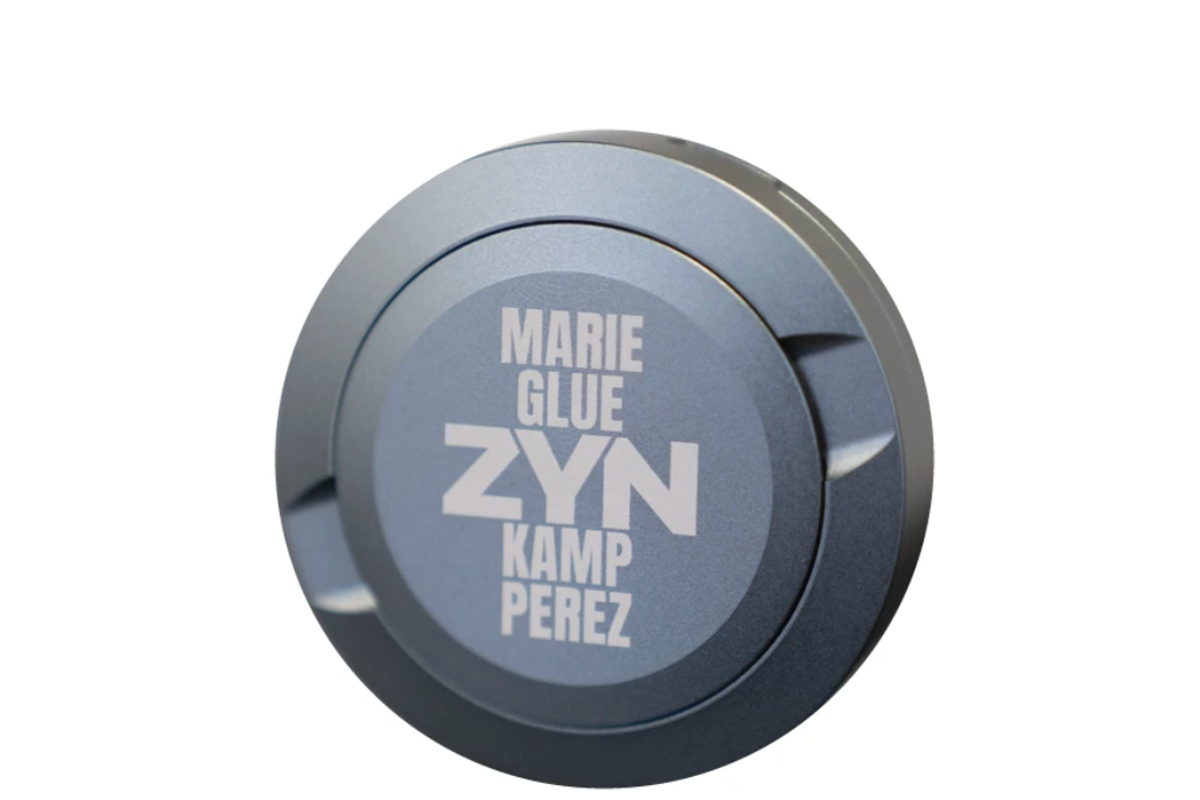
Campaign merchandise operates as a signaling mechanism rather than a revenue stream, functioning primarily to codify group identity and project alignment onto physical environments. When a congressional campaign operating within a competitive, politically fractured constituency introduces physical artifacts styled after high-affinity cultural commodities, the objective is deliberate identity arbitration. The introduction of a storage tin modeled after nicotine pouch packaging by a vulnerable incumbent in a right-leaning district represents an operational attempt to bypass traditional partisan sorting through consumer subculture. Analyzing this maneuver requires examining the intersection of demographic alignment, product-market fit in political branding, and the structural friction between micro-targeting and corporate intellectual property enforcement.
The mechanics of this branding strategy rely on capturing an existing semiotic shortcut. Nicotine pouches, specifically dominant formats like Zyn, have saturated the daily habits of young working-class demographics, particularly men in rural and exurban regions. These geographic segments often exhibit deep skepticism toward institutional Democratic messaging, creating a persistent outreach deficit for center-left candidates. By adopting the distinct visual architecture of these round tins—complete with modified typography—a campaign attempts to project cultural fluency. The strategic thesis posits that shared aesthetic consumption can temporarily neutralize partisan reactance, rendering a political actor legible to an audience that typically rejects standard party signaling.
This approach targets a specific vulnerability in contemporary electoral strategy: the hyper-polarization of everyday lifestyle markers. Traditional political campaign merchandise relies on explicit textual declarations, such as candidate names and ballot numbers, which trigger immediate partisan filtering. A functional or semi-functional object subverts this filtering mechanism by anchoring the campaign's presence to an item of utility or irony. The economic cost function of such an artifact is heavily asymmetric. Priced at a premium point of fifty dollars, the item functions less as a mass-market accessory and more as a high-visibility media catalyst. The earned media value generated by press coverage and digital sharing vastly exceeds the manufacturing and logistics costs, transforming a localized novelty into a national conversation on political branding adaptability.
However, executing this strategy introduces immediate structural friction, most notably through intellectual property governance. Corporate entities maintaining strict brand boundaries will aggressively protect proprietary trade dress to avoid political co-optation or liability. When parent companies issue formal cease-and-desist mandates against political campaigns utilizing modified brand aesthetics, the operational timeline of the merchandise strategy is abruptly truncated. This creates a high-risk, high-reward deployment window. The campaign must extract maximum digital impressions and cultural penetration before the legal injunction forces inventory withdrawal, rendering the physical item a scarce collector artifact and amplifying its symbolic currency.
The broader utility of this tactic highlights an ongoing evolution in political communication: the shift from ideological persuasion to tribal adjacency. Candidates defending razor-thin margins in districts won by opposing presidential nominees cannot rely solely on nationalized talking points or baseline party identification. They must construct a localized brand equity that decouples their personal reputation from the broader national brand of their party. Aligning with vernacular cultural objects allows an incumbent to signal shared regional realities, hobbies, and social spaces.
Evaluating the efficacy of subcultural political merchandise requires separating immediate behavioral response from long-term brand retention. While novel items generate viral digital cycles and secure temporary coverage across news aggregators, their conversion rate into actual ballot choices remains mediated by core legislative voting records and macroeconomic conditions. Cultural mimicry can open a communication channel with skeptical demographics, but it cannot override persistent policy disagreements on major fiscal and social votes. The tactic serves strictly as an attention-acquisition mechanism, designed to pierce the noise of a saturated media environment rather than serve as a substantive policy platform.
Future campaign cycles will likely see an increase in attempts to weaponize vernacular subcultures as traditional media consumption fragments further. Campaigns operating in competitive environments will continually search for high-salience cultural symbols that resonate with non-traditional voting blocks. The operational playbook moving forward requires pairing rapid-response cultural signaling with robust legal risk assessment, ensuring that creative branding maneuvers can survive corporate IP challenges long enough to achieve their intended distribution milestone.
Allocate digital advertising budgets toward hyper-localized micro-targeted placements featuring earned media reactions from these cultural artifacts, while simultaneously preparing rapid-pivot physical inventory lines to capitalize on public friction before legal containment takes effect.
Fubu Toy review
This video provides context on recent public health and advocacy campaigns targeting the widespread marketing and cultural impact of nicotine pouches among youth demographics.
http://googleusercontent.com/youtube_content/1