The Strategic Value of Political Speculation
Media cycles within the United Kingdom function as a feedback loop between internal party sentiment and public perception management. The current discourse surrounding Wes Streeting as a potential successor to the premiership is not an accidental byproduct of organic popularity; it is a calculated assessment of his performance metrics relative to the incumbent leadership. In political theory, this represents a Transition Risk Premium. When the incumbent’s polling data stagnates, the market—in this case, the electorate and the press—begins to price in the probability of a successor who offers a different "product" profile.
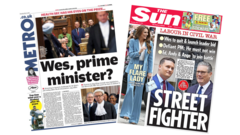
Streeting’s profile is built on a specific archetype: the centrist reformer with high media literacy. By analyzing the headlines from major broadsheets and tabloids, we observe a deliberate testing of his viability. This serves two functions. First, it acts as a stress test for his current policy portfolio, particularly in high-friction sectors like the National Health Service (NHS). Second, it creates a hedge against current leadership fatigue. To understand the "Wes, prime minister?" narrative, one must look past the personality and evaluate the structural vacuum he is being positioned to fill.
The Mathematical Reality of Health Care Reform as a Political Lever
The primary engine behind Streeting’s rise is his positioning within the Department of Health and Social Care. The NHS represents the largest single fiscal pressure on the UK budget, and its performance is the most significant non-economic variable in voter retention. Streeting has adopted a stance defined by Managed Confrontation. Unlike traditional partisan defenders of the system, he acknowledges systemic inefficiency, which grants him a "permission to lead" among skeptical independent voters.
The cost function of the NHS is currently unsustainable due to an aging demographic and a backlog of elective procedures. Streeting’s strategy involves three core pillars:
- Capital-Labor Substitution: Utilizing technology to automate administrative tasks and shift the burden of care away from high-cost hospital settings.
- Private Sector Integration: Reducing wait times by utilizing spare capacity in the private sector, a move that signals pragmatic governance over ideological purity.
- Preventative Decentralization: Shifting the focus of the health budget toward primary care to catch chronic conditions before they require acute, high-cost interventions.
These pillars are designed to appeal to a Treasury-minded observer. By framing health as an economic asset—a healthy workforce is a productive workforce—Streeting transforms a liability into a growth narrative. This is the intellectual foundation that makes the "Prime Minister" moniker plausible to the City and the public alike.
Narrative Arbitrage and the 'My Flare Lady' Phenomenon
While the broadsheets focus on succession, the tabloid press engages in Visual Narrative Arbitrage. The headline "My Flare Lady," referencing Princess Catherine’s fashion choices at public engagements, exemplifies the use of soft power to maintain institutional stability. In the UK’s uncodified constitution, the monarchy serves as a stabilizer for the volatile political landscape.
Media outlets utilize these stories to balance the "hard" news of political infighting. However, from a strategic standpoint, these segments are not fluff. They represent the Visibility Quotient required for the Royal Family to maintain its social license. Every public appearance is a data point in the calculation of "Value for Money" that the monarchy provides through tourism and national branding.
The juxtaposition of a potential future Prime Minister and a high-profile Royal event creates a comprehensive media product. One addresses the management of the state; the other addresses the continuity of the nation. For an analyst, the relevant metric is not the fashion itself, but the volume of engagement these stories generate relative to policy-heavy content. High engagement on "soft" stories provides the financial subsidies that allow newsrooms to maintain the staff required for political investigative reporting.
The Infrastructure of Press Curation
The process of "The Papers"—reviewing the next day's front pages—is a ritual of Narrative Front-Running. Political actors use the late-night news cycles to gauge reaction before a story reaches full saturation the following morning. This creates a 12-hour window where narratives can be "spun" or neutralized.
The frequency with which a specific politician appears in these previews is a direct indicator of their Internal Party Capital. If the papers are asking "Wes, prime minister?" it suggests that the briefing machines within the party are either actively promoting him or, at the very least, are not actively suppressing the rumor. In a disciplined political organization, silence is a form of endorsement.
This creates a First-Mover Advantage. By being the first "named" successor in the public consciousness, Streeting sets the benchmark against which all other potential rivals must be measured. Any other candidate who emerges later will be framed not as an independent option, but as the "alternative to Streeting." This framing is a powerful psychological tool in leadership contests.
Structural Bottlenecks in Political Ascension
Despite the positive media framing, Streeting faces significant structural hurdles that the standard news cycle ignores. These are the "hidden variables" in the equation of political power:
- The Incumbent’s Longevity: A Prime Minister who has just won a significant mandate is unlikely to be moved by mere speculation. The "Streeting for PM" narrative operates on a much longer timeline than the current 24-hour news cycle suggests.
- Intra-Party Fractionalization: The very centrist positioning that makes Streeting popular with the press creates friction with the party’s traditionalist wings. Power in the UK is held by the Parliamentary Party, and media popularity does not always translate to internal votes.
- Economic Exogenous Shocks: No amount of personal charisma can overcome a failing macro-economy. If the UK enters a sustained period of low growth or high inflation, the focus will shift from "who is the best leader" to "who is the best crisis manager." These are two very different skill sets.
The media’s focus on personality often obscures the fact that a Prime Minister is merely the chief executive of a massive bureaucratic machine. The ability to manage that machine is rarely tested in a television studio or on a front page.
The Strategic Play for Successor Positioning
To move from a speculative headline to the actual residence at 10 Downing Street, a candidate must execute a Multi-Phase Consolidation Strategy.
First, they must secure their current brief. For Streeting, this means delivering tangible reductions in NHS wait times before the next election cycle. Failure here renders the "Prime Minister" talk moot. He must prove that his frameworks for health reform are not just theoretically sound but operationally viable.
Second, he must build a Cross-Departmental Coalition. A Prime Minister needs more than a grasp of health; they need a vision for energy, defense, and the economy. Streeting must begin to weigh in on these topics without appearing to overstep his current mandate—a delicate balancing act of "Strategic Overreach."
Finally, the candidate must survive the Satiation Point. The media is fickle; a name that is mentioned too often can become stale. The "Wes, prime minister?" narrative must be pulsed—brought to the forefront during moments of leadership weakness and tucked away during periods of stability.
The ultimate goal is to become the "Inevitable Choice." When the time for a transition finally arrives, the groundwork must be so thoroughly laid that the party and the public feel as though the decision was made months or years prior. The current headlines are not the end goal; they are the initial deployment of a long-term influence campaign designed to normalize the idea of a new leadership era long before the first ballot is ever cast.