The envelope sat in a drawer, sealed, addressed, and entirely unsendable. It was October 1946. Outside, the world was frantically rushing into a bright, atomic future, a future that Richard Feynman had helped build with his own calculations. He was twenty-eight years old, a certified genius, a titan of quantum mechanics, and a man utterly unraveled by a single piece of paper.
The letter was addressed to Arline Greenbaum. His wife.
She had been dead for sixteen months.
We tend to look at the giants of science as flesh-and-blood supercomputers. We imagine them operating in a pristine space of pure logic, where equations balance perfectly and human messiness is filtered out by the scientific method. We think of Feynman especially this way—the brilliant, bongo-playing iconoclast of the Manhattan Project who unlocked the secrets of the universe with a few strokes of chalk. But logic is a fragile shield against grief. When the laws of physics collide with the reality of profound loss, even the most brilliant mind in the world finds itself grasping for something that defies calculation.
The Girl from Long Island
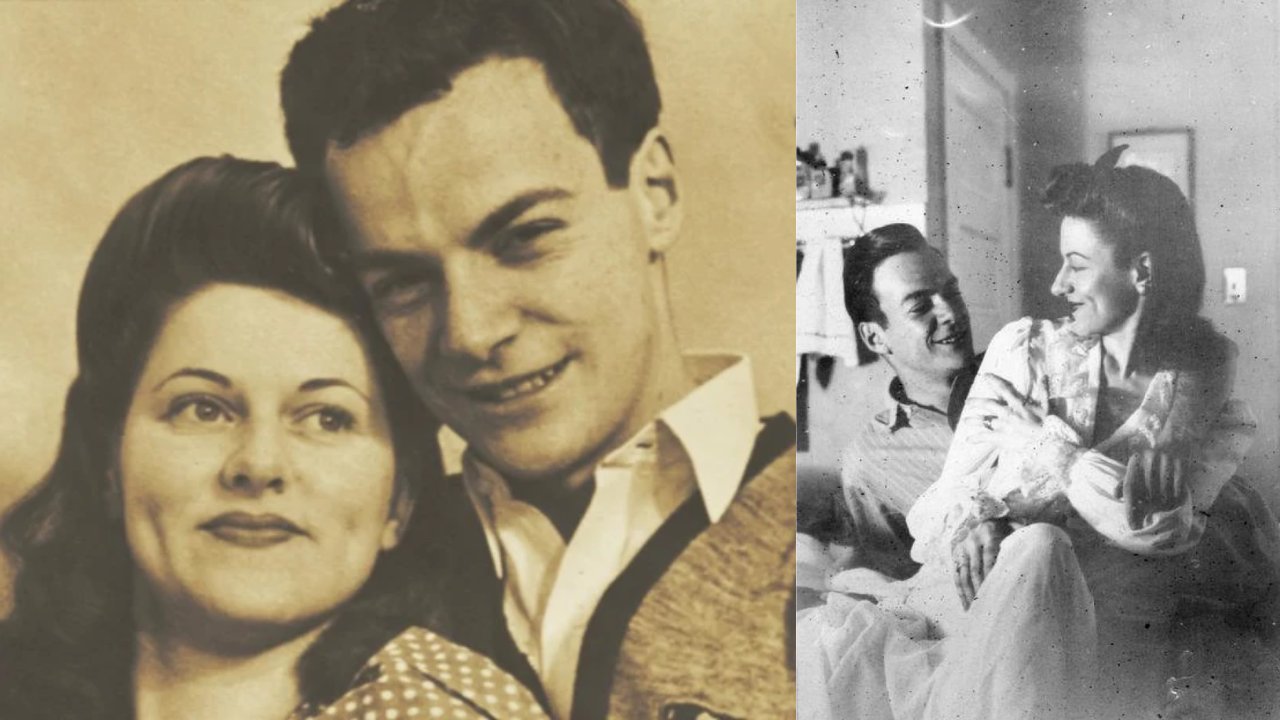
To understand the weight of the letter, you have to understand the girl who inspired it. They met as teenagers in New York. Arline was artistic, vivacious, and fiercely independent. Richard was the awkward science prodigy who saw the world in terms of cause and effect. They balanced each other perfectly. When Richard worried about what other people thought of his eccentricities, Arline would look him in the eye and ask a question that became the defining motto of his life: "What do you care what other people think?"
Then came the cough.
It started with a swollen lymph node in her neck. The doctors shifted from one incorrect diagnosis to another while Richard watched the girl he loved waste away. Finally, the verdict arrived like a physical blow: tuberculosis of the lymphatic system. In the 1940s, this was a death sentence. It was a slow, agonizing decline with a predictable, mathematical certainty.
Richard’s family begged him not to marry her. They warned him that he would catch the disease, that it would ruin his budding career, that it was a tragedy he didn't need to invite into his life.
He married her anyway.
They wed in a hasty, sterile ceremony at a city hall in Staten Island on their way to a bus station. No family attended. Richard couldn't even kiss his bride on the lips for fear of infection; he settled for a gentle kiss on her cheek. Immediately afterward, he took her to a hospital in New Jersey. Shortly after that, the United States government whisked him away to a secret laboratory in the middle of the New Mexican desert. Los Alamos.
The Double Life of Los Alamos
Imagine living in two completely different realities at the exact same time.
In one reality, you are working alongside the greatest minds of a generation to unlock the fundamental energy of the universe. You are calculating the behavior of neutrons, running simulations, and engineering a weapon of unprecedented power. The stakes are global, terrifying, and immediate.
In the other reality, you are spending your weekends driving a battered car across ninety miles of rough desert roads to a sanatorium in Albuquerque. You sit by a bedside. You watch a twenty-five-year-old woman lose her breath. You play word games, you share jokes, and you pretend that there is a tomorrow.
Richard lived this duality for years. He compartmentalized. In the lab, he was the unstoppable force of nature, the young physicist who wasn't afraid to tell Robert Oppenheimer or Niels Bohr when their calculations were wrong. By Arline's bedside, he was just a husband desperately trying to hold back the tide.
She made him promise to remain honest, to keep his mind sharp, and never to lose his zest for life. She bought him a set of drums to play in the desert. She sent him silly postcards that tested the limits of the strict military censors at Los Alamos. She kept him human in a place that was dedicated to building an instrument of mass destruction.
Then, in June 1945, the countdown stopped. Arline’s body finally gave out.
Richard was there when she took her last breath. He watched the clock on the wall of her hospital room tick forward. The digital precision of his scientific mind recorded the exact moment of her passing, but his emotional core went entirely numb. He didn't cry. He felt a profound sense of confusion. He packed her things into his car, drove back to Los Alamos, and went straight back to work.
A few weeks later, the world changed forever when the first atomic bomb detonated at the Trinity site. Feynman watched the blinding flash of light through the windshield of a truck. He saw the power of nature unleashed. Yet, the true devastation had already occurred in a quiet hospital room in Albuquerque.
The Sinking Weight of Reality
Grief is a strange predator. It doesn't always strike when you expect it to. It waits. It lets you think you are fine, that you have survived the worst of it, and then it springs upon you in the most mundane moments.
For Richard, the numbness lasted for months. He moved to Ithaca, New York, to teach at Cornell University. He tried to throw himself back into the rhythm of academia. He walked through the streets, looked at the crowds of people, and felt an immense, echoing distance from the rest of humanity. The world was moving on, rebuilding itself after the horrors of World War II, but his internal clock was stuck in June 1945.
The breaking point didn't happen at a funeral. It didn't happen while looking at old photographs.
It happened outside a clothing store.
He was walking past a storefront in town when a dress in the window caught his eye. It was bright, stylish, and entirely Arline's taste. The thought flashed through his mind instantly, effortlessly, with the speed of an instinct: Arline would love that. I should buy it for her.
Then, the cold, hard logic of reality caught up with the instinct.
She wasn't there. She would never wear the dress. The realization hit him like a physical blow to the chest. The dam broke. Right there on the sidewalk, surrounded by strangers going about their daily business, the young scientist wept uncontrollably. The numbness evaporated, leaving behind a raw, cavernous ache that no equation could fill.
The Letter to Nowhere
He went back to his room. He took out a piece of paper. He began to write.
He didn't write an essay on grief. He didn't write a philosophical treatise on the nature of mortality. He wrote directly to her. He spoke to her as if she were simply in the next room, or away on a short trip, or waiting for him at the end of a long day.
"D'Arline," the letter began.
I adore you, sweetheart.
I know how much you like to hear that—but I don't only write it because you like it—I write it because it makes me warm all over inside to write it to you.
The words poured out of him. It was a torrent of love, frustration, longing, and absolute vulnerability. He confessed how difficult it was to live without her, how empty his achievements felt when he couldn't share them with her. He told her about his work, his struggles, and how he still found himself talking to her in the quiet hours of the night.
He wasn't writing for an audience. He wasn't writing for history. He was writing because his soul was overflowing with a love that had nowhere else to go. The laws of thermodynamics state that energy cannot be destroyed; it can only change form. Feynman was experiencing the emotional equivalent of that law. The immense, passionate love he had for his wife hadn't vanished when her heart stopped beating. It was still there, trapped inside him, burning with the same intensity as always.
He acknowledged the apparent irrationality of what he was doing. He was a scientist, after all. He understood the finality of death better than most.
It is difficult for me to understand to write to you this way when you are dead—and yet I must do it. I cannot keep this love inside me another minute.
He filled the pages with memories, promises, and the quiet details of his daily life. It was a beautiful, heartbreaking attempt to bridge the gap between the living and the dead through the sheer force of written words. He poured out his hopes, his loneliness, and his enduring devotion.
Then, he reached the very end of the letter. He signed his name.
But there was one final, devastating postscript. A line that cuts through the decades and exposes the raw, unvarnished truth of his grief.
P.S. Please excuse my not mailing this—but I don't know your new address.
The Secret in the Desk
He didn't show the letter to anyone. He didn't mail it to a ghost. He folded it up, placed it back into the envelope, and tucked it away in the deepest corner of his desk drawer.
Richard Feynman went on to live an extraordinary life. He revolutionized quantum electrodynamics. He won the Nobel Prize in Physics in 1965. He became one of the most beloved educators in the world, famous for his ability to make the most complex ideas accessible to anyone. He married again, raised a family, traveled the world, and left an indelible mark on human history.
Yet, the letter remained in the drawer.
It stayed there through the decades. It stayed there while he unlocked the secrets of the subatomic realm. It stayed there while he investigated the Challenger disaster. It stayed there until his own death in 1988.
When his family was sorting through his papers after his passing, they found the envelope. The glue had dried. The paper had yellowed with age. The ink was decades old. They opened it and read the words that a twenty-eight-year-old grieving physicist had written to his lost bride forty-two years earlier.
We often look for closure in life. We like stories that tie up neatly, where the protagonist heals completely and moves on into a bright, uncomplicated future. We want to believe that time heals all wounds.
But the truth is far more complex.
Time doesn't erase love, nor does it completely erase the pain of its absence. Feynman's letter shows us that a great love doesn't simply disappear when a life ends. It changes shape. It becomes a quiet companion, a hidden room in the heart that we visit when no one else is looking.
The brilliant physicist couldn't find an equation to solve his grief. He couldn't build a machine to bring her back. In the end, he did the only thing a human being can do when faced with the infinite expanse of loss.
He loved her anyway.