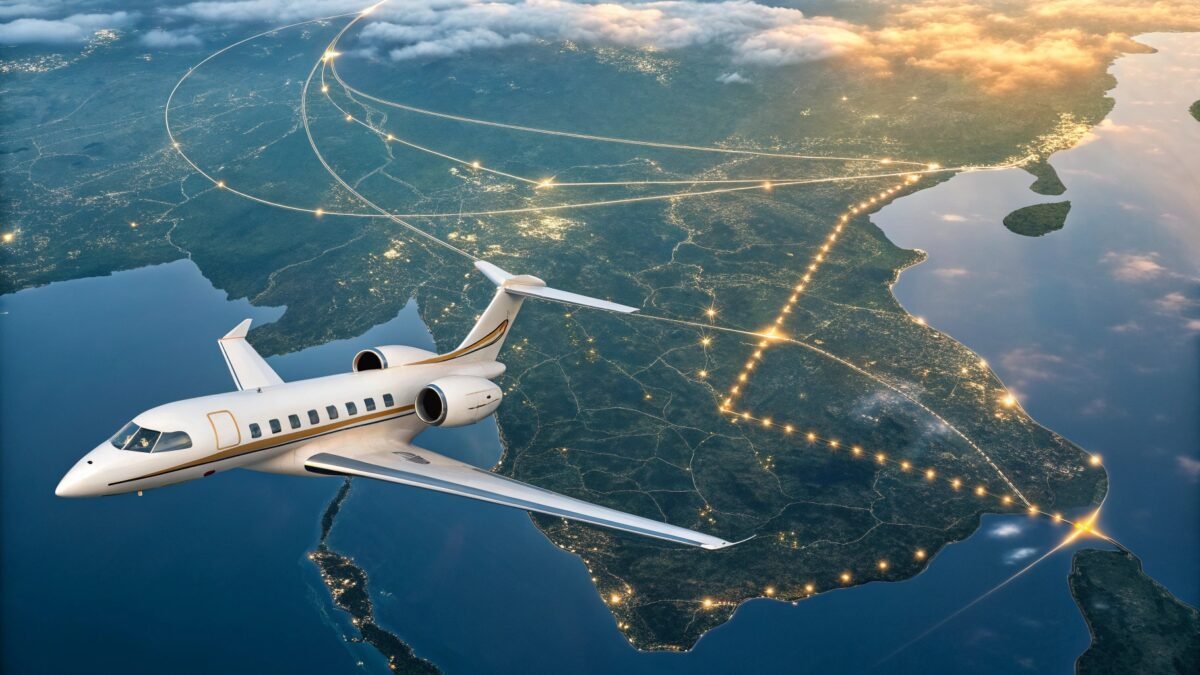
The silence of a grounded fleet has a specific, heavy frequency. It isn’t the absence of sound, but the presence of weight. On the tarmac at Ben Gurion or the sprawling runways of Amman, that weight is felt in the gut of every traveler staring at a flickering "Cancelled" notification. When the airspace over the Middle East tightens—a reaction to the sudden, violent geometry of missile trajectories and escalating brinkmanship—the world doesn't just stop moving. It splits in two.
On one side of the glass are the thousands tethered to the whims of commercial carriers, clutching vouchers for hotels that are already full. On the other side is a very small, very quiet group of people who are currently paying $232,000 to make the sky belong to them again.
Flight is no longer a matter of logistics in a conflict zone. It is an act of high-stakes gambling where the currency is both liquid capital and raw nerves.
The Anatomy of an Exit
Consider a hypothetical executive named Elias. He is not a villain, nor is he a hero; he is simply a man with a family in Dubai and a board meeting in London that he cannot miss because his company’s survival depends on it. As the regional tensions between Iran and Israel spike, the standard corridor of travel collapses. Major airlines—Lufthansa, Air France, Delta—pull back. They see the risk-reward ratio tilting toward catastrophe and they choose the safety of the hangar.
Elias watches the screen. His flight is gone. The border is a bottleneck. The sea is a slow, uncertain path.
He picks up a phone. This is where the luxury charter boom begins. It starts with a frantic inquiry to a broker who doesn't sleep. These brokers are the new architects of the exodus. They don't sell seats; they sell "out."
The cost for a heavy jet, perhaps a Gulfstream G650 or a Global 7500, to reposition and extract a small group from the edge of a war zone has surged. We are seeing price tags that mirror the cost of a suburban home. $200,000. $250,000. For a one-way trip.
This isn't just about leather seats and vintage champagne. It’s about the "War Risk Insurance" premiums that have ballooned by 400 percent in a matter of weeks. It’s about the pilots who require "hazard pay" to fly into a region where GPS jamming is now a daily meteorological constant.
The Invisible Map
When you look at a flight tracking app, the sky looks like an open field. This is a mirage. To a pilot in the Middle East right now, the sky is a labyrinth of shifting walls.
The closure of Iranian airspace doesn't just affect flights to Tehran. It creates a massive "no-go" block that forces every other piece of traffic to squeeze through narrow corridors over Iraq or Saudi Arabia. It’s a literal bottleneck in the heavens. When thousands of planes try to fit through a hole meant for hundreds, the system breaks.
Commercial flights have to follow rigid, pre-approved paths. They are tankers in a narrow canal. But a private charter? A charter is a speedboat.
The $232,000 price tag buys you a team of flight followers who are rewriting your coordinates in real-time. They are watching the geopolitical "weather" more closely than the actual clouds. If a specific waypoint becomes too hot—politically or kinetically—the jet pivots. It finds a gap. It uses the agility that a Boeing 777 packed with 300 tourists simply doesn't possess.
This agility is the ultimate luxury. It is the ability to bypass the collective paralysis of the masses.
The Moral Friction of the Lifeboat
There is an inherent discomfort in discussing these figures. While families wait in sweltering terminals, wondering if they will be stuck for days or weeks, the ultra-wealthy are literally rising above the chaos.
It is a vivid, modern illustration of the "Lifeboat Ethics" proposed by ecologists, but played out at 40,000 feet. If the boat is sinking and there are only a few spots left, who gets them? In the current Middle Eastern crisis, the answer is whoever can wire a quarter-of-a-million dollars before the next slot disappears.
The brokers report a shift in the clientele. It’s no longer just the tech billionaires or the oil scions. It’s corporations extracting their key personnel. It’s NGOs trying to move leadership to safety. It’s the "merely" wealthy who are liquidating assets because the cost of staying is suddenly higher than the cost of the flight.
The demand has become so frantic that "empty legs"—the flights where a jet returns to its base without passengers—are being snapped up for full price. Normally, these are the bargain bins of the private aviation world. Not today. Today, an empty seat is a wasted lifeline.
The Technical Toll
Why is it so expensive? We have to look at the machinery and the math.
A single flight from a city like Tel Aviv or Beirut to a safe haven in Europe involves a staggering amount of behind-the-scenes friction. You are paying for:
- Fuel Surcharges: Fueling in a conflict-adjacent zone is a logistical nightmare.
- Permit Expediting: Getting overflight rights when governments are on high alert requires "fixers" and 24-hour coordination.
- Security Detachments: Many of these flights now include on-ground security to ensure the transition from the armored car to the cabin is seamless.
- The Risk Factor: If a jet is "trapped" on the ground during an airport closure, the owner loses millions in potential charter revenue elsewhere. That risk is priced into your ticket.
The GPS jamming mentioned earlier is perhaps the most harrowing technical hurdle. Pilots are reporting "spoofing" where their instruments tell them they are over an entirely different country. Imagine flying a $70 million aircraft and suddenly your navigation system insists you are at the center of a desert you haven't even reached yet. Charter pilots are often more seasoned, frequently coming from military backgrounds, and are trained to fly "old school"—using ground references and inertial navigation—when the digital world fails.
That expertise isn't cheap. You are paying for a human being who can outthink an electronic ghost.
The Psychology of the Departure
If you talk to the people who handle these flights, they describe an atmosphere that is far from celebratory. There is no "glamour" in these cabins. There is a frantic, focused silence.
The passengers aren't posting selfies with their caviar. They are on their laptops. They are on satellite phones. They are looking out the window at the horizon, waiting for the moment the pilot announces they have cleared the "high-threat" zone.
There is a specific sigh of relief that happens at that altitude. It’s the sound of the world becoming "normal" again. Once the jet crosses into Mediterranean or European airspace, the invisible walls vanish. The $232,000 has successfully bought a return to a reality where the sky is just the sky.
But for every Global 7500 that streaks away toward the sunset, there are thousands of eyes watching from the ground. They are watching the white contrails and calculating their own odds.
The Shrinking Sky
We are entering an era where geography is being reasserted. For thirty years, we lived in a world where "global" meant "accessible." You could go anywhere for the price of a mid-range smartphone. That era is flickering.
As regional conflicts become more frequent and more technologically sophisticated, the "public" sky is shrinking. It is being reclaimed by the powers that fight over the land beneath it.
The luxury charter boom is a symptom of a fractured planet. It tells us that safety is becoming a tiered commodity. It suggests that in the future, the ability to move through the world will not be a right, but a premium service available to those who can afford to outrun the headlines.
The real cost of that flight out of the Middle East isn't the fuel or the insurance. It’s the realization that the horizon is no longer free.
The engine's whine reaches a crescendo. The wheels leave the hot tarmac. Below, the city is a grid of lights and uncertainties. Above, the air is thin, cold, and—for the right price—perfectly clear. Elias closes his eyes. He is moving. The world is still burning, but for the next six hours, he is somewhere else. He is in the only place that money can still reliably buy: the gap between the earth and the end of the world.
The jet banks left, chasing a sun that refuses to set, leaving the shadows of the conflict to lengthen over the runways left behind.