The air inside a construction site has a specific, gritty weight. It tastes of pulverized concrete and the metallic tang of welding sparks. Somewhere beneath the sprawling expanse of a new Senate office building project, a steamfitter or an electrician pauses to wipe sweat from their brow, unaware that their labor is being recast as a punchline in a high-stakes game of real estate comparisons.
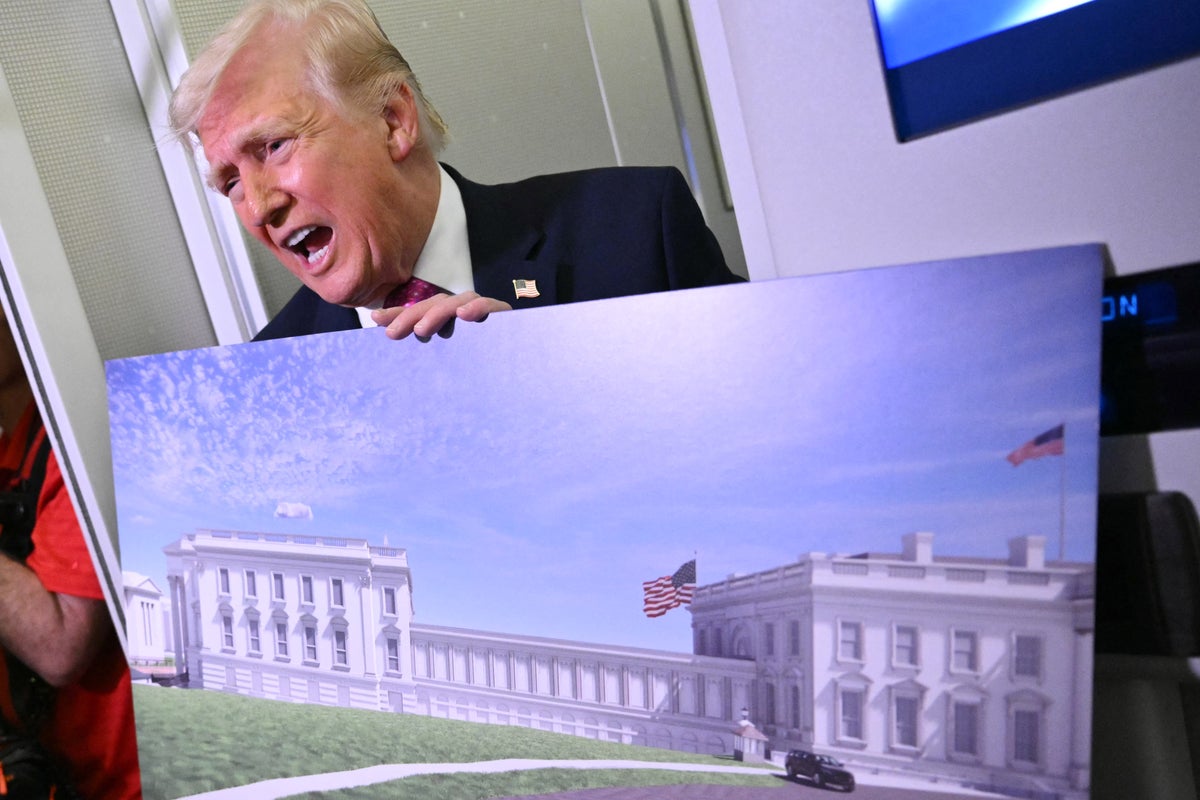
Donald Trump recently took to the digital stage to defend the optics of a $400 million ballroom. He called it a bargain. He framed it as a masterclass in private-sector efficiency, a shining example of what happens when a builder knows the true value of a dollar. But in the shadow of that gleaming chandelier-heavy space, a much larger, quieter number is moving through the veins of the American taxpayer.
One billion dollars.
That is the sum Senate Republicans reportedly funneled into a massive expansion project for their own workspace. While the public dickers over the cost of gold leaf and velvet curtains in a private club, the machinery of government is quietly assembly-lining a billion-dollar monument to bureaucracy. This isn't just about ledger sheets or partisan bickering. It is about the fundamental disconnect between the people who pay for the rooms and the people who get to stand inside them.
The Art of the Diversion
Consider the psychology of the "bargain." When a billionaire tells you he spent $400 million on a room and saved money doing it, it creates a momentary flash of cognitive dissonance. We start doing the math. We think about our own mortgages, our own kitchen renovations, the cost of a gallon of milk. The sheer scale of the number is meant to stun, while the claim of "efficiency" is meant to soothe. It is a classic magician’s trick: look at the shiny object in my left hand so you don’t see what the right hand is doing behind the curtain.
The right hand, in this case, belongs to the Senate GOP.
While the headlines were occupied with the aesthetics of a Florida ballroom, a legislative maneuver tucked a staggering $1 billion into a spending bill for the construction of a new Senate office facility. If a $400 million ballroom is a "bargain," what does that make a billion-dollar office block? It makes it an invisible mountain. It is a cost so high that the human brain almost refuses to process it, yet it is being funded by the collective pockets of people who will likely never step foot inside its climate-controlled halls.
Imagine a small-town business owner in Ohio. Let's call her Sarah. Sarah spends her Saturday mornings agonizing over a $2,000 increase in her commercial property insurance. She looks at her overhead, her payroll, and the thinning margins of her craft supply store. To Sarah, $1 billion isn't a number. It’s a fantasy. It’s an impossible sum that could fund her entire town’s infrastructure for a century. When she hears about a billion-dollar office building being added to a bill like an afterthought, the "bargain" of a private ballroom starts to look like a very different kind of problem.
The Hidden Stakes of Public Architecture
Buildings are never just buildings. They are statements of priority. When the private sector builds, it risks its own capital. If the ballroom fails to attract events, if the gold leaf peels, the loss belongs to the investor. But when the government builds, the risk is socialized. The stakes are moved from the boardroom to the dinner table.
The $1 billion addition for the Senate project wasn't born out of a sudden, desperate need for more desks. It was the result of a quiet consensus, a realization that in the chaos of modern politics, massive expenditures can be camouflaged by louder, more colorful controversies.
The contrast is jarring. On one side, you have the loud, brassy defense of a private luxury space, used as a political cudgel to prove "business savvy." On the other, you have a silent, bureaucratic expansion that costs more than double and carries none of the same scrutiny. We are being asked to judge the cost of a chandelier while ignoring the cost of the entire ceiling hanging over the heads of our legislators.
Why does this happen? Because complexity is a shield. It is easy to understand a ballroom. You can picture the weddings, the galas, the polished floors. It is much harder to visualize a "multi-phase administrative infrastructure expansion." The language of government is designed to be boring. It is designed to make the eyes glaze over so that the mind stops asking where the money went.
The Gravity of the Invisible Dollar
Money has a physical weight in the lives of ordinary people. It represents time. It represents the hours spent away from family, the stress of the commute, the sacrifices made for a future that feels increasingly expensive. When $1 billion is moved across a legislative table, it isn't just a digital transaction. It is the reallocation of the public’s collective time and effort.
Think about the "Senate GOP" as a character in this story. Not as a faceless entity, but as a group of people who have become so accustomed to the rarified air of the Capitol that a billion dollars feels like a reasonable line item for a workspace upgrade. They aren't checking the price of the drywall. They aren't worried about the cost of the HVAC system. They are building a legacy on a credit card that belongs to someone else.
The irony is thick enough to choke on. The same political movement that often prides itself on fiscal conservatism and the decrying of "wasteful spending" found a way to slip a ten-figure construction project into the budget. And they did it while the world was distracted by a debate over whether a $400 million ballroom was a good deal.
It’s like watching a homeowner argue with a contractor over the price of a $50 faucet while the backyard is being quietly excavated for a $500,000 swimming pool they didn't ask for. The faucet is the ballroom. The pool is the Senate office building. We are all standing in the kitchen, pointing at the chrome, while the heavy machinery is tearing up the earth behind us.
The Emotional Tax
There is a psychological cost to this kind of fiscal sleight of hand. It erodes trust. It creates a sense that the rules of reality—the ones that Sarah in Ohio has to live by—simply don't apply to the people in Washington or the people in the penthouses.
When a leader calls a $400 million project a bargain, it feels like a gaslighting of the working class. It suggests that if you aren't thinking in hundreds of millions, you aren't thinking big enough. But when that same leader’s allies add $1 billion to the public debt for their own comfort, it moves beyond gaslighting into a form of structural betrayal.
We are living in an era of "The Gilded Office." It isn't just about the aesthetics; it's about the insulation. These buildings—whether they are private ballrooms or public Senate wings—act as barriers. They are thick-walled fortresses that keep out the noise of the struggle. Inside, the temperature is always 72 degrees. The lighting is always soft. The reality of a crumbling bridge in the Midwest or a struggling school system in the South feels very far away.
The Reality of the "Bargain"
Let’s dismantle the idea of the bargain. A bargain implies value. It implies that for every dollar spent, something of equal or greater worth is gained. In the private sector, that value is measured in profit. In the public sector, that value should be measured in the well-being of the citizenry.
If we spend $1 billion on a Senate office building, what is the return on investment for the person working two jobs to keep the lights on? Does the legislation get better? Does the government become more efficient? Or do we simply get more sophisticated rooms for the same old stalemates?
The $400 million ballroom is a distraction, but it is a revealing one. it shows us what the elite value: scale, optics, and the appearance of victory. But the $1 billion Senate expansion shows us what they take for granted: our silence and our money.
We are told to be impressed by the builder who can put up a palace for "only" $400 million. We are told to look the other way when the government spends $1 billion on a cubicle farm for the powerful. But the math doesn't add up for the people on the ground.
The real cost of these projects isn't found in the invoices. It is found in the widening gap between the governed and the governors. It is found in the cynicism that grows every time a billion dollars disappears into the marble and stone of a city that seems to have forgotten the value of a single cent.
The ballroom will eventually host its parties. The Senate offices will eventually be filled with aides and lobbyists. The chandeliers will glow, and the carpets will muffle the sound of footsteps. But outside, in the world of Sarah and the steamfitter and the taxpayer, the weight of that billion dollars remains. It is a debt that doesn't just sit on a balance sheet; it sits on the shoulders of a nation.
A billion dollars could have rebuilt a thousand crumbling playgrounds. It could have funded medical research that saves lives. It could have stayed in the pockets of the people who earned it. Instead, it is being transformed into walls and windows that will only serve to further distance the powerful from the people they represent.
That is the true price of the gilded room. It isn't measured in gold leaf. It is measured in the quiet, steady loss of the idea that we are all in this together.
The crane swings over the construction site. Another girder is locked into place. Another million dollars is spent. And somewhere, a "bargain" is being touted to a crowd that is too tired to do the math, while the mountain of debt grows just a little bit higher against the horizon.