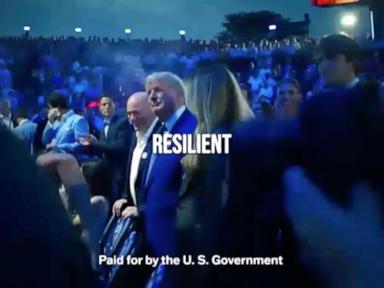
The room is dark except for the blue, restless pulse of the television. It is past eleven. Most of the city is asleep. On the screen, a choir of soaring strings swells behind a smooth, resonant voiceover that speaks of national renewal, economic triumph, and the steady hand at the helm. Images flash by at cinematic speed: smiling workers in hard hats, golden wheat fields rippling in the midday sun, a pristine highway stretching toward a bright horizon.
Then comes the familiar seal, the subtle stamp of executive authority, and the fade to black.
Evelyn sits on her sofa, a cold cup of tea cradled in her hands. She is a bookkeeper by trade. Her mind does not drift easily into the passive trance of advertising. Instead, her eyes narrow at the corner of the screen. She thinks of the receipts she spent all evening auditing, the stubborn discrepancies in her ledger, the relentless bite of withholding tax taken from every paycheck she has ever earned.
A sharp, uncomfortable question forms in the quiet room.
Who paid for this?
Not the campaign committee wearing matching lapel pins. Not the political action committee filing confidential disclosures. But her. The woman who wakes up before dawn to balance columns of numbers. The quiet citizen whose labor feeds the massive, invisible engine of the federal treasury.
To the casual viewer, an advertisement broadcast across living rooms nationwide is simply background noise, a fleeting commercial break between local news and late-night reruns. But beneath the polished production value lies a profound constitutional friction. When an administration in power produces and broadcasts commercial spots that glorify its own leadership, the boundary separating public administration from political campaigning begins to dissolve. And that dissolution carries a heavy price.
The Anatomy of an Executive Dollar
To understand how an administration’s promotional video finds its way onto millions of home televisions, one must first dismantle the machinery of government appropriations.
Federal agencies do not operate on loose change or casual whims. Every dollar spent by a department—whether it is the Department of Transportation, the Department of Energy, or Health and Human Services—is carved out by congressional legislation. Dollars are appropriated for specific public purposes: building bridges, distributing food stamps, researching pharmaceuticals, securing borders.
When an agency decides to run a public service campaign, it justifies that expenditure under the banner of public education. If a disease is spreading, the government has a duty to inform citizens how to wash their hands or seek a vaccine. If a new bridge is under construction, drivers need to know about detour routes. These are functional communications. They serve a direct, measurable civic necessity.
The friction begins when public education morphs into self-congratulation.
Consider the subtle alchemy of political messaging. A thirty-second television spot does not overtly tell a viewer how to cast a ballot. It does not flash a candidate’s name with a "Vote For" disclaimer at the bottom in bold letters. Instead, it deploys mood, tone, and association. It pairs the face of current prosperity with the stewardship of the current administration. It presents policy achievements not as the collective work of a bipartisan legislature or the enduring resilience of the citizenry, but as the personal triumph of the executive branch.
When that commercial airs during prime-time programming, it costs money. Serious money. Millions of dollars in airtime purchased from local affiliates and national networks. If those dollars come from an agency's operational budget—money authorized by taxpayers to pave roads or manage public lands—a dangerous boundary has been crossed.
The public is no longer merely funding governance. The public is unwittingly financing its own persuasion.
The Gray Zone of Federal Messaging
Walk into a federal communications office in Washington, and you will find walls covered in storyboards, color swatches, and demographic charts. The people working here are not political operatives in the traditional sense; they are civil servants, graphic designers, media buyers, and public affairs specialists.
They speak in a specialized dialect of reach, frequency, and impressions. To them, an ad campaign is an analytical puzzle. How do we communicate a complex policy shift to a population that scrolls past news feeds in three-second increments? How do we translate legislative jargon into an emotional resonance?
Yet, the pressure from above is constant.
An administration facing sinking poll numbers or fierce legislative battles feels an existential urge to speak directly to the public, bypassing critical press corps and skeptical commentators. Television remains the most potent amplifier in existence. It bypasses the intellectual filters of analysis and strikes directly at the nervous system.
To achieve this without triggering legal alarms, administrations rely on the gray zone. They craft messaging that walks a meticulous line. They brand the campaign as an official update on economic recovery or infrastructure modernization. They use agency letterheads. They wrap the executive agenda in the flag of objective institutional communication.
Underneath the legalistic compliance, however, the political pulse beats loudly.
When the ad highlights the president's direct actions, when the visual focal point is the leader standing before cheering crowds or signing executive orders with a flourish, the distinction between state and campaign vanishes for the viewer at home. To Evelyn sitting on her couch, the message is singular: the person currently in charge is delivering results.
And the taxpayer funded the megaphone.
The Architecture of Accountability
For decades, Congress has attempted to build firewalls against this exact scenario.
Federal law explicitly prohibits agencies from using appropriated funds for "publicity or propaganda purposes" designed to support or defeat legislation or to bolster a politician's public standing. The Antideficiency Act and various annual appropriations riders serve as legislative tripwires. If an agency spends public money on self-aggrandizement, it violates federal law.
Enter the Government Accountability Office.
The GAO functions as the financial watchdog of the federal government, a fortress of forensic accounting. When watchdog groups or congressional members raise alarms about a suspicious executive ad campaign, the GAO investigates. Investigators subpoena contracts, review media buys, analyze scripts, and measure the ratio of policy information to executive promotion.
If the GAO determines that an ad constitutes illegal self-aggrandizement or covert propaganda, it issues a formal legal opinion. It declares that the agency violated the publicity-prohibitions statute and orders the misuse of funds to be reported to Congress and the President.
It sounds severe. It sounds like an unyielding check on executive overreach.
Yet, reality moves much faster than accounting investigations.
By the time the GAO completes its meticulous review, gathers all the contract records, debates the statutory definitions, and publishes its report, months have passed. Often, an entire election cycle has turned over. The ad has long since finished its broadcast run. The political impact has already been absorbed by the electorate. The message has landed, the votes have been cast, and the administration has either secured another term or packed its boxes.
A retroactive accounting reprimand is little more than a paper tap on the wrist. It cannot un-ring a bell heard by fifty million viewers on a Tuesday night. It cannot return the tax dollars spent on prime-time airtime back to Evelyn’s ledger.
The Currency of Trust
At its core, this ongoing debate over television ads is not merely a technical argument about budgetary line items or administrative statutes. It is a crisis of trust.
Trust is the invisible currency that holds a republic together. When citizens pay taxes, they enter into a silent, profound compact with the state. They surrender a portion of their hard-earned labor under the assumption that the money will be used for common defense, infrastructure, health, and justice—not to finance a political commercial designed to keep the current tenant in power.
When that compact is frayed, cynicism takes root.
When Evelyn sees a polished, expensive commercial praising the administration on her television screen, she stops believing in the neutrality of government information. Every public service announcement about health, safety, or economic data begins to carry an asterisk in her mind. Is this real information meant to protect my family, or is it a political pitch disguised as civic duty?
That skepticism is corrosive. It spreads outward from federal spending to institutional integrity, poisoning the well of democratic participation. If the government uses the citizen's own money to persuade the citizen how to feel about the government, the fundamental premise of a representative democracy begins to invert itself. The servant starts managing the master.
The television screen goes dark. The commercial break ends, and the late-night local news returns with a weather report.
In the quiet room, the blue light fades from the wall. The remote rests on the cushion. But the question remains suspended in the air, waiting for the next election cycle, the next federal budget, and the next citizen looking closely at the ledger, wondering where their labor truly went.