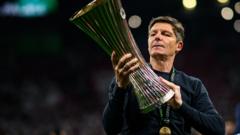
Oliver Glasner departs Crystal Palace having delivered three trophies in a breakneck two-year spell, securing the club's first-ever European silverware with a 1-0 Conference League final victory over Rayo Vallecano in Leipzig. Yet the defining story of his tenure is not one of smooth, uninterrupted progress. It is an exhausting tale of boardroom friction, multi-club bureaucracy, high-profile player departures, and mid-season tactical reinvention. Glasner took a club traditionally content with Premier League survival and injected a ruthless, top-tier winning mentality, but the infrastructure around him struggled to keep pace with his ambition.
The triumph in Germany, secured by a signature Jean-Philippe Mateta strike, serves as the ultimate parting gift from a manager who confirmed his summer departure months ago. To understand how Palace reached this peak—and why it ultimately cost them the manager who built it—one must look past the celebratory ticker tape. Meanwhile, you can find similar events here: Why Carson and Granada Hills Dominating Los Angeles Softball Matters Far Beyond the City Section.
The Illusion of Continuity
When Crystal Palace stunned Manchester City at Wembley to lift the FA Cup, it felt like the dawn of a permanent new reality in south London. A subsequent penalty shootout victory over Liverpool in the Community Shield only solidified that belief.
The summer brought an immediate, sobering reality check. To explore the bigger picture, check out the detailed analysis by FOX Sports.
Palace fans expected a Europa League campaign to reward their domestic cup success. Instead, UEFA enforced its strict multi-club ownership rules due to John Textor’s dual stakes in Palace and Lyon. The Eagles were demoted to the Conference League before kicking a ball. This administrative gut-punch altered the club's financial calculus and disrupted recruitment plans.
Rather than building from a position of absolute strength, Glasner found himself fighting fires. The transfer window became a battleground between a manager demanding elite reinforcements and a hierarchy balancing the realities of a complex ownership structure. Talismanic forward Eberechi Eze departed for Arsenal in a club-record deal, leaving a creative void that could not be easily filled.
The winter window brought further disruption. Center-back Marc Guéhi was sold to Manchester City, a departure that source reports indicate triggered Glasner's internal decision to walk away at the end of the season. The Austrian manager felt the squad was being systematically dismantled just as he was being asked to compete on multiple fronts.
Tactical Evolution Under Pressure
Glasner's initial success at Selhurst Park was built on a highly dynamic 3-4-2-1 system. It relied heavily on the individual brilliance of Eze and Michael Olise occupying the twin number ten pockets, creating overloads and feeding a revitalized Mateta.
The system required specific profiles to function.
When those profiles left, the tactical blueprint had to change. Opposition teams also adapted, frequently deploying ultra-deep defensive blocks to deny Palace the space they preferred to exploit on the counter-attack. A prime example occurred during their European tie against Fredrikstad at Selhurst Park, where the visitors sat in a rigid 5-4-1 low block.
Glasner showed his elite tactical flexibility by adjusting mid-game, shifting into an aggressive 3-1-6 shape. He pushed his wing-backs extremely high to stretch the pitch, using midfielders like Will Hughes to overload the wide channels while generating crosses into a crowded penalty box.
   [CB]      [CB]      [CB]
             [DM]
[WB]   [8]   [10]   [10]   [8]   [WB]
             [CF]
The tactical shift proved that Glasner was not wedded to a single formation. He recognized that system rigidity is fatal in modern football.
Managing the Physical Load
The sheer volume of games took a massive toll on a thin squad. Midfielder Adam Wharton, the engine of the Palace midfield, played over 1,000 more minutes than his previous season baseline. Managing his fitness became a weekly tightrope walk for the medical staff.
Glasner publically insisted he would only start players who were entirely fit, yet the drop-off in quality behind his core starting eleven meant key individuals had to be pushed to their absolute limits. The squad's defensive organization remained elite, but the domestic campaign suffered from the physical exhaustion of balancing Thursday night European travel with rigorous Premier League weekends.
The Mateta Redemption
No player embodies the volatile nature of the Glasner era quite like Jean-Philippe Mateta. The French striker went from a rotational option under previous regimes to one of the most lethal forwards in Europe, culminating in his historic winning goal in Leipzig.
His journey was far from simple.
In January, Mateta was on the verge of a transfer to AC Milan. The move collapsed at the eleventh hour due to a knee issue flagged during medical discussions. The failed transfer left a section of the Selhurst Park support frustrated, questioning the player's long-term commitment to the project.
Mateta's Performance Arc:
[Pre-Glasner: Rotational/Inconsistent]
  -> [FA Cup Run: Elite Finisher]
  -> [Jan 2026: Collapsed Milan Move]
  -> [May 2026: European Cup Winner]
Instead of letting the situation fester, Glasner handled the forward with expert man-management. He reintegrated Mateta immediately, publicly praising his character and humor while demanding absolute focus on the pitch. Mateta responded with total commitment, culminating in his crucial rebound finish from a parried Wharton shot to secure European glory.
A Bitter Sweet Legacy
Oliver Glasner leaves south London as statistically the most successful manager in Crystal Palace history, boasting the highest top-flight win percentage of any permanent boss at the club. He proved that with elite coaching and tactical clarity, a traditional mid-table club can win major honors.
The project was unsustainable under the current club model.
The friction between a world-class manager's sporting ambition and the operational constraints of a multi-club ownership group ultimately fractured the relationship. Glasner refused to accept a compromised vision. He leaves with his reputation enhanced across the continent, having delivered a lifetime of memories to the fans, while the Palace hierarchy is left facing a massive task to replace a manager who proved to be bigger than the structure around him.