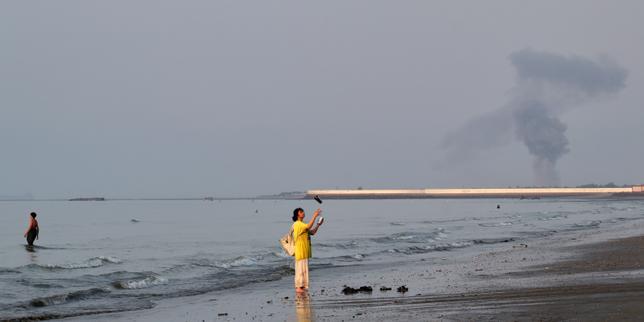
A single, heavy brass key turned in a lock on the third floor of an unremarkable apartment building in Isfahan. It was late afternoon, the hour when the heat of the Iranian sun usually begins its slow retreat, leaving behind the scent of dust and baked asphalt. Inside, a woman named Shirin set down a plastic bag containing three flatbreads and a small carton of milk. She did not turn on the television. She did not check her phone immediately. Instead, she stood by the window and listened to the silence of her city, a silence that felt increasingly brittle, like glass cooled too quickly.
Seven thousand miles away, in a windowless briefing room beneath the Pentagon, a young analyst adjusted his tie. His eyes were bloodshot from a twelve-hour shift spent staring at satellite imagery of specialized transport trucks moving across the desert near Natanz. He reached for a lukewarm cup of coffee, his fingers tapping a restless rhythm against the desk.
These two people will never meet. They speak different languages, inhabit different worlds, and harbor different anxieties. Yet they are bound together by an invisible, tightening cord. They are trapped inside the rekindled machinery of a geopolitical stalemate that the world thought it had moved past, a deadlock that the headlines call a political impasse, but which feels, on the ground, like a slow-motion collision.
The grand narrative of international relations often treats nations as monoliths. We speak of "Washington" and "Tehran" as if they are two giant, thinking chess players moving pieces across a board. But nations do not bleed. Decisions are made by tired individuals in air-conditioned rooms, and the consequences are borne by people buying bread in the fading light.
The Architecture of Misunderstanding
To understand how the relationship between these two powers collapsed back into the familiar grooves of hostility, one must look at the nature of a promise. A decade ago, a fragile bridge was built out of ink and compromise. It was a dense, hyper-technical document designed to trade economic survival for nuclear restraint. It was imperfect, but it functioned as a rare channel of predictability in a region defined by chaos.
When that bridge was dismantled, it was not replaced by a new strategy. It was replaced by a vacuum.
Think of it as two neighbors who share a cracked retaining wall. For years, they shout across the fence, argue about the boundaries, and eventually agree to a flawed system of bracing the concrete. Then, one neighbor decides the deal is bad and kicks the braces away. The wall does not fall immediately. Instead, tiny fissures spiderweb through the stone. The silence between the houses grows heavy. Every time one neighbor starts a lawnmower or moves a shovel, the other assumes they are digging a trench.
That is the current reality of the maximum pressure dynamic and the resistance doctrine that opposes it. It is an escalatory loop where every defensive action by one side is perceived as an offensive provocation by the other.
In Washington, the calculation became simple: squeeze the economy until the system buckles or bends. The policy papers spoke of leverage, behavior modification, and strategic deterrence. They used clean, sterile words to describe a messy, unpredictable human experiment.
In Tehran, the response followed an ancient, stubborn script. To bow under pressure is to invite destruction; therefore, the only logical response to force is defiance. If the economy must suffer, then the centrifuges must spin faster, the regional proxies must move closer to the chess pieces, and the threshold of tolerance must be pushed to the absolute limit.
The Ledger of the Unseen
The tragedy of this impasse is that its primary victims are invisible to the policymakers who orchestrate it.
Consider the currency markets in Tehran. When the value of the rial plummets against the dollar, it does not just change a number on a digital exchange board. It changes the menu at a family dinner table. It means a grandfather skips his heart medication for a week so his granddaughter can buy a new pair of shoes for school. It means a young entrepreneur, who spent years studying software engineering, packs a single suitcase and leaves for Europe, draining his country of the very talent required to build a future.
Shirin felt this shrinkage of life every day. Her savings, once meant to secure a modest retirement, had become a shifting sand dune. A year ago, her brother needed an imported medical device for a chronic kidney condition. The device was technically exempt from international sanctions, but the banks were too terrified of American penalties to process the payment. The transaction became a ghost, chased through three front companies in Dubai and Istanbul, accumulating fees until the price had tripled.
This is the hidden tax of the geopolitical freeze. It is not paid in blood on a battlefield—at least, not yet. It is paid in the slow, agonizing erosion of daily dignity.
Meanwhile, the strategic objective of the pressure campaign remains unfulfilled. The assumption that economic hardship naturally translates into political transformation is a flawed reading of human psychology. History suggests that when a community feels under siege from an external force, internal divisions often calcify. The moderate voices, those who argued for engagement and integration with the global community, are drowned out. They are labeled as naive, or worse, complicit. The hardliners smile, point across the ocean, and say, We told you they could never be trusted.
The impasse feeds the very forces it was ostensibly designed to defeat.
The Mirage of Deterrence
Behind the closed doors of defense think tanks, experts debate the concept of deterrence thresholds. It is a mathematical way of asking: how far can we push them before they strike back? And how far can they push us before we are forced to retaliate?
The flaw in this mathematics is that human beings are notoriously bad at reading minds.
Imagine two men standing in a dark room, each holding a loaded pistol. They cannot see each other's faces, only the faint outline of a silhouette. One man shifts his weight because his leg is cramping. The other hears the rustle of clothing and assumes the hammer is being cocked. He fires. The first man fires back. Later, the historians write about the inevitable outbreak of conflict, ignoring the fact that it began with a muscle spasm.
We are currently living in that dark room. The communication channels that once existed—the direct hotlines, the casual diplomatic encounters on the sidelines of international summits—have been systematically dismantled. What remains is a public theater of threats. Speeches delivered at military rallies, videos of missile tests, and stern press releases from the State Department have replaced actual conversation.
When diplomacy is reduced to public posturing, compromise becomes synonymous with treason. A politician who suggests a concession is instantly savaged by their domestic opponents. Therefore, the safest political position is always the most rigid one. You stand your ground, you raise your fist, and you hope the other side blinks first.
But what if neither side can afford to blink?
The United States faces an electorate that is deeply weary of foreign entanglements, yet fiercely allergic to any perception of American weakness. Any administration that appears to give ground to an adversarial regime faces immediate domestic castigation. The political cost of a bad deal is viewed as far higher than the strategic cost of no deal at all.
Across the divide, the Iranian leadership views its survival through the lens of ideological constancy. The system was forged in the fire of revolution and an eight-year war that cost a generation of young lives. For the men who hold the levers of power in Tehran, compromise under duress is not just a tactical error; it is an existential threat to the narrative that justifies their rule.
The Cost of the Quiet
The danger of an impasse is that it feels sustainable until the exact second it isn't.
Months turn into years. The headlines move on to other conflicts, other crises, other elections. The world grows accustomed to the low-grade fever of the standoff. We begin to believe that the status quo can last forever, that the two giants can stand toe-to-toe indefinitely without ever swinging.
This is a dangerous illusion. The longer the deadlock persists, the more the margin for error shrinks. A rogue drone, a miscalculated naval encounter in the Strait of Hormuz, or a cyberattack that hits the wrong target could instantly transform this cold stalemate into a hot war.
And if that happens, the young analyst in the Pentagon will stay at his desk for another thirty-six hours, tracking targets on a map. Shirin will listen to the sirens wailing over Isfahan, wondering if the apartment walls will hold.
The tragedy is not that a solution is impossible to find. The technical blueprints for a mutual step-back are well known to every diplomat who has ever worked the file. They exist in dusty binders on shelves in Vienna and Geneva. The tragedy is that the political will to reach for those binders has been entirely consumed by the fear of looking weak.
The sun finally set over Isfahan, painting the sky in shades of bruised purple and amber. In her kitchen, Shirin tore off a piece of the flatbread. It was smaller than it used to be, and it cost twice as many rials as it did six months ago. She ate in the dark, saving the electricity, listening to the hum of the traffic below, waiting for a future that felt less like a promise and more like a sentence.
:max_bytes(150000):strip_icc():focal(749x0:751x2)/auschwitz-2-691cb034ee9e43cfa45a0969012c6337.jpg)