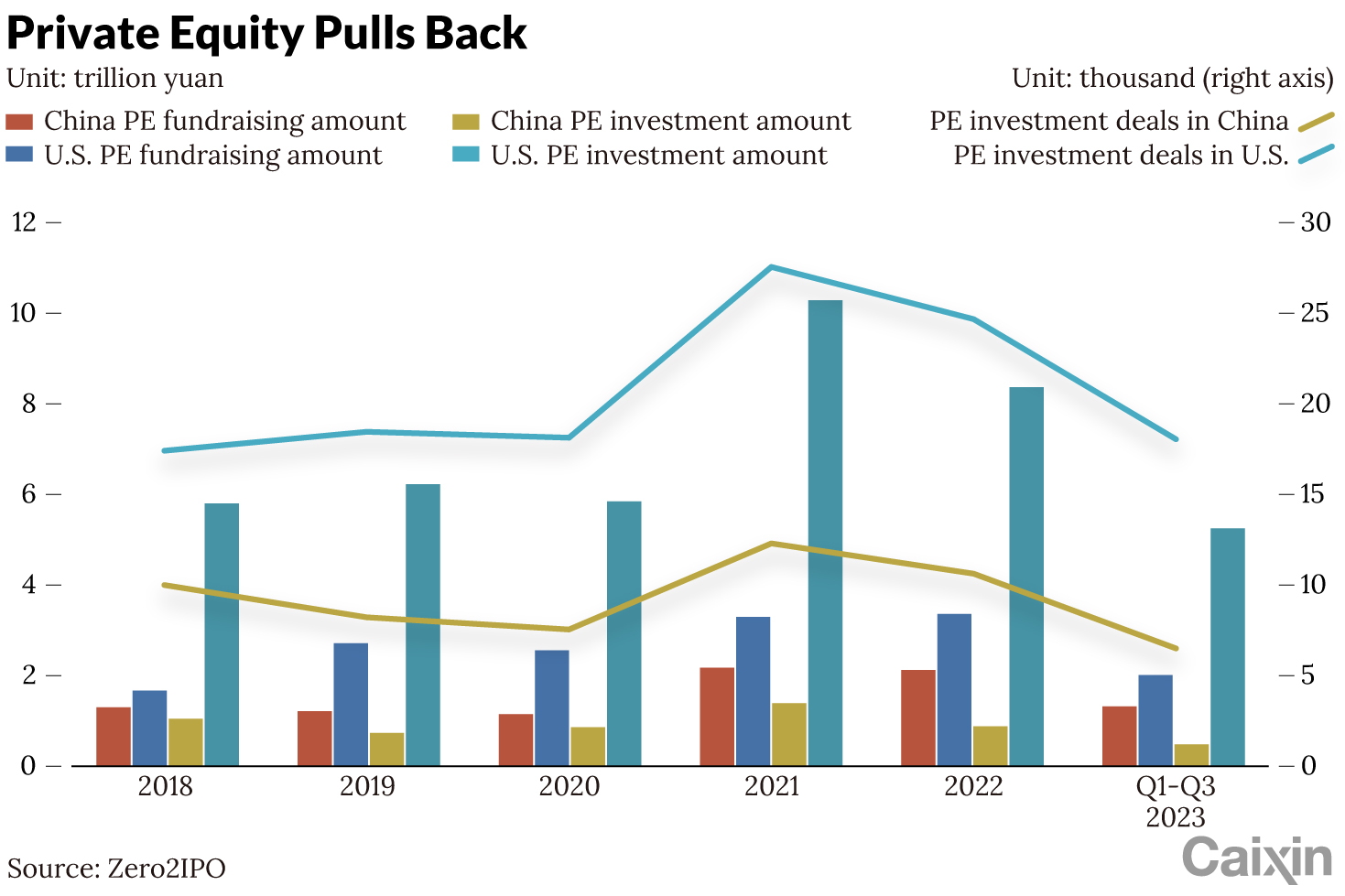
Global private equity deployment inside mainland China has effectively flatlined, marked by periods where zero foreign buyout deals are recorded within measured quarters. Media commentary frequently diagnoses this phenomenon through sentiment-driven phrases like "not worth the squeeze," attributing the contraction entirely to geopolitical friction or shifting regulatory moods. This diagnosis mistakes surface-level friction for structural insolvency.
The retreat of international buyout capital is not a temporary emotional reaction to regulatory noise. It is the rational mathematical output of a broken liquidity loop. When exit channels via domestic initial public offerings and cross-border trade sales close simultaneously, the private equity model fails at its foundational unit economic level: capital return.
To understand why international general partners have stopped writing checks in the Chinese market, one must deconstruct the private equity value chain into its three operational constraints: entry valuation mechanics, operational value creation limitations, and exit velocity.
The Valuation Disconnect and Currency Controls
The historical thesis for investing in Chinese growth companies relied on a simple arbitrage. Western capital brought institutional governance and scale to fragmented, high-growth domestic sectors, exiting later through high-multiple public listings on domestic exchanges like the ChiNext or overseas venues like the New York Stock Exchange.
That arbitrage collapsed under the weight of regulatory tightening and structural macroeconomic deceleration. On the entry side, foreign general partners face severe competition from state-backed guidance funds and domestic venture capital vehicles. These local entities often operate under different mandates, prioritizing national industrial policy, technological self-reliance, and employment metrics over immediate financial internal rates of return. Consequently, entry valuations remain inflated relative to the risk-adjusted cash flows foreign limited partners demand.
On the capital mobility side, foreign exchange controls administered by the State Administration of Foreign Exchange introduce severe friction. Repatriating capital, dividends, or exit proceeds requires navigating rigorous regulatory approvals. For a fund structured in US dollars with institutional investors expecting distributions within a standard ten-year lifecycle, the duration risk of trapped capital breaks the fund model. When the probability of currency conversion delays exceeds the expected alpha of the underlying asset, rational capital allocation dictates zero deployment.
The Operational Control Deficit
Value creation in mature private equity markets relies on operational intervention. General partners take controlling stakes, replace management teams, optimize supply chains, execute roll-up acquisitions, and drive margin expansion through rigorous financial engineering.
In China, foreign buyout funds have historically struggled to secure genuine operational control, particularly in sectors deemed strategically sensitive. Minority stakes remain the default transaction structure, leaving foreign investors exposed to key-person risk with founders while lacking the legal authority to pivot business models or restructure failing divisions during downturns.
Furthermore, the operational playbook that works in Western markets—leveraged buyouts utilizing domestic debt markets—is largely unavailable. Chinese commercial banks operate under strict macroprudential frameworks overseen by the People's Bank of China and the National Financial Regulatory Administration. Debt sizing for private equity buyouts is conservative, eliminating the leverage multiplier that historically drove a significant portion of Western private equity returns. Without the leverage lever and without controlling equity stakes, foreign general partners are reduced to passive minority shareholders absorbing asymmetric downside risk.
The Exit Bottleneck
The primary vulnerability of the current deployment strike is the exit bottleneck. Private equity is a recycling mechanism. Capital is called, deployed, grown, harvested, and returned to limited partners, who then reallocate portions of those distributions back into subsequent vintage funds.
When the harvest phase breaks, the entire engine stalls. The traditional exit ecosystem for foreign private equity in China relied on three primary conduits:
- Domestic initial public offerings
- Overseas initial public offerings
- Trade sales to strategic acquirers
Each of these conduits faces distinct structural impediments. Domestic regulators have systematically tightened rules on initial public offerings, extending review timelines, restricting listings for companies experiencing slower revenue growth, and discouraging capital extraction through public markets. Overseas listings for Chinese operating entities via variable interest entity structures face heightened scrutiny from both Chinese regulators aiming to prevent capital flight and data security leaks, and US regulators enforcing stringent auditing compliance through the Public Company Accounting Oversight Board.
Trade sales—historically the most reliable secondary exit route—have dried up due to the retreat of multinational corporations from cross-border acquisitions in China. Strategic buyers are increasingly pursuing localization strategies or outright de-risking supply chains rather than expanding footprint through domestic acquisitions.
Without a predictable path to monetization, holding periods extend indefinitely. For institutional limited partners such as pension funds and university endowments, an illiquid asset portfolio creates asset-allocation imbalances, forcing secondary market sales of Chinese private equity stakes at deep discounts to net asset value.
The Strategic Realignment of Global Portfolios
The current zero-deal quarters signal a permanent structural recalibration rather than a cyclical pause. Institutional capital is fungible. When the risk-adjusted return profile of one jurisdiction deteriorates past a specific threshold, capital migrates to alternative corridors offering clearer regulatory frameworks and unhindered exit velocities.
General partners managing existing portfolios in China are shifting their operational focus from value creation to asset wind-down, cash generation, and dispute resolution. New capital commitments to Greater China-focused USD funds have contracted to historic lows, with institutional allocators reallocating those mandates to India, Southeast Asia, or domestic North American and European strategies.
Future deployment inside the market will likely be restricted to domestic renminbi-denominated funds backed by state capital, operating within domestic policy parameters, and unconcerned with Western currency repatriation mandates. For global private equity, the era of deploying dollar-denominated institutional capital into Chinese corporate expansion has reached its structural limit, constrained not by sentiment, but by the immutable mechanics of liquidity.