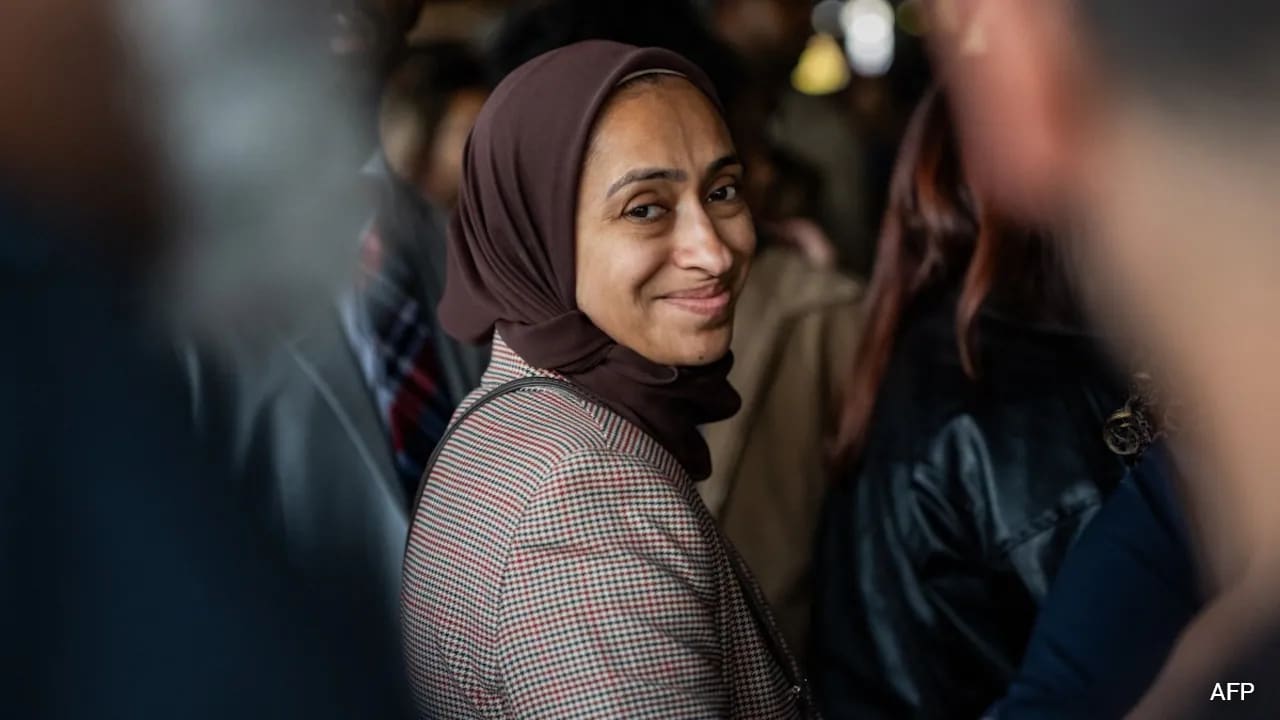
Media coverage of political spouses relies heavily on surface-level biographical summaries, frequently compounding factual inaccuracies to manufacture viral narratives. The competitor headline—"Meet Sarah Jukaku, Indian-Origin Wife Of America's First Muslim Senator Abdul El-Sayed"—commits multiple structural and factual errors before the reader reaches the first paragraph. First, it misidentifies Abdul El-Sayed's political office; El-Sayed is a physician, epidemiologist, former executive director of the Detroit Health Department, and former Michigan gubernatorial candidate, not a United States Senator (nor is he the first Muslim in Congress, a distinction belonging to Keith Ellison). Second, framing Sarah Jukaku strictly as an adjunct to a mislabeled political title obscures the operational reality of their household: a dual-career medical and public health partnership where clinical practice, academic medicine, and electoral politics intersect under strict regulatory and reputational constraints.
Analyzing Sarah Jukaku requires stripping away campaign-trail mythmaking and evaluating the concrete variables that define her career, her background, and her role within high-stakes American politics. When a clinical practitioner enters the orbit of statewide political campaigns, three distinct operational systems collide: medical credentialing and clinical liability, cross-cultural coalition building, and family resource allocation under public scrutiny.
Deconstructing the Factual Record Versus Viral Misinformation
Viral political profiles routinely sacrifice accuracy for search-engine bait. Correcting the baseline record establishes the actual scope of Jukaku's career and her husband's public trajectory.
- Clinical Identity and Medical Specialization: Sarah Jukaku is a practicing physician specializing in psychiatry. She earned her Doctor of Medicine (MD) and completed her residency training in psychiatry, establishing a clinical career independent of electoral cycles. Unlike political spouses who pivot into campaign management or non-profit consulting, Jukaku maintained active clinical responsibilities throughout her husband's tenure in municipal government and his 2018 run for Governor of Michigan.
- Cultural and Geographic Origin: Jukaku is of Indian heritage, raised in Michigan. Her family background reflects the post-1965 wave of South Asian professional migration to the American Midwest—specifically physicians, engineers, and academics who settled in suburban Detroit and Ann Arbor. Abdul El-Sayed, born in Detroit to an Egyptian-American father and an American mother from Gratiot County, Michigan, represents a distinct demographic trajectory. Their marriage unites two separate streams of the American Muslim experience: South Asian immigrant professional networks and second-generation Arab-American/Midwestern roots.
- The Political Office Correction: El-Sayed served as Detroit's Health Director from 2015 to 2017, becoming the youngest health officer in a major U.S. city, before launching a progressive campaign in the 2018 Michigan Democratic gubernatorial primary, where he finished second to Gretchen Whitmer. Labeling him "America's First Muslim Senator" conflates state-level executive candidacy with federal legislative office. Understanding Jukaku's public role requires evaluating her within the context of a Michigan gubernatorial primary and progressive municipal governance, not the U.S. Senate.
The Dual-Physician Household in Electoral Politics
Managing a household where both partners hold medical degrees introduces structural friction that standard political biographies ignore. In economics, this is a classic time-allocation and human-capital optimization problem. Medicine demands rigid, non-negotiable physical presence, strict compliance with patient confidentiality laws (HIPAA), and continuous credential maintenance. Electoral politics demands total schedule fluidity, radical public transparency, and constant media availability.
Asymmetric Schedule Constraints
A gubernatorial campaign operates on a 16-hour daily cycle driven by fundraising deadlines, town halls, and rapid-response media appearances. Clinical psychiatry operates on fixed appointment blocks where continuity of care is an ethical and legal mandate. When El-Sayed resigned from the Detroit Health Department in early 2017 to campaign full-time, the household experienced an immediate income compression alongside a spike in logistical overhead. Jukaku's continued clinical work functioned as the financial stabilizer for the family unit, absorbing the opportunity cost of El-Sayed's unpaid campaign labor.
Clinical Boundaries Under Public Scrutiny
Psychiatrists face unique reputational vulnerabilities when thrust into public life. The therapeutic alliance depends on neutrality and strict boundary maintenance. When a psychiatrist becomes a public political figure by association, two risks emerge:
- Transference and Patient Selection Bias: Prospective patients may seek out or avoid the clinician based entirely on political alignment rather than clinical fit, complicating the intake and diagnostic process.
- Opposition Research Exposure: Statewide campaigns subject candidates and their immediate families to aggressive opposition research. For a practicing physician, this means every licensing filing, academic publication, and institutional affiliation is audited by political operatives looking for regulatory infractions or ideological vulnerabilities.
Jukaku navigated this by maintaining a clear operational firewall between her medical practice and campaign strategy. While she appeared at select campaign events and spoke about healthcare access from a practitioner's perspective, she avoided assuming formal campaign titles or blurring her clinical identity with political messaging.
Demographic Signaling and Coalition Mechanics
In modern electoral politics, a candidate's spouse is rarely viewed merely as a private citizen; political strategists analyze them as a demographic signal that either expands or constrains the candidate's voter coalition. In Michigan—a state with one of the largest Arab-American populations in the United States alongside a rapidly growing, high-propensity South Asian voter bloc—the El-Sayed–Jukaku partnership carried measurable structural weight.
Bridging Intra-Community Divides
American Muslim voters are not a monolith. Historically, political organizing in Southeast Michigan has exhibited clear fault lines between Arab-American communities (concentrated in Dearborn, Dearborn Heights, and parts of Wayne County) and South Asian Muslim communities (concentrated in Oakland and Washtenaw Counties, including Troy, Canton, and Ann Arbor). These groups often maintain separate mosques, distinct civic organizations, and divergent socioeconomic priorities.
Jukaku's Indian heritage and deep ties to Michigan's South Asian medical and civic networks provided El-Sayed with organic entry points into communities that might otherwise have viewed an Egyptian-American candidate from Detroit as an outsider. Rather than relying on paid field organizers to build trust from scratch, the campaign benefited from pre-existing social capital. In network theory, Jukaku acted as a high-trust bridge node connecting two dense, otherwise loosely coupled social graphs.
Countering Monolithic Stereotypes
Mainstream political coverage frequently flattens Muslim candidates into single-issue caricatures centered on foreign policy or religious orthodoxy. The visual and biographical reality of two Michigan-raised physicians—one of Egyptian and European-American descent, the other of Indian descent—disrupted standard media framing. It anchored the campaign in recognizable Midwest professional norms: public education (both attended the University of Michigan), medical service, and suburban-urban civic engagement.
The Structural Limitations of Spousal Capital
Relying on a spouse's professional credibility and demographic reach has hard operational limits. Campaign strategists often overestimate how much spousal biography transfers to ballot-box conversion, leading to misallocated resources.
- The Turnout Ceiling: High affinity within niche professional or ethnic networks does not automatically scale to statewide primary victory. While Jukaku's network accelerated early fundraising and volunteer recruitment among South Asian professionals and healthcare workers, those demographics represented a fraction of the total Michigan Democratic primary electorate.
- Vulnerability to Bad-Faith Framing: The very attributes that make a cross-cultural, dual-physician couple compelling to base voters make them targets for disinformation. During the 2018 cycle, El-Sayed faced coordinated smear campaigns attempting to link him to extremist organizations. A spouse's background provides zero insulation against bad-faith narrative attacks; in some cases, media outlets amplify false claims simply by repeating them in fact-check headlines—much like the competitor article's fabrication of a U.S. Senate seat.
- The Burnout Equation: Sustaining a medical career while supporting a statewide political campaign—especially while parenting a young child, as the couple welcomed their daughter Emmeline during the 2018 campaign cycle—creates severe cumulative fatigue. The physical and cognitive toll of postpartum recovery, clinical practice, and campaign travel imposes a finite runway on how aggressively a political family can contest consecutive election cycles.
Evaluating Political Biographies With Analytical Rigor
When assessing figures like Sarah Jukaku, analysts and readers must separate verifiable institutional records from algorithmic content farming. The proliferation of AI-generated or poorly researched biographical articles—evidenced by headlines inventing non-existent Senate seats—degrades public understanding of how modern political coalitions actually function.
To accurately evaluate the intersection of clinical careers and public office, apply a strict verification filter:
- Audit Institutional Credentials First: Verify medical licenses, academic appointments, and exact political offices held through primary state registries and official election filings before accepting media summaries.
- Map Resource Flows Over Rhetoric: Look at how a political household manages income, childcare, and career continuity during a campaign. Who maintains employment, and who absorbs the financial risk, reveals far more about household dynamics than staged campaign profiles.
- Measure Network Effects, Not Symbolism: Evaluate a political spouse's impact through concrete coalition mechanics—fundraising clusters, geographic reach, and institutional endorsements—rather than relying on vague cultural platitudes.
As progressive and minority candidates continue to build electoral infrastructure in battleground states like Michigan, dual-career households will become the operational norm rather than the exception. Media outlets that fail to distinguish between a municipal health director, a gubernatorial candidate, and a U.S. Senator will continue to misread the electorate, while rigorous observers will focus on the underlying professional networks and institutional trade-offs that actually drive political viability.


