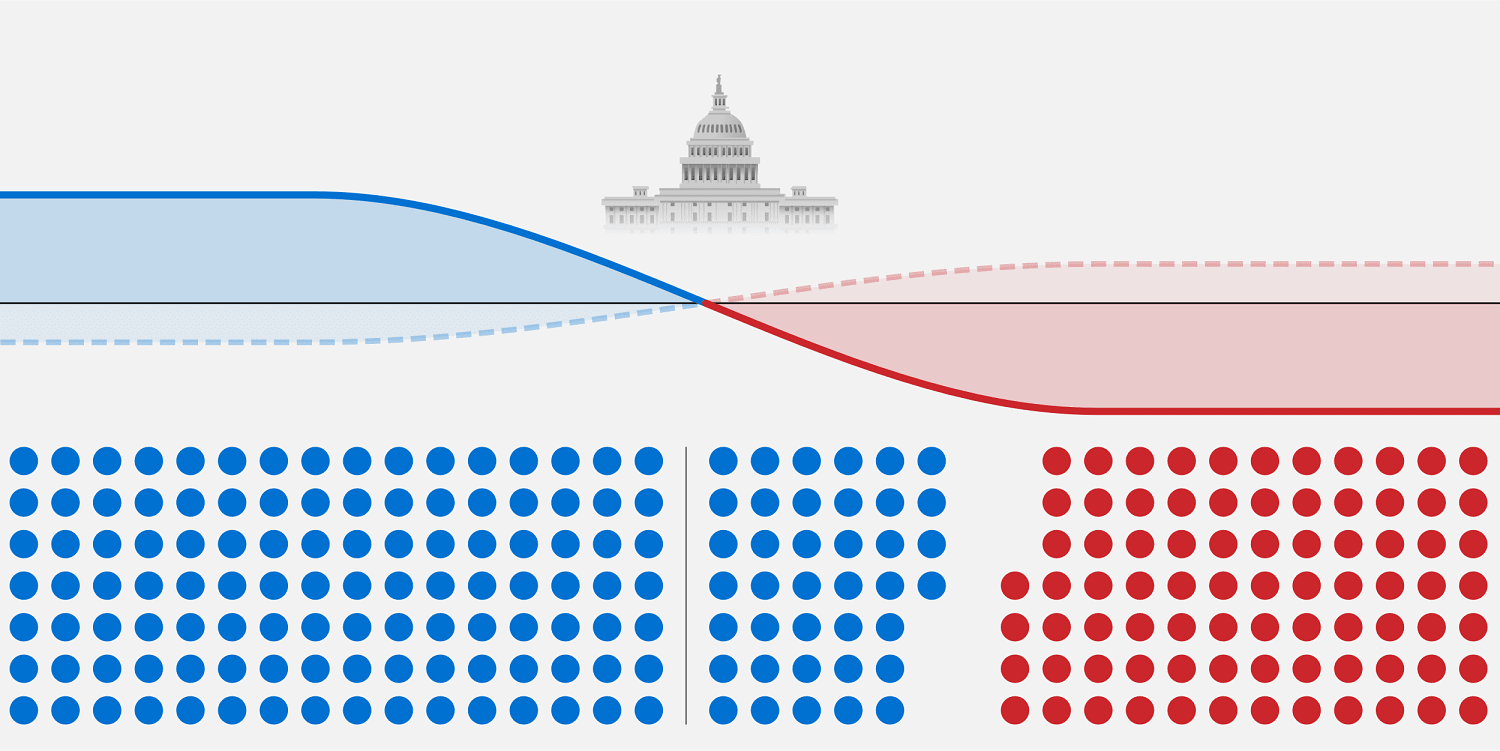
Everybody loves a dramatic election night map. Pundits point at glowing red and blue touchscreens, tossing around words like "tsunami" and "realignment" before half the precincts on the West Coast have even closed.
Honestly, most of that noise misses the actual mechanics of how the U.S. House of Representatives changes hands. For a more detailed analysis into similar topics, we suggest: this related article.
Winning control of the House isn't about sweeping the nation in a grand ideological shift. It's a gritty, district-by-district street fight fought on razor-thin margins across fewer than thirty truly competitive seats. Because gerrymandering and geographic sorting have locked down roughly 85% of the 435 congressional districts well before a single ballot is cast, the battle for the gavel comes down to a tiny sliver of suburban swing districts and rural crossover seats.
If you want to understand how Democrats take control, how Republicans defend their turf, and where the early warning signs of a political wave actually show up, you have to ignore national polling averages. You need to look at the math of the map. For broader details on this development, comprehensive coverage can also be found on NBC News.
The Structural Reality of Modern House Maps
Let's clear up a massive misconception first. National generic ballot polls—those surveys asking voters whether they'd prefer a generic Democrat or a generic Republican in Congress—don't translate cleanly into seats.
Not anymore.
Because Democratic voters are heavily concentrated in dense urban centers, they routinely run up massive margins in cities like New York, Chicago, and Los Angeles. Those extra tens of thousands of votes don't win extra seats. Meanwhile, Republican voters are spread more efficiently across exurban and rural counties, giving the GOP a built-in structural advantage in the median congressional district.
I've watched election cycles where one party wins the national popular vote by two or three points and still comes up short on seat count. To flip the chamber, Democrats generally need to clear a higher popular-vote bar than Republicans do just to break even. The exact threshold shifts slightly every decade after redistricting, and court-ordered map redraws in states like New York, North Carolina, Alabama, and Louisiana constantly tweak the baseline. Still, the fundamental rule holds: Democrats have to win the national mood decisively, while Republicans can survive a tie.
How Democrats Win the House
For Democrats to claim the majority, they don't need to convert deep-red rural counties. They just need to execute a very specific, geographically targeted playbook that relies on three pillars.
Sweeping the Biden-District Republicans
The single clearest path to a Democratic majority runs straight through suburban districts that voted for Joe Biden in 2020 (or Kamala Harris in 2024) at the presidential level, yet elected a Republican to the House.
Think about districts in the New York City suburbs—places like New York's 4th or 17th districts—or agricultural-suburban hybrids in California's Central Valley and Orange County, like CA-13, CA-22, CA-41, and CA-45. In these seats, ticket-splitting voters gave the GOP a chance because they were frustrated with inflation, local crime narratives, or border policies.
Democrats win the House when they nationalize those local races and tie incumbent Republicans directly to the most polarizing figures and policies of the national GOP. When turnout in presidential years surges among younger voters, college-educated suburbanites, and occasional voters in these blue-leaning districts, moderate Republicans get swamped by the top of the ticket. In midterm cycles, Democrats rely on a different dynamic: high-propensity voter enthusiasm. College-educated suburban women have become the most reliable midterm voting bloc in American politics, and when they show up angry about reproductive rights or governance chaos, those crossover GOP seats evaporate fast.
Maximizing Court-Ordered Redistricting Gains
Sometimes, the map itself hands a party a gift before campaigning even begins. Legal battles over the Voting Rights Act and state-level partisan gerrymandering have reshaped several state maps in recent cycles.
When federal courts forced Alabama and Louisiana to draw second majority-Black districts, those rulings effectively created two near-automatic pickups for Democrats in the Deep South. On the flip side, Republicans squeezed three extra seats out of North Carolina after the state's newly conservative Supreme Court reversed a prior ruling and allowed aggressive partisan lines.
Democrats can't afford to leave a single court-created opportunity on the table. Winning the House requires banking every favorable map adjustment in states like Alabama, Louisiana, and New York while holding the line against GOP map advantages in Texas, Florida, and Ohio.
Solving the Non-College Voter Bleed
Here's the quiet vulnerability that keeps Democratic strategists awake at night. Over the last decade, Democrats have bled support among working-class voters without a four-year college degree—and that erosion is no longer limited to white rural voters.
Data from the Pew Research Center and Catalist shows steady GOP gains among Hispanic and Black working-class men in urban and border districts. Look at South Texas (districts like TX-15 and TX-34) or working-class pockets of Nevada and Arizona. Democrats don't need to win non-college voters outright to take the House, because their margins among college graduates offset a lot of the damage. They do need to stop the bleeding. If Democratic candidates can keep their margins among Hispanic and Black voters close to historical norms through aggressive economic messaging on kitchen-table costs—housing, groceries, healthcare—they preserve the coalition needed to hold borderline seats in Nevada, Arizona, and Pennsylvania.
How the GOP Hangs On
Republicans play an entirely different game. Because the underlying geography favors them, the GOP path to holding the gavel is all about defense, turnout asymmetry, and localized messaging.
Mastering the "Local Moderate" Brand
How did Republicans like Mike Lawler in New York or David Valadao in California win districts that voted comfortably for a Democratic president? They refused to run like national cable-news conservatives.
To hang onto the House, vulnerable GOP incumbents have to build a distinct local brand. They vote against their own party on high-profile symbolic bills when it helps them back home, show up at every local diner and firehouse pancake breakfast, and hammer hyper-local issues like property taxes, state-level bail reform, or water rights. If a Republican incumbent in a blue-leaning district successfully convinces swing voters that they're an independent check on both parties rather than a rubber stamp for House leadership, they can outrun the top of the ticket by five to eight points. That cushion is often enough to survive.
Flipping Rural and Rust Belt Holdouts
While Democrats hunt in the suburbs, Republicans hunt in the remaining rural and industrial pockets still represented by Blue Dog or moderate Democrats.
Look at seats like Maine's 2nd District, represented by Jared Golden, or Washington's 3rd District, held by Marie Gluesenkamp Perez, or Alaska's at-large seat. These are places where Donald Trump won comfortably, yet voters kept a Democrat in Congress because that Democrat broke with their party on energy policy, gun rights, or border enforcement.
Republicans hold the House by relentlessly tying those moderate Democrats to the national party's progressive wing. You'll see millions of dollars in outside super PAC money from groups like the Congressional Leadership Fund flooding local airwaves with ads linking rural Democrats to San Francisco or New York politicians. The goal is simple: destroy the incumbent's independent reputation and force voters to vote their presidential preference down-ballot.
Winning the Turnout Differential
In low-turnout elections, enthusiasm is everything. Republicans have spent years building a turnout machine centered on cultural grievances, skepticism of institutions, and populist economic themes that resonate deeply in rural counties and outer-ring suburbs.
When the party out of power in the White House feels motivated—or when the party in power suffers from voter apathy—the electorate shifts noticeably older, whiter, and more conservative. Even in a presidential year, if the GOP drives up sky-high turnout in rural counties across Pennsylvania, Michigan, and Wisconsin while Democratic turnout lags in cities like Philadelphia, Detroit, and Milwaukee, Republicans don't just win swing districts. They knock off vulnerable Democratic incumbents in places like PA-7, PA-8, and MI-7.
Where to Look for an Actual Wave
Forget the national pundits shouting about waves in October. By the time a wave makes the Sunday morning talk shows, smart political analysts have already spotted it weeks earlier using a handful of specific bellwether indicators.
If you want to know on election night—or even before—whether one party is headed for a blowout, watch these four exact pressure points.
1. The East Coast Early Bellwethers (7:00 PM to 8:00 PM Eastern)
Because polls close on the East Coast first, a handful of early-reporting districts act as the canary in the coal mine for the entire country.
- Virginia's 7th District (Spanberger's old seat) and Virginia's 2nd District (Jen Kiggans): Northern Virginia exurbs and the Virginia Beach military corridor react immediately to national shifts. If the GOP candidate is comfortably ahead in VA-7 early in the night, Democrats are in for a brutal evening nationwide. Conversely, if Democrats are running up the score in VA-2, a blue wave is building.
- New Hampshire's 1st District (Chris Pappas): This swingy coastal district bounces back and forth between parties more reliably than almost anywhere else in New England. An early blowout here signals regional momentum across the Northeast.
2. The Suburbs of Philadelphia and Columbus
If you only watch two metro areas all night, make it the collar counties around Philadelphia (Bucks, Chester, Montgomery, and Delaware counties) and the suburban rings around Columbus, Ohio.
In Pennsylvania, PA-1 (Brian Fitzpatrick) and PA-7 (Susan Wild) sit right on the fault line of American politics. Fitzpatrick is one of the toughest bipartisan survivors in Congress; if a Democrat knocks him off, the Republican majority is dead. On the flip side, if Republicans sweep PA-7 and PA-8 in northeastern Pennsylvania, the GOP is cruising.
3. Special Election Overperformances Before November
You don't even have to wait for November to spot a wave. Political analysts like Elliott Morris and the team at The Cook Political Report track special elections held throughout the two-year cycle to fill vacant seats.
Individual special elections are noisy, sure. One weird candidate can skew a single race. Across a sample of ten or more special elections, though, the average partisan margin compared to the district's baseline presidential vote is arguably the single best predictor of the November environment. When one party consistently outperforms its presidential baseline by five to eight points in random special elections from Ohio to Florida, that's not a fluke. That's a measurable enthusiasm gap.
4. Cash-on-Hand Disparities in Tier-Two Races
Follow the money—specifically, look at where the Democratic Congressional Campaign Committee (DCCC) and the National Republican Congressional Committee (NRCC) cancel ad buys in October.
Party committees don't spend money out of charity. They rely on brutal, internal district-level polling. When you see a party suddenly pull $3 million in reserved TV ads out of a seat they currently hold—say, a Democrat abandoning an Iowa district or a Republican pulling the plug on a seat in upstate New York—they are triaging. Conversely, when a party suddenly dumps late October cash into a district rated "Likely" for the other side (districts with a baseline partisan lean of R+7 or D+7), that's the clearest sign on earth that a wave is expanding the playing field.
How to Track the Race Like an Insider
If you're following the battle for the House over the coming months, stop refreshing national generic ballot trackers every morning. They create more heat than light.
Instead, bookmark the district-by-district ratings from nonpartisan handicappers like The Cook Political Report with Amy Walter, Sabato's Crystal Ball, and Inside Elections. Filter their lists down to the Toss-Up column—usually around 20 to 25 seats—and pay close attention to which party holds more seats in that specific bucket. Whichever party has more incumbents sitting on the Toss-Up list is playing defense, and playing defense in a polarized electorate is exhausting.
Watch the third-quarter Federal Election Commission (FEC) fundraising reports in mid-October to see which challengers are actually raising enough small-dollar and PAC money to stay on the airwaves during the final stretch. And on election night, skip the pundit panels, pull up county-level vote returns in suburban Philadelphia, central California, and the Hudson Valley, and compare the margins directly to the last presidential race. You'll know who owns the House gavel hours before the networks make the call.