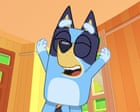
Seven o'clock on a Tuesday morning in a suburban living room smells like burnt toast, spilled milk, and the faint, plasticky scent of a couch cushion that has survived three years of toddlerhood. On the television screen, a six-year-old blue heeler puppy named Bluey is negotiating the complex, high-stakes rules of a game called Keepy Uppy with her sister, Bingo, and their endlessly patient father, Bandit.
For seven minutes, the frantic noise of the adult world stops. The bills sitting unopened on the kitchen counter fade away. The shouting matches on cable news dissolve. A parent sips lukewarm coffee and watches a cartoon dog teach a quiet, devastatingly tender lesson about empathy, imagination, and the fleeting magic of early childhood. For a deeper dive into similar topics, we recommend: this related article.
Now, picture that same living room a few hours later. The child is at daycare. The parent scrolls through a social media feed and suddenly sees that exact blue heeler—the same familiar snout, the same expressive eyebrows, the same vibrant palette of Brisbane sunshine—recast into a gritty, partisan political attack ad.
That jarring collision of worlds is no longer a hypothetical scenario. It is the exact flashpoint at the center of an escalating cultural and legal storm in Australia, where the Australian Broadcasting Corporation (ABC) is moving to demand that Pauline Hanson’s right-wing One Nation party immediately cease using unauthorized depictions of Bluey in a political cartoon series. To get more context on this development, in-depth coverage can be read at NBC News.
To understand why a public broadcaster is preparing to go to war over an animated dog, you have to look past the surface-level copyright infringement. On paper, this is a dispute about intellectual property, trademarks, and broadcast standards. In reality, it is a gut-level fight over what happens when modern political warfare refuses to respect the few remaining sanctuaries of shared cultural innocence.
The Anatomy of a Cultural Hijacking
When the ABC, alongside the show's creator Ludo Studio and commercial partner BBC Studios, labeled One Nation’s animated parody "shocking and disrespectful," the language wasn't chosen by accident. Corporate legal departments rarely use words like disrespectful. They prefer clinical terms like unauthorized derivative work or trademark dilution.
The emotional weight of the ABC’s response reflects a profound sense of violation. One Nation, known for its populist, nationalist platform and provocative media campaigns—most notably its long-running Please Explain satirical cartoon series—decided to pull Australia’s most beloved children’s export into the political mud. By co-opting the visual language and unmistakable likeness of Bluey to push partisan messaging, the party didn't just borrow a cartoon character. They hijacked an emotional shorthand that millions of families trust implicitly.
Consider how advertising and propaganda actually work on the human brain. We build cognitive walls against political messaging. The moment we hear the ominous brass music of a campaign ad or see the stern face of a politician at a podium, our skepticism flares up. We brace ourselves to be manipulated.
Children’s entertainment operates on the exact opposite frequency. A show like Bluey bypasses our defenses entirely because it is built on radical sincerity. Since debuting in 2018, the series has grown from a modest local production in Queensland into a global phenomenon, consistently ranking among the most-streamed programs on the planet. It achieved this not through cynical marketing, but by capturing the authentic, messy, deeply loving reality of modern family life. Parents don't just tolerate Bluey; they weep openly during episodes like "Sleepytime" and "Baby Race."
When a political party slips its ideology inside that familiar visual wrapper, it is attempting a Trojan horse maneuver on the public psyche. It uses the warmth, nostalgia, and safety associated with a children's show to smuggle divisive political talking points past the viewer's natural defenses.
The Blurred Line Between Satire and Exploitation
Of course, political cartoonists have been borrowing pop culture icons to skewer politicians for centuries. If you walk into any newspaper archive from the nineteenth century, you will find politicians drawn as characters from Shakespeare, nursery rhymes, and Dickens novels. In Australia, political satire is practically a national sport, protected by strong cultural norms and legal provisions for fair dealing.
This is where the argument gets complicated, and honestly, a little messy. Defenders of One Nation’s cartoon will inevitably point to the tradition of political parody. They will argue that in a free democracy, no cultural icon is above satire, and that a publicly funded broadcaster like the ABC shouldn't be in the business of policing political speech.
It is a fair point, up to a point. Satire is vital. A healthy democracy needs sharp elbows and irreverent humor to puncture the pomposity of those in power.
Yet there is a massive difference between mocking a politician and weaponizing a toddler's favorite character. Think of it like the difference between a street caricaturist sketching a mayor with exaggerated ears and a campaign worker printing political flyers on the back of a elementary school coloring book. One is commentary; the other is an intrusion into a space that society has collectively agreed should remain off-limits.
Under Australian copyright law, "fair dealing" for the purpose of parody or satire requires a genuine element of humor or critical commentary aimed at the work itself or the broader society, and it cannot unfairly exploit the original creator's commercial or moral rights. Legal experts who have watched similar battles play out over icons like Mickey Mouse or Peppa Pig note that the courts look closely at whether the parody creates confusion, tarnishes the reputation of the original work, or trades unfairly on its massive goodwill.
When a political party mimics the exact art style and character design of a preschool show to deliver partisan talking points, the line between commentary and exploitation vanishes. The creators at Ludo Studio spent years painstakingly crafting a world that feels safe for four-year-olds and deeply resonant for their parents. They intentionally kept Bluey free of heavy-handed political agendas so that families across the entire ideological spectrum—from inner-city progressives to rural conservatives—could sit on the same couch and laugh together.
That universality is Bluey’s superpower. In a fractured media ecosystem where algorithms constantly sort us into angry, isolated tribes, Bluey is one of the last remaining campfires where everyone is welcome. Dragging the Heeler family into a partisan food fight doesn't just violate a trademark. It threatens to poison the waterhole.
The Invisible Stakes for Parents and Creators
To truly grasp the fallout of this clash, step into the shoes of two different people caught in the crossfire.
First, imagine a hypothetical animator working late at night in Brisbane. Let’s call her Maya. Maya has spent five years drawing the subtle micro-expressions on Bingo’s face—the slight droop of an ear when she feels left out, the sudden wideness of her eyes when she discovers a walking leaf insect. Maya pours her own childhood memories and parenting anxieties into every frame, knowing that millions of kids around the world will watch her work before bedtime. When she wakes up to see her life's work twisted into a crude political attack ad, the feeling isn't just professional annoyance. It feels like watching someone spray-paint a slogan across the wall of a nursery.
Now, imagine a father in regional Queensland—let’s call him Dave. Dave works a tough physical job, doesn't spend much time analyzing media law, and genuinely loves watching Bluey with his twin daughters every evening. Maybe Dave agrees with some of One Nation’s policies, or maybe he can't stand them. Either way, when he opens his phone during his lunch break and sees Bluey acting as a mouthpiece for a political party, something breaks. The magic trick is ruined. The next time his daughters ask to put the show on, a tiny, unwelcome static of adult cynicism lingers in the back of his mind.
This is the hidden cost of hyper-politicization. When everything becomes a vehicle for political warfare—from the beer we drink to the cartoons our children watch—we lose the neutral ground required to remain a cohesive society. If we cannot even agree that a six-year-old cartoon dog belongs to the kids, what exactly is left?
Why the ABC Cannot Afford to Blink
The ABC’s decision to issue a formal demand to One Nation isn't merely about protecting a lucrative licensing empire, though the financial stakes are undeniably massive. Bluey is a multi-billion-dollar global brand whose merchandise, live stage shows, and streaming deals generate vital revenue that supports Australian arts and public broadcasting. Allowing any political faction to freely commandeer the brand would open the floodgates. Today it is One Nation; tomorrow it is a rival party, a mining lobby, or an activist group, until the characters are hollowed out into generic puppets shouting conflicting slogans.
More importantly, the public broadcaster has a statutory and moral obligation to protect the integrity of children's programming. Trust is the currency of public media. Parents hand over their children's attention to the ABC because they trust that the content has been vetted, cared for, and shielded from commercial and political manipulation. If the ABC fails to draw a hard, unmistakable line here, that implicit contract with Australian families begins to erode.
History shows that once a cultural boundary is breached without consequence, it rarely snaps back into place. During the rise of viral internet memes over the past fifteen years, countless independent artists watched their creations—from Pepe the Frog to various beloved comic characters—get absorbed, mutated, and weaponized by political movements until the original creators could no longer recognize their own work. Once an image becomes a political totem, it is nearly impossible to scrub the stain away.
The creators of Bluey and the executives at the ABC have clearly watched those cautionary tales unfold. They understand that you do not wait until the damage is irreversible to defend your creation. You step in immediately, forcefully, and publicly to sever the association before the mud dries.
The Sanctuary of Childhood
We live in an era that seems determined to accelerate adulthood, pushing adult anxieties, ideological battles, and tribal grievances down into younger and younger spaces. Screens follow us everywhere, carrying an endless stream of outrage into our pockets, our bedrooms, and our dinner tables.
Against that relentless tide, a seven-minute cartoon about a blue heeler playing shadowlands or learning how to ride a bike is not a trivial thing. It is a small, fiercely guarded miracle. It reminds adults how to slow down, listen, and inhabit the present moment with the people they love. It gives children a mirror that reflects their own small, magnificent worlds back to them with dignity and joy.
Politics has plenty of stages. It has parliament floors, press galleries, billboards, town halls, and endless hours of cable news airtime. It has more than enough oxygen to burn.
Tomorrow morning at seven o'clock, millions of living rooms will light up once again with the familiar, cheerful theme song of a family of cartoon dogs dancing in the living room. A toddler will laugh at a red balloon floating toward the ceiling, a parent will catch their breath before the rush of the workday begins, and for seven precious minutes, the world will remain entirely, mercifully pure.