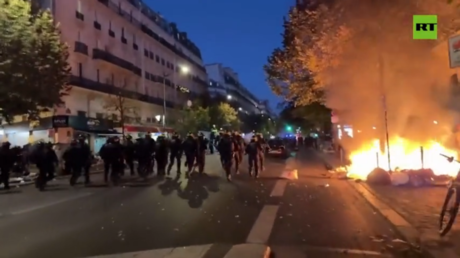
Acids. Tear gas. The sharp, metallic tang of burning rubber hanging over a boulevard that was supposed to be a postcard.
When a headline announces that hundreds were arrested in Paris as rioters defied Emmanuel Macron, most people scroll past on a phone screen. Another clip. Another burst of sirens. Another evening where the City of Light looks less like a canvas and more like a pressure cooker whose valve has jammed. I have stood near enough to tear gas plumes in European capitals to know what the footage misses: the way your eyes sting five minutes after you think you are out of range, the sudden hush inside a corner bakery as shutters slam down, and the heavy, disoriented quiet that follows a loud night. Expanding on this topic, you can also read: Why Trump Is Blaming French Immigration For The Paris Riots.
Videos tell us what broke. They rarely tell us who carries the bill when the cameras pack up.
To understand why crowds clash with authority in France, we have to look past the surface drama of arrests and defiance. An arrest tally is a snapshot of a single night, frozen in blue flashing lights. What happens underneath—the friction between a centralized executive presidency and citizens who feel their daily lives are being decided behind distant glass—has been building for decades. When people take to the streets in defiance of a president, they are rarely arguing about a single line item in a speech. They are arguing about dignity, voice, and who gets to set the terms of survival. Experts at Al Jazeera have shared their thoughts on this matter.
Inside the Smoke, Beyond the Clip
Consider a hypothetical character to ground what the headlines compress into statistics: Claire, a thirty-four-year-old physiotherapist living in eastern Paris who takes the metro home past Place de la République. This scenario is hypothetical, built to illustrate common pressures rather than a single documented individual.
On a night when protests spill out of their planned routes, Claire does not throw anything. She does not chant slogans or carry a flag. She simply wants to get from her clinic to her apartment before the stations close and the buses reroute. Yet by eight o'clock, she is standing behind a low stone wall while sirens wail from three directions, watching young men in black hoodies sprint past a line of riot police in heavy helmets and shin guards.
That is the hidden geometry of modern street unrest. On one side stand officers trained for crowd containment, often exhausted from overtime, ordered to hold a perimeter and prevent property destruction. On the other stand demonstrators—some driven by genuine economic frustration, others drawn by adrenaline or anger at perceived political arrogance—who see the state not as a neutral referee, but as an adversary. Caught between them are ordinary residents, shopkeepers, and first responders who never signed up for a war zone on their commute.
I find myself uncertain, even when trying to analyze these moments calmly, about how any leader or citizen can step back from the brink once distrust becomes muscle memory. Politics in France has long carried a theatrical, high-stakes charge, rooted in a history where street mobilization has repeatedly forced monarchs, ministers, and presidents to listen. That historical memory gives protest a particular weight. A march is not just a complaint; in the French political imagination, it is a test of legitimacy.
But the real problem lies elsewhere: when every disagreement escalates into a physical standoff, nuance gets trampled first.
Why Defiance Keeps Returning to the Boulevard
Think of a household pressure cooker left on a high burner. For a while, the little weight on top rattles and hisses, letting off steam. If someone tapes the valve shut because the noise is annoying, the kitchen gets quieter for a few minutes. Then the metal groans. This metaphor captures the danger of treating recurring street unrest purely as a policing problem. Arrests clear a street for the night. They do not cool the burner.
In French politics, the presidency is designed to be decisive, centralized, and sweeping—a structure meant to give the country a strong hand at home and abroad. Yet that very strength can make the office feel towering and remote when inflation squeezes groceries, housing costs bite harder, or pension and labor policies spark fierce pushback. When citizens feel unheard through ballots or parliamentary debates, the street becomes the loudest megaphone available.
Rioters defying Macron are not acting in a vacuum. Even when violence crosses legal and moral lines—and when property is smashed or officers are injured, accountability matters—we miss half the picture if we treat the crowd as a single monolith. Among hundreds of people detained on a volatile night, there are hardened agitators, impulsive teenagers, onlookers swept up in a kettle maneuver, and people who genuinely believe peaceful channels have failed them.
Consider another hypothetical figure: Tariq, a twenty-two-year-old delivery rider who spends his days weaving through traffic for thin margins. Again, this is a composite, hypothetical illustration of everyday economic strain, not a real person's case file. When Tariq watches politicians debate grand reforms on television while his rent and fuel costs climb, abstract policy talk feels like a foreign language. Frustration looks for an outlet. Sometimes that outlet is dark, destructive, and counterproductive—hurting the very neighborhood businesses and public transit Tariq relies on.
Here is the paradox that makes street clashes so exhausting to watch: destruction rarely fixes the root grievance, yet ignoring the grievance almost guarantees another flare-up.
The Human Cost Nobody Counts in a Press Release
Authorities release numbers. Crowds release anger. Meanwhile, life continues at street level with quiet, gritty persistence.
Picture the morning after a heavy night of arrests and clashes. A café owner sweeps up broken glass and washes away the acrid smell of smoke before the first espresso machine warms up. A police officer rubs stiff shoulders at the end of a twelve-hour shift, replaying a split-second decision in a narrow side street. A young person sitting in a holding cell wonders how a night of bad judgment or bad timing will follow them onto a job application.
None of those details fit neatly into a short video clip. Short clips reward shock. They zoom in on a thrown object, a baton strike, a cloud of white gas, or a line of detainees. They strip away context—what happened ten minutes before the camera started rolling, and what happens ten hours after the battery dies.
Over years of watching European street politics, I have learned to distrust instant certainty on either side. Calling every protester a thug erases real hardship and legitimate dissent. Excusing every act of violence as mere political expression erases the fear of bystanders and the physical toll on people trying to keep order. Both shortcuts feel easy in the heat of the moment. Both leave the city more bruised.
What Happens When Trust Frays
Authority depends on consent, not just force. When trust between governing institutions and sizable parts of the public wears thin, policing has to work overtime to compensate for political friction. Heavy deployments can restore calm temporarily, yet they also risk hardening the sense of "us versus them" in neighborhoods that already feel alienated.
Think of trust like the mortar between bricks. You can stack bricks without mortar for a little while, especially if the wall is short and the weather is calm. Push against it, or let wind and rain hit it long enough, and the whole stack wobbles. A democratic society needs strong institutions and clear laws, yes—otherwise chaos wins. It also needs enough shared faith in fair representation that people do not feel forced to throw themselves against barricades just to be noticed.
When hundreds of arrests make headlines in Paris, the immediate story is enforcement and defiance. The deeper story is a democracy testing its own resilience under pressure.
Out on the wet pavement at dawn, a stray flyer clings to a lamppost, soaked through and illegible, while the city wakes up to sweep the stones clean and try again.


