The kettle does not care about artillery.
Even when the windows rattle in their frames and the dust shakes loose from the ceiling plaster in gray, choking ribbons, water still boils at one hundred degrees Celsius. You learn that quickly when the sirens become background noise. You learn to measure time not by the clock on the wall, which stopped ticking three blackouts ago, but by the intervals between the low, percussive thuds on the edge of town.
Consider a hypothetical woman named Nadia. Let us place her in a third-floor apartment in a city under siege—it could be Kharkiv, it could be Gaza City, it could be Khartoum. Nadia is thirty-four. She is a civil engineer by training, though right now her primary profession is keeping two children quiet inside a reinforced hallway while the sky outside turns the color of a fresh bruise.
When a mortar shell strikes the bakery two streets over, Nadia does not become a statistic immediately. First, she becomes a mother trying to find clean water to wash powdered concrete out of her daughter's hair. She becomes a daughter trying to carry her seventy-year-old mother down four flights of unlit stairs because the elevator shaft is now a chimney for smoke. And if the next shell lands fifty meters closer, Nadia becomes part of a number that United Nations analysts will spend six months verifying, cross-referencing against hospital morgue logs and satellite imagery, before publishing in a sober, double-spaced report that almost nobody outside Geneva will read past the headline.
Here is the headline they missed: the proportion of women and girls killed in armed conflict has doubled.
Doubled.
Say the word out loud. Let it sit in the room. It is not a gradual creep upward, not a statistical anomaly caused by better record-keeping in a single region. Between 2021 and 2023, the share of female fatalities in war zones surged from roughly two in ten to four in ten. According to data compiled by the United Nations Entity for Gender Equality and the Empowerment of Women, tens of thousands of women and girls were killed directly by bombs, bullets, and drones in a single twelve-month span—a figure that makes a mockery of every international treaty drafted since the ashes of 1945 cooled.
We have a habit, when reading news from war zones, of letting big numbers anesthetize us. Our brains are simply not wired to grieve in multiples of ten thousand. Evolution built us to care about the person standing across the fire, not an Excel spreadsheet of casualties from three continents away. So when a report announces that conflict-related deaths among women have doubled, we nod, feel a brief, sharp pang of helpless sympathy, and scroll down to see what the weather will be like on Thursday.
That numbness is a luxury. And for the women living inside those numbers, it is a death sentence.
The Architecture of Modern Battlefields
To understand why women are dying at twice the rate they were just a few years ago, you have to look at where wars are fought today.
For centuries, war had a terrible, rigid geometry. Men marched out to fields, valleys, or trenches away from the town square. Civilians suffered—through famine, through occupation, through the brutal aftermath of defeat—but the actual mechanics of industrialized slaughter were largely concentrated on designated front lines. Even in the twentieth century, when aerial bombardment brought fire to London, Dresden, and Tokyo, there remained a nominal distinction in military doctrine between the soldier in uniform and the woman hanging laundry on a balcony.
That distinction has collapsed.
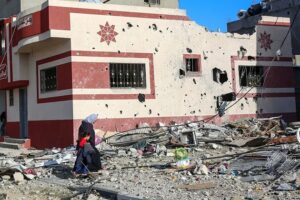
Modern warfare has moved into the kitchen. It has moved into the maternity ward, the primary school, the crowded open-air market where women gather at seven in the morning because that is the only hour the curfew lifts. Today's conflicts are overwhelmingly urban, fought with heavy explosive weapons in densely populated neighborhoods where walls are thin and basements are scarce.
Think of a modern city under bombardment as a pressurized glass bottle. When high-explosive munitions detonate inside an urban grid, the blast wave does not dissipate harmlessly into open air; it ricochets off concrete, shatters glass into thousands of supersonic blades, and brings entire apartment blocks down on top of the people least likely to have fled.
And who stays behind when a city empties?
It is rarely the young, unencumbered, and mobile. It is the women. They stay because someone has to tend to the bedridden grandmother who cannot survive a three-day journey on the back of a flatbed truck. They stay because they are eight months pregnant and the nearest functioning clinic is forty kilometers away across a checkpoint manned by teenagers with automatic rifles. They stay because children need routine, need food, need a familiar bed to keep the terror from swallowing them whole.
When you drop a two-thousand-pound bomb onto a residential neighborhood, you are not hitting a strategic abstraction. You are hitting the exact demographic most likely to be indoors at two in the afternoon.
I remember speaking once with a trauma nurse who had worked three rotations in conflict hospitals across the Middle East. She told me you could tell the time of day a strike happened just by looking at the triage ward. Early morning meant laborers and bakers. Late afternoon meant children walking home from makeshift classrooms. Midday meant women. Always women. They came in covered in flour from kneading dough, or clutching plastic bags of lentils, their bodies torn apart by shrapnel because they had stepped out onto a balcony to check on a neighbor.
The Deaths That Never Make the Ledger
Yet the doubling of direct fatalities—horrific as it is—is only the visible tip of a much darker iceberg.
United Nations casualty figures count the bodies pulled from the rubble. They count the gunshot wounds, the drone strikes, the roadside mines. What they struggle to capture, and what rarely makes the evening broadcast, is the slow, silent attrition that follows the gunfire.
Consider what happens next when a hospital loses power.
In every active war zone from Sudan to Myanmar to Gaza, healthcare infrastructure is among the first casualties. Sometimes it is destroyed by direct strikes; other times it simply starves to death—run out of diesel for the generators, out of anesthesia, out of sterile sutures, out of clean water. For a healthy twenty-five-year-old man, a lack of obstetric care is an abstract policy failure. For a woman in obstructed labor, it is an agonizing, preventable execution.
Right now, across global conflict zones, hundreds of women die every single day from complications of pregnancy and childbirth. Not from shrapnel. Not from sniper fire. They bleed to death on the floors of darkened clinics or in the backseats of stalled cars because the ambulance could not get clearance to cross a military checkpoint, or because the only surgeon in the district fled six months ago.
Let us return to our hypothetical Nadia for a moment. Suppose she survives the blast at the bakery. Suppose her apartment building stays standing. Now introduce a different kind of crisis: her youngest child develops a fever, and Nadia herself is seven months pregnant with complications that require a simple, routine blood transfusion.
In peacetime, this is a minor medical inconvenience. In a conflict zone, it is a labyrinth with no exit. The local blood bank was looted in the first week of fighting. The pharmacy shelves are bare. Nadia walks three miles in the heat, past burned-out vehicles and cratered asphalt, only to find the maternity ward has been converted into a surgical trauma unit for wounded fighters. There are no beds for mothers. There is no insulin, no antibiotics, no clean gauze.
When Nadia dies three weeks later from an infection that a ten-dollar course of penicillin would have cured, her death certificate—if one is ever issued—will say sepsis. It will not say war. It will not be added to the United Nations tally of conflict fatalities. Yet without the war, she would have lived to see her grandchildren.
This is the invisible math of modern conflict. The bombs kill fast, and the cameras record them. The collapse of everything that sustains female life kills slowly, in silence, behind closed doors.
Weaponizing the Body
There is another truth we must confront, uncomfortable as it is to read over morning coffee. In contemporary conflicts, women are not merely caught in the crossfire. Increasingly, they are the target.
Sexual violence has accompanied armies since the dawn of recorded history, treated for millennia as an inevitable, ugly byproduct of conquest. Today, it is deployed with cold, bureaucratic precision as a weapon of war. Verified cases of conflict-related sexual violence have surged by fifty percent in recent years, and every researcher on the ground will tell you that for every woman who survives to report an assault, dozens more are silenced by trauma, stigma, or death.
Why do armed groups use sexual violence systematically? Because it works.
It destroys the social fabric of a community faster and more cheaply than artillery. When fighters assault women in front of their families, they are not acting out of uncontrolled impulse; they are executing a strategy designed to humiliate, terrorize, and permanently fracture a population so that it will flee its land and never return. A displaced community does not organize resistance. A traumatized family does not rebuild.
And even when the physical violence ends, the architecture of impunity ensures the suffering continues. In almost every major conflict today, perpetrators walk free while survivors are left without medical care, without legal recourse, and often shunned by the very communities they tried to hold together.
The Illusion of the Peace Table
If you want to understand why this crisis keeps accelerating, look away from the battlefield for a moment and look instead at the rooms where wars are supposedly ended.
Picture a grand conference hall in a neutral European capital. Heavy oak tables, bottled water, simultaneous translation headsets, flags lined up in neat alphabetical order. Inside this room, men in dark suits—men who ordered the airstrikes, men who armed the militias, men who profited from the blockade—sit across from one another to negotiate a ceasefire.
Where are the women?
In 2000, the United Nations Security Council passed Resolution 1325, a landmark commitment recognizing that women are disproportionately affected by war and must be central to preventing and resolving it. Twenty-six years later, that promise looks like a museum piece. In major peace negotiations around the world, women still account for less than ten percent of negotiators. In several recent high-stakes ceasefires and political transitions, they accounted for zero.
This is not a matter of polite representation or checking a diversity box. It is a matter of survival.
When women are excluded from peace tables, the resulting agreements reflect the priorities of the men who fought the war. They focus on troop movements, border demarcation, power-sharing ministries, and amnesty for commanders. They routinely ignore the things that actually keep civilians alive: humanitarian corridors for medical supplies, the clearance of unexploded ordnance from agricultural fields, accountability for sexual violence, and funding for maternal healthcare.
History offers brutal proof of what happens when you build peace without the people who survived the war. Peace treaties signed exclusively by armed men fail at staggering rates—often collapsing back into violence within five years. Conversely, when women are meaningfully involved in peace processes, the resulting agreements are thirty-five percent more likely to last at least fifteen years.
Why? Because women who have spent years keeping children alive in basements do not negotiate for abstract political prestige. They negotiate for water, for schools, for safe passage, and for justice. They know that a ceasefire on paper means nothing if a woman cannot walk to the well without stepping on a landmine.
Yet the international community continues to treat women's participation as an afterthought—a nice-to-have garnish once the "real" security issues have been settled by the men with the guns. Meanwhile, global military spending has climbed past two trillion dollars a year, while funding for women's grassroots organizations in conflict zones remains a rounding error, shrinking even as the body count climbs.
What the Numbers Demand of Us
It is easy to feel paralyzed by the scale of this. When you look at the map of the world right now—Sudan spiraling into famine and ethnic slaughter, Gaza reduced to gray rubble, Ukraine locked in grinding attrition, Haiti, Myanmar, the Democratic Republic of Congo—the suffering feels infinite, and our leverage feels microscopic.
That paralysis is precisely what keeps the machinery turning.
The doubling of women's deaths in war is not an act of God, like an earthquake or a monsoon. It is the direct result of human choices. Choices about which weapons to sell and to whom. Choices about whether to enforce international humanitarian law when an ally bombs a hospital, or whether to look the other way because it is diplomatically inconvenient. Choices about who gets a seat at the table when the shooting stops, and whose organizations get funded when the cameras pack up and leave.
We have spent decades building an intricate legal framework—the Geneva Conventions, the Rome Statute, Security Council resolutions—designed to put a fence around human brutality. Right now, that fence is trampled flat, and the people paying the price are mothers, daughters, grandmothers, and girls who never picked up a rifle in their lives.
Think back to Nadia in her dark hallway, listening to the kettle whistle over the rumble of distant artillery. She does not want our pity. Pity does not rebuild a maternity ward, clear a minefield, or put a female negotiator in a conference room in Geneva.
She needs the rules of war to mean something again. She needs the world to stop treating the death of four women out of every ten war casualties as an unfortunate footnote to geopolitics.
The kettle is boiling. The ceiling dust is still falling. And somewhere, another analyst is opening a fresh spreadsheet to count the dead.