The fluorescent lights in a Jerusalem hospital hallway hum at a frequency that gets into your teeth by four in the morning. If you have ever sat on one of those vinyl chairs waiting for a surgeon to push through the double doors, you know the specific, hollow quiet of a country holding its breath.
For years, that hallway has been the unofficial waiting room of the Israeli psyche. Every election cycle, every late-night Knesset vote, every siren cutting through the humid air of Tel Aviv or the dry chill of the Galilee feels like waiting for a doctor who never quite arrives with a clear diagnosis. You drink terrible coffee from a paper cup. You check your phone. You wonder if the person holding the scalpel actually knows how to stop the bleeding, or if they are just arguing over who gets credit for the incision. Meanwhile, you can read similar stories here: What Most People Get Wrong About Surviving a Tourist Hotspot Shooting.
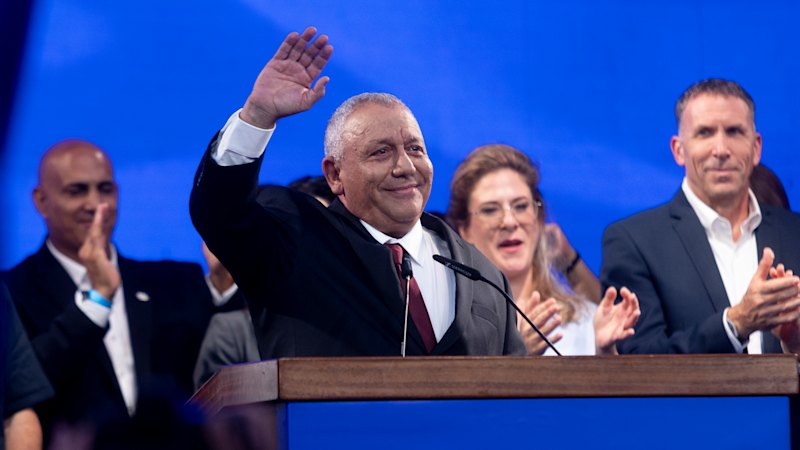
Now, the doors have swung open, and the man standing there is not the fiery orator who has dominated the stage for nearly two decades. It is Gadi Eisenkot.
When Israel’s president formally tapped opposition candidate Gadi Eisenkot to form a government, handing a sharp political setback to Benjamin Netanyahu, the wire services treated it like a chess move. A bishop traded for a rook. A shift in coalition math. They tallied the Knesset seats, noted the procedural deadlines, and moved on to the next headline. To explore the bigger picture, check out the excellent report by BBC News.
They missed the pulse of the room.
To understand what actually happened in Jerusalem, you have to look away from the podiums and look at the faces of the people watching from their kitchen tables in Beersheba, Haifa, and the evacuated communities along the northern border. You have to understand what it means when a nation exhausted by noise turns toward a man who speaks barely above a whisper.
The Weight of an Empty Chair
Politics usually rewards the loudest voice in the room, the performer who can turn a policy dispute into an existential crusade before the evening news goes to air. Benjamin Netanyahu built an entire era on that kind of theatrical gravity, mastering the art of survival in a parliamentary system designed to fracture. For years, even his fiercest critics privately admitted that nobody else knew how to work the levers of Israeli power quite like him.
Until the levers stopped moving the country forward.
Consider a hypothetical family—let’s call them the Mizrahis—living in a three-bedroom apartment in Rishon LeZion. Neither the husband, an electrical engineer, nor the wife, a high school history teacher, considers themselves a political activist. Three years ago, their dinner table arguments were about mortgage rates and summer vacations. Over the past few years, those conversations turned into low-grade dread. Reserve duty stretched from weeks into months. Businesses shuttered. Every television broadcast felt like a shouting match between tribes that no longer shared a dictionary, let alone a future.
For families like the Mizrahis, the news that the president bypassed Netanyahu to give Eisenkot the mandate to build a coalition isn't an abstract constitutional update. It is a sudden, disorienting change in barometric pressure.
Eisenkot does not look like a savior, and he certainly doesn't talk like one. A former Chief of Staff of the Israel Defense Forces, he carries himself with the heavy, deliberate posture of a man who has spent forty years reading terrain maps in the dark. He is the son of Moroccan immigrants who grew up in the port city of Eilat, far from the political salons of Jerusalem. He lost his son, Gal, and his nephew, Maor, in the brutal fighting in Gaza—a grief he wears not as a political badge, but as a quiet, permanent shadow behind his eyes.
When he speaks, there are no rhetorical fireworks. No viral soundbites crafted for social media algorithms. Just short, declarative sentences delivered with the flat cadence of an infantry commander giving a briefing before dawn.
In a country addicted to charisma, his plainness is the shock.
How the Math Actually Works
If you have never tried to assemble a ruling coalition in the Knesset, imagine trying to build a watch out of wet sand while twelve people argue over what time it is.
Israel uses a system of proportional representation where voters cast ballots for a party, not an individual candidate. Because the threshold to enter the 120-seat parliament is relatively low, no single party has ever won an outright majority in the nation's history. Every government is a patchwork quilt stitched together from ideological rivals, religious factions, centrist technocrats, and nationalist hardliners. To govern, you need at least 61 seats.
Think of the Israeli president’s role as the host of a high-stakes dinner party where half the guests refuse to sit next to each other. The president doesn't choose the prime minister; the president looks at the guest list, counts who has the best chance of keeping everyone at the table without flipping it over, and hands that person the seating chart.
For months, Netanyahu’s coalition looked like a fortress. Built on a narrow alliance of right-wing and ultra-Orthodox parties, it held together through sheer political discipline and mutual necessity. Even when public anger boiled over into massive street demonstrations, the parliamentary arithmetic refused to budge. Sixty-one seats is sixty-one seats, whether the streets are calm or on fire.
Then the fractures started showing.
Disputes over military conscription exemptions for ultra-Orthodox men—an issue that cuts straight to the bone of shared sacrifice in a nation at war—began eroding the trust holding the bloc together. Economic strain mounted as international credit agencies issued warnings and tech investment hesitated. Slowly, quietly, backchannel conversations began between opposition leaders and disillusioned members of the ruling camp.
When the president finally made the call, it was a recognition that Netanyahu’s path to a stable majority had narrowed to a hairline. By handing the mandate to Eisenkot, the presidency signaled that the center of gravity had shifted—not necessarily toward the left, and not toward a sudden ideological revolution, but toward a desperate search for competence.
The Trap of the Mandate
Here is the part that gets lost in celebratory headlines: getting tapped to form a government is not the same thing as becoming prime minister. In Israeli politics, it is closer to being handed a ticking clock and a box of mismatched puzzle pieces.
Under Israeli law, Eisenkot has a strict window—initially twenty-eight days, with the possibility of a fourteen-day extension at the president’s discretion—to cobble together those elusive 61 signatures. If he fails, the mandate can bounce back to the Knesset as a whole, or the country could be hurled straight into yet another exhausting election cycle.
And the obstacles in his path are massive.
To reach 61 seats, Eisenkot has to bridge divides that have swallowed seasoned politicians whole. He must satisfy secular centrists who demand immediate reforms to judicial oversight and equal military service, while simultaneously reassuring moderate right-wing lawmakers who refuse to compromise on security doctrine or territorial policy. And hovering over every negotiation is the question of Arab-Israeli parties—whether they will sit inside the coalition, support it from the outside, or remain completely excluded, a decision that instantly triggers backlash from one flank or the other.
Meanwhile, Benjamin Netanyahu is not quietly packing his boxes.
Even in the opposition, Netanyahu remains the most formidable tactical operator in Middle Eastern politics. A setback for him has historically been the prelude to a counteroffensive. His allies control key media megaphones, his base remains fiercely loyal, and his ability to exploit the smallest crack inside a fragile rival coalition is legendary. History offers a sobering reminder: in 2021, a diverse "change government" led by Naftali Bennett and Yair Lapid successfully unseated Netanyahu, only to collapse under its own internal contradictions barely a year later.
I remember watching that coalition unravel in real time. At first, there was euphoria—ministers from opposite ends of the political spectrum smiling together at cabinet meetings, promising a new era of polite disagreement. Within months, every routine vote became a hostage negotiation. One defection here, a threatened walkout there, and the whole structure folded like a wet cardboard box.
People remember that collapse. That memory is the ghost sitting at Eisenkot’s negotiating table right now.
Why a Soldier Appeals to a Tired Public
So why him? Why would voters and lawmakers who watched the 2021 experiment implode believe that Gadi Eisenkot can pull off an even harder trick under far worse conditions?
The answer lies in the psychology of exhaustion.
When a society lives in a state of prolonged crisis, the qualities people admire in a leader undergo a quiet inversion. During peacetime or periods of rapid growth, voters want visionaries. They want storytellers who paint grand portraits of national destiny. During sustained trauma, visionaries start sounding like salespeople. People stop wanting a prophet and start wanting an engineer.
Eisenkot’s entire biography reads like an antidote to political theater. During his tenure as IDF Chief of Staff from 2015 to 2019, he earned a reputation not for flashy operations, but for methodical restraint and institutional honesty. He was the commander who famously told soldiers not to empty a magazine into a teenage girl holding scissors if she no longer posed a lethal threat—a remark that drew fury from hardline politicians, yet cemented his standing among troops who knew he valued moral clarity over cheap applause.
Later, when he joined the emergency war cabinet after October 7, he operated behind closed doors, pushing relentlessly for clear strategic endgames rather than open-ended military entanglement. When he concluded that political considerations were overriding strategic necessity, he walked away from the table without staging a dramatic press conference.
Consider an analogy from aviation. When a passenger jet hits severe turbulence at thirty-five thousand feet, nobody on board wants the captain to get on the intercom and deliver an inspiring speech about the history of flight. You want the voice that sounds slightly bored. You want the pilot who reads the altitude, checks the fuel gauge, and adjusts the flaps by two degrees without raising their heart rate.
Right now, millions of Israelis feel like they are strapped into seat 14B in the middle of a storm. Eisenkot sounds like the pilot who isn't sweating.
The Invisible Stakes Beyond the Border
What happens in those closed-door rooms in Jerusalem over the next four weeks will echo far beyond the Judean hills.
In Washington, diplomats are watching with barely concealed urgency. A government led by Eisenkot opens the door to recalibrating strained relations with the White House, reviving stalled regional normalization talks with Saudi Arabia, and presenting a unified diplomatic front that has been nearly impossible to sustain amid constant internal infighting.
In Riyadh, Cairo, and Amman, intelligence chiefs and foreign ministers are running their own quiet calculations. Regional leaders deal with whomever holds power in Jerusalem, of course, but predictability is the currency of Middle Eastern statecraft. A pragmatic centrist coalition changes the calculus for postwar governance arrangements, border security agreements, and economic corridors that have been frozen in ice.
Even financial markets respond to the tone of leadership. Currency traders and foreign investors don't read campaign manifestos; they look at institutional stability. The mere possibility of a broad unity government capable of passing a realistic wartime budget without ideological ransom payments sends an immediate signal to global capital.
Yet none of that matters if the human foundation at home remains cracked.
Walk down Rothschild Boulevard in Tel Aviv or through the Mahane Yehuda market in Jerusalem on a Friday afternoon, and you can feel the strain beneath the surface. People still buy challah, still argue over the price of tomatoes, still laugh with their neighbors. Underneath the routine, though, is a brittle fatigue. Young couples talk quietly about whether their children will grow up in a country that demands everything from them while offering no coherent plan for peace or security. Reservists check their phones every hour, waiting for the next text message summoning them back to the front.
For these people, politics is no longer a spectator sport. It is the air they breathe.
The Long Night Ahead
Nobody knows if Eisenkot will succeed. Anyone who claims certainty about Israeli coalition talks is either lying or hasn't been paying attention for the last decade.
Over the coming days, the leaked memos will fly. Unnamed sources will tell reporters that talks are on the verge of a breakthrough, only for another anonymous official to declare them dead an hour later. Party leaders will storm out of hotel suites in front of television cameras, then slip back in through the service entrance at midnight to haggle over the housing ministry or the finance committee gavel.
It is messy. It is frustrating. At times, it looks completely broken.
And yet, there is something undeniably electric about watching an era begin to turn—not with a roar, but with the deliberate footsteps of a man who understands what things cost.
Imagine that hospital hallway in Jerusalem again. Four in the morning. The hum of the fluorescent tubes. The cold paper cup of coffee in your hand. The doors have finally opened, and the person stepping out isn't promising a miracle cure by sunrise. He isn't claiming the pain will vanish overnight, or that the scar won't stay for a lifetime. He is simply holding a clipboard, looking you dead in the eye, and telling you the truth about what it will take to survive the night.
Sometimes, after years of loud promises, the truth in a quiet voice is the only thing worth listening to.