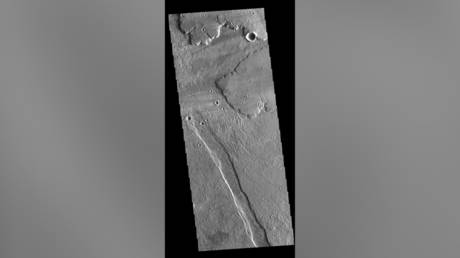
Cold.
For half a century, that single word has defined the scientific consensus on our nearest planetary neighbor. We have been taught to view Mars as a cosmic museum piece, a rust-colored husk whose geological heart stopped beating hundreds of millions, perhaps even billions, of years ago. When we look at the towering silhouette of Olympus Mons—a volcano three times the height of Mount Everest—we are told to see a tombstone. A monument to a violent, fiery youth that burned out long before human beings ever learned to bang two stones together.
I have spent years reporting on planetary science, sitting in windowless university basements while tired researchers scroll through grainy, monochrome telemetry from machines operating millions of miles away. You get used to the language of dead things. You learn to read impact craters like wrinkles on an old face, counting them to determine just how long a surface has lain undisturbed in the freezing dark.
Then, a crack appears in the stone.
In late 2024, a team of researchers led by scientists at Moscow State University and the Space Research Institute of the Russian Academy of Sciences published findings that didn't just nudge the textbook—they threatened to tear out the final chapters. Focusing their instruments on the Tharsis region, the massive volcanic plateau that dominates the Martian western hemisphere, they noticed something that shouldn't have been there. They found evidence suggesting that Mars is not a cold, dead rock after all. Beneath its frozen, radiation-scoured crust, the planet may still be simmering with active volcanism.
To understand why this matters, you have to stop looking at Mars through the lens of dry orbital mechanics and start looking at it the way a detective looks at a cold case where the body is still warm.
The Ghost in the Tharsis Bulge
Picture a hypothetical analyst—let’s call her Elena—sitting in a cramped Moscow office while sleet rattles against the double-paned glass outside. On her monitor isn't a dramatic Hollywood eruption with rivers of glowing orange lava. Planetary science rarely offers that kind of immediate gratification. Instead, she is staring at spectral data and high-resolution surface morphology gathered from orbital probes, cross-referencing thermal anomalies with the density of small impact craters.
This is how you take the temperature of a world you cannot touch.
In planetary geology, craters are a clock. Because the solar system is a shooting gallery of space debris, any planetary surface exposed to the void accumulates scars at a roughly predictable rate. If a plain on Mars is pockmarked with thousands of craters, it is ancient. If a patch of ground is eerily smooth, something wiped the slate clean recently.
When the Russian-led team analyzed specific volcanic structures within the Tharsis Montes—a chain of three colossal shield volcanoes named Ascraeus, Pavonis, and Arsia Mons—alongside nearby fissure vents, they found surfaces that looked disturbingly young. Not "young" in the way a forty-year-old feels young, and not even young by the standard yardstick of Martian geology, where a hundred million years ago counts as yesterday. They found volcanic deposits and structural deformations pointing to activity within the last few million years, and critically, signs that the underlying magma chambers haven't fully solidified.
Think of a cast-iron skillet pulled off a roaring campfire. At first, it radiates intense heat. An hour later, the surface feels cool enough to brush with your fingertips, fooling you into thinking the danger has passed. Yet deep inside the thick metal, thermal energy lingers, waiting. For decades, astrophysicists assumed Mars was too small—roughly half the diameter of Earth and only a tenth of its mass—to hold onto its internal heat. Like a small potato cooling faster than a large one on a kitchen counter, Mars should have lost its primordial warmth eons ago, freezing its core and shutting down its geological engine.
The data coming out of Moscow, echoing recent seismic rumblings detected by NASA’s now-retired InSight lander in the nearby Cerberus Fossae region, tells a different story. The skillet isn't cold. There is a plume of hot mantle rock rising from the deep interior, pushing upward against the Martian crust like a slow-motion fist.
The Invisible Stakes of a Warm Core
It is easy to dismiss a few warm rocks on another planet as academic trivia. Who cares if a volcano on Mars burped fifty thousand years ago or might burp again tomorrow?
You should care. Because on a rocky planet, heat is the difference between a wasteland and a cradle.
Every single thing that keeps you alive right now—the air in your lungs, the liquid water in your glass, the invisible magnetic shield deflecting lethal solar radiation above your head—exists because Earth is geologically alive. Our planet’s molten interior churns, driving plate tectonics that recycle carbon and belch out the gases that form our atmosphere. Volcanism isn't just destruction; it is the planetary breath.
When Mars lost its magnetic field roughly four billion years ago, the solar wind stripped away its thick atmosphere, turning rivers into ice and leaving the surface sterile. We assumed that was the end of the story. But if the Russian-led research holds up under peer review and future robotic scrutiny, it changes the entire equation for two massive questions: did life ever survive there, and can humans ever live there?
Consider what happens next when magma meets ice.
Mars is locked in a deep freeze, with average surface temperatures hovering around minus eighty degrees Fahrenheit. Yet orbital radar has confirmed that vast sheets of water ice lie buried just beneath the dust across much of the mid-latitudes and volcanic provinces. When an active magma chamber pushes upward into permafrost, it doesn't just create a volcano. It creates a hydrothermal system.
On Earth, we know exactly what happens in the dark, scalding waters where volcanic vents meet freezing ocean floors. Life thrives. Blind shrimp, giant tube worms, and dense mats of chemosynthetic bacteria flourish in total darkness, feeding not on sunlight, but on the raw chemical energy leaching out of hot rock. If Mars still possesses localized pockets of volcanic heat interacting with subsurface ice, then beneath that dead, rusty exterior could be warm, liquid aquifers—isolated subterranean oases that have sheltered microbial Martian life for billions of years.
I admit, whenever I think about this, I feel a strange mix of exhilaration and vertigo. We have spent billions of dollars scraping the top two inches of Martian dirt with rovers, looking for fossilized traces of ancient life, when the real action might be happening two miles under our wheels in warm, dark water. We might be searching a dry riverbed for fish bones while a hidden spring bubbles quietly beneath our boots.
A History of Being Wrong About Dead Worlds
If this feels hard to believe, remember that science has a long, humbling tradition of pronouncing worlds dead right before they prove us wrong.
In the 1970s, before the Voyager spacecraft flew past Jupiter, the prevailing wisdom held that the outer solar system was a frozen graveyard. Moons like Io and Europa were expected to be inert balls of rock and ice, utterly devoid of internal energy because they sat so far from the warmth of the sun. Then Voyager 1 snapped a photo of Io, and an engineer spotted a massive, umbrella-shaped plume erupting 190 miles into space. Io turned out to be the most volcanically active body in the solar system, kneaded like dough by Jupiter’s immense gravity. Later, Europa revealed a global subsurface ocean warmed by tidal flexing, instantly becoming one of the prime targets in the search for extraterrestrial life.
We made the exact same mistake with Venus. For decades, planetary scientists argued over whether Venus was geologically dead, trapped in a stagnant lid regime where heat couldn't escape. Then, in 2023, re-analysis of thirty-year-old radar images from the Magellan mission caught a volcanic vent visibly changing shape and overflowing with lava over an eight-month period.
We suffer from a profound bias of timescale. Human beings live for eighty years; we measure history in centuries. Planets operate on rhythms that make human civilization look like a camera flash. When a volcano on Mars goes quiet for two hundred thousand years between eruptions, we declare it extinct. To the planet, that silence isn't death. It is merely the pause between two heartbeats.
The Russian team's work fits directly into this pattern of cosmic humility. By examining the morphology of young lava flows, grabens—long, sunken trenches formed when the crust stretches over rising magma—and localized atmospheric anomalies, they aren't claiming Olympus Mons is going to blow its top next Tuesday. They are pointing out that the geological timeline of Mars refuses to end.
The Architecture of Future Survival
Let’s pull this closer to home—or at least, to the home we are actively trying to build.
Right now, space agencies and private aerospace giants are drawing up blueprints to put human boots on Mars within the next two decades. If you have ever looked closely at those mission architectures, you know the hardest problem isn't the rocket ride. It isn't even the radiation during the nine-month transit. The hardest problem is keeping people alive once they land, without bankrupting Earth to ship them every gallon of water and kilowatt of power.
In aerospace engineering, this is called in-situ resource utilization—living off the land.
If Mars is a completely cold, dead cinder, early settlers face a brutal thermodynamic deficit. Every drop of water has to be mined from rock-hard ice and melted using massive nuclear reactors or sprawling fields of fragile solar panels that Martian dust storms love to suffocate. Every ounce of oxygen has to be cracked from thin carbon dioxide air at a staggering energy cost.
Now, change the premise. Imagine landing near a region where residual volcanic heat still bleeds upward through fractured bedrock.
Suddenly, the survival calculus shifts dramatically. Geothermal energy—tapping into the planet’s own lingering warmth—becomes possible. Instead of hauling gigawatts of power generation across forty million miles of vacuum, a future Martian outpost could drill into a thermal anomaly, using the natural heat gradient of the crust to generate electricity, warm pressurized habitats against the brutal Martian night, and melt subsurface ice into liquid water at a fraction of the energy cost.
Even the minerals deposited by ancient and recent hydrothermal activity—sulfur, silica, clays, and concentrated metals—become the raw building blocks for manufacturing tools, cement, and electronics right on the surface. A geologically active Mars isn't just more scientifically fascinating; it is vastly more habitable.
The Friction of Uncertainty
Of course, science doesn't move forward on poetry alone, and the findings from the Moscow team come wrapped in the messy, contentious reality of modern planetary research.
Interpreting remote sensing data from Mars is notoriously treacherous. A smooth patch of ground might be a recent lava flow, or it might just be a thick blanket of wind-blown dust that buried older craters. A subtle spike in atmospheric methane—another tantalizing clue often linked to either subterranean microbes or volcanic outgassing—might be real, or it might be an instrument artifact caused by drastic temperature swings in the orbiters' electronics.
There is also the geopolitical friction that inevitably shadows science in the mid-2020s. Following the collapse of joint European-Russian Mars missions like ExoMars earlier in the decade, researchers in Moscow have had to rely heavily on archival datasets, international public repositories, and independent modeling rather than fresh hardware of their own on the Martian surface. Skeptics in the West will rightly demand independent verification before rewriting the textbooks. They will want high-resolution thermal infrared mapping from upcoming orbiters, and eventually, new seismometers planted directly onto the Tharsis plateau to listen for the telltale low-frequency hum of moving magma.
That skepticism is healthy. It is how science keeps itself honest. You don't overturn fifty years of planetary theory because one paper spots suspiciously smooth lava tubes and warm fractures. You treat it as a flare fired into the dark sky—a signal telling everyone else where to point their telescopes.
Listening to the Quiet
Step outside tonight, look up into the dark, and find the faint, steady reddish point of light wandering through the constellations.
To the naked eye, Mars looks utterly static. A drop of dried paint on black velvet. Even through a backyard telescope, it appears silent, serene, and frozen in time.
For generations, that stillness fooled us. We projected our own impatience onto the universe, assuming that because nothing moved while we were watching, nothing was moving at all. Yet somewhere out there in the cold dark, ninety million miles away, pressure is slowly building beneath miles of basalt and frozen dust. Rock is flexing. Heat is rising. And the red planet is quietly waiting for us to look closer.