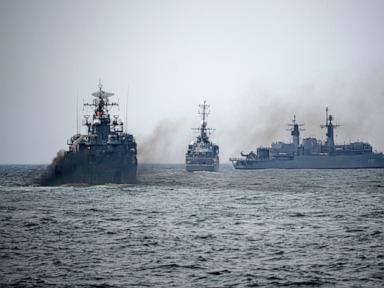
Salt hangs in the air above the Black Sea long before dawn breaks, heavy enough to coat radar glass and rust the hinges of a bridge wing door in a single night. Out there, water does not look like a geopolitical chessboard. It looks gray, cold, and restless, rolling toward coastlines where people still argue about grain prices, ferry schedules, and whether the fog will lift by noon.
Listen. A low buzz in a clear sky.
Most people hear an uncrewed aircraft and picture a tiny camera hovering over a backyard fence or a neat rectangle of pixels on a television screen. They do not hear the thin, frantic whine of a cheap piston engine or a fiber-optic drone skimming ten feet above whitecaps while an operator in a windowless room watches a battery meter tick toward zero. Out over the Black Sea, cheap machines are colliding with very expensive questions. And the scariest part is not always the explosion itself. It is the silence two seconds after the radar blip vanishes, when commanders on both sides of a line have to decide what that disappearance meant.
To understand why drone strikes in the Black Sea set off alarms far beyond the immediate shoreline, you have to look at what happens in the gray zone—that narrow, maddening strip between quiet deterrence and open war. Think of a room full of people holding lit candles near curtains that have been drying in the sun for weeks. Nobody has to throw a torch to start a fire. A draft is enough. That is a metaphor for escalation in a contested sea, where miscalculation does not need malice to turn fatal; it only needs bad weather, a jammed GPS signal, or a pilot guessing wrong in the dark.
Let us step onto a hypothetical patrol vessel—let us call her the Korsakov, a mid-sized coast guard cutter cruising a maritime corridor near the western approaches of the Black Sea. This scenario is hypothetical, built to show how friction feels on a steel deck rather than on a policy brief. On the bridge, the air smells of burnt coffee, hot electronics, and wet wool. Lieutenant Elena Vance—again, a composite figure representing crews who stand these watches—watches the green sweep of the surface radar. Everything looks routine until the bearing marker jumps. Not a fishing trawler. Not a bulk carrier hauling sunflower oil or steel coils. Something small, low, and fast, flying without a transponder, riding the swell like a skipping stone.
Elena does not see a grand Kremlin master plan on her screen. She sees a speck of light and a clock running out. Should she illuminate it with fire-control radar? A radar lock can look like a prelude to a shot. Should she call it in over an unencrypted channel? Every second spent confirming identity is a second a loitering munition or reconnaissance drone has to map a port, clip a sensor mast, or drift toward territorial waters where alliance obligations suddenly stop being theoretical.
That is the heart of the anxiety surrounding Black Sea drone strikes. When Russian forces or proxies launch uncrewed systems across contested waters—or when debris, electronic warfare spoofing, and stray strikes creep uncomfortably close to NATO members like Romania, Bulgaria, or Turkey—the danger is not just the tactical hit. It is the probe.
Probing is an old game played with new hardware. Historically, great powers test boundaries with submarines slipping into fjords, bombers flying right up to an air defense identification zone and peeling away at the last minute, or maritime militias crowding fishing grounds. Drones change the economics of the test. A cheap airframe costs less than a single air-defense interceptor missile. Firing a million-dollar missile at a drone worth a fraction of that—or holding fire and risking a strike on a radar station, a pipeline, or a commercial ship—puts defenders in an agonizing bind.
I have stood on coastal overlooks where the wind off the water carries the faint hum of distant engines and watched ordinary routines continue beside extraordinary tension. A fisherman mending nets on a concrete quay does not care about diplomatic notes delivered at midnight in Brussels or Moscow. He cares whether his boat can leave at four in the morning without hitting a mine, getting swept by GPS jamming, or being waved off by a patrol craft whose crew is jumpy because an unidentified drone came down ten miles offshore three hours earlier.
That disconnect—between high-level strategic signaling and gritty, physical reality—is where people get hurt.
Why Small Wings Carry Heavy Doubt
Why would Moscow use drones in the Black Sea to test NATO when a full-scale confrontation with the alliance carries catastrophic risks for Russia itself?
Start with ambiguity. Deniability is oxygen in gray-zone warfare. If a drone drifts off course, suffers a navigation failure, or strikes near an alliance border, officials can claim technical malfunction, GPS interference, or a defensive action against Ukrainian targets. Even when analysts suspect deliberate testing—gauging NATO scrambling times, sensor coverage, reaction thresholds, or political nerve—ambiguity gives leaders room to maneuver without crossing an unmistakable red line.
Consider what happens next: a fragment washes ashore or a radar track lingers near alliance airspace. Capitals face a brutal choice. Overreact, and you risk escalating a localized incident into a wider clash that nobody wants. Underreact, and you invite more testing tomorrow, slightly closer to the line, slightly bolder than today.
It is easy to talk about "credibility" from a warm desk thousands of miles away. Credibility sounds clean on paper. In practice, credibility is tested in minutes, under incomplete information, while crews are tired and communications are noisy.
I will admit something candidly: I find the certainty of some commentators hard to swallow. Watching pundits declare with absolute confidence whether a given drone flight was a calculated provocation, a botched strike, or simple signal noise often tells you more about the commentator than the flight path. Sometimes we do not know right away. Sometimes the fog of war is literal, and sometimes it is bureaucratic. Pretending otherwise does not make us wiser; it makes us blind to how fragile restraint actually is.
The Invisible Stakes Beneath the Surface
Black Sea escalation rarely stays confined to military hardware. The sea is a tight, enclosed basin connected to the wider world through narrow straits and vital trade arteries. When drone activity spikes, maritime insurers raise war-risk premiums. Shipping companies reroute or pause sailings. Grain, fertilizer, energy infrastructure, and coastal tourism all feel the tremor.
Even more quietly, trust erodes. Alliance politics depend on shared perception. If one capital views a series of drone incursions or near-misses as a direct probe of collective resolve while another views them as spillover from the war in Ukraine, friction builds inside the alliance itself. Testing an adversary is one way to probe strength. Testing whether allies flinch or hesitate at the margin is another.
Picture a port dispatcher in Constanța or a grain terminal manager watching weather forecasts and maritime advisories on a flickering monitor at 2:00 a.m. A single headline about downed drones or radar alerts can stall a shipment worth millions or leave a crew anchored in limbo, waiting for clearance to cross a stretch of water where rules of engagement feel stretched thin. Nobody puts that exhaustion in a headline about geopolitical chess, yet it shapes real lives every day.
Reading the Pattern Without Losing Your Head
When news breaks about drone strikes in the Black Sea and fears of Russian escalation toward NATO, panic is an easy response and a terrible guide. Escalation is a process, not a single switch flipped overnight. Most adversaries who probe limits are looking for information—how fast do radars light up? How do patrol ships respond? Does public anxiety push governments toward caution or toughness?—rather than seeking an immediate, all-out war they know could spiral out of control.
At the same time, dismissing every incident as "just noise" is just as dangerous. Patterns emerge over time: shifts in launch corridors, increased electronic warfare along coastal sectors, heavier use of decoys and loitering munitions, and closer proximity to alliance boundaries. Watching the trendline matters far more than reacting to a single sensational clip.
Back on our hypothetical cutter Korsakov, the blip on Elena's screen finally fades—either dropping low into sea clutter, losing signal, or turning back toward its launch point. The watch continues. Another cup of coffee goes cold. Nobody cheers, and nobody relaxes completely, because the sea has a way of reminding everyone on it that calm water and quiet water are not the same thing.
Out past the breakwater, where black waves meet a low ceiling of cloud, the real test is rarely a single dramatic strike. It is whether steady heads, clear eyes, and disciplined restraint can hold when the sky above dark water fills with small, buzzing shadows.