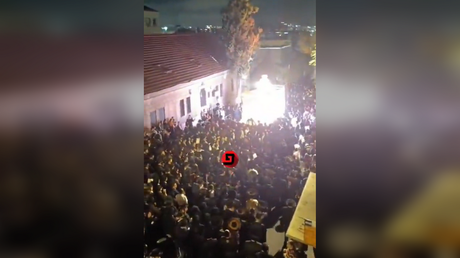
The afternoon heat in Bnei Brak does not settle; it presses down like a hot wool blanket. Dust motes dance in the slanting rays of sunlight filtering through narrow alleys where black-coated figures move with a swift, purposeful momentum. Here, the hum of the modern world is muffled. There are no billboards for streaming services or luxury cars. Instead, peeling posters on concrete walls scream warnings in heavy black Hebrew type, calling the faithful to assemble, to resist, to protect the purity of the sanctuary against an encroaching tide.
At the corner of a sun-bleached street, a group of teenage boys in crisp white shirts and black trousers cluster around a glowing smartphone screen. The video playing on the small glass rectangle is jerky and loud. It shows a street in Mea Shearim: an Israeli military vehicle creeping forward, surrounded by a jeering mob. Young men with sidecurls flying bang on the metal chassis. They spit. They scream insults that cut sharper than knives, labeling the soldiers inside not merely as fellow countrymen, but as representatives of an enemy army. You might also find this related coverage insightful: The Diplomatic Blind Spot Keeping Sudan’s Army in Power.
To an outsider peering in from across the globe, the scene is an incomprehensible paradox. How can citizens of a nation forged in the fires of collective survival, a country surrounded by hostile borders where military service is viewed by the secular majority as an absolute sacred duty, turn upon their own defenders with such bitter vitriol?
To understand this fracture, one must abandon the maps of modern geopolitics and step backward in time, deep into the psychology of a traumatized people who decided long ago that survival depended on a weapon entirely different from the rifle. As reported in recent coverage by The Washington Post, the implications are widespread.
Consider the historical bargain struck in the turbulent birth year of 1948. David Ben-Gurion, the secular founding father of the state, looked out at a decimated remnant of European Jewry. Millions had perished in the ashes of the Holocaust. Among the survivors were a tiny handful of elite scholars, remnants of the great academies of Lithuania and Poland, holding in their memories the burnt remains of an entire religious civilization. Ben-Gurion agreed to exempt a few hundred full-time Torah scholars from military service, believing that the ancient texts needed preservation just as much as the borders needed defending.
That small, pragmatic exemption was supposed to be a temporary bridge. Instead, it became a ticking tectonic plate.
Decades passed. Birth rates in the Ultra-Orthodox, or Haredi, community soared. What was once a fragile handful of scholars grew into hundreds of thousands of citizens living in semi-autonomous enclaves. They pay taxes, vote in coalition-making political blocks, and run their own school systems funded largely by the state. Yet they remained exempt from the draft. Generation after generation of secular and national-religious Israelis shouldered the burden of compulsory military service, standing watch on freezing northern ridges and sweltering southern borders, while their Haredi neighbors spent their youth swaying over holy books.
For a long time, the tension simmered beneath the surface, lubricated by political compromises and mutual avoidance. But tectonic plates do not stay still forever.
When the Supreme Court of Israel finally ruled that the sweeping exemptions had no legal basis under the principle of equality, and when successive regional conflicts stretched the armed forces to their absolute breaking point, the fault line cracked wide open. The state needed manpower. The military needed soldiers. And the Haredi community, guarding its way of life with the fierce intensity of an endangered tribe, perceived a direct assault on its very soul.
Walk through a Haredi neighborhood on any given night, and you will hear the kol Torah—the voice of Torah. It is an incessant, rhythmic murmuring that rises from the study halls like a collective heartbeat. Hundreds of young men sit shoulder to shoulder, rocking back and forth over heavy leather-bound volumes of the Talmud, debating fine points of ancient rabbinic law written two millennia ago.
To the young student sitting at that wooden desk, the world outside is an illusion. He has been raised from infancy to believe that the physical army patrolling the borders is secondary. In his worldview, the physical gun is only as effective as the spiritual merit earned by those who study the word of God. To him, abandoning the study hall to wear an olive-green uniform is not civic duty; it is spiritual suicide. It is an invitation to be assimilated into a secular culture that views traditional piety with skepticism or disdain.
When recruitment orders arrive in the mail, they are not treated as bureaucratic notices. They are treated as mobilization papers from a hostile foreign power.
This is where the rhetoric crosses into dangerous territory. When fringe elements, and increasingly mainstream voices within the radical factions, label the Israel Defense Forces an enemy army, they are engaging in a profound rhetorical inversion. They look at a military that includes their own cousins, uncles, and brothers, and they choose to see an occupying force of secularism. They point to the integration efforts within the military—efforts designed to accommodate kosher standards and prayer times—and dismiss them as traps designed to secularize the pious youth.
Yet, reality is stubbornly complex. Behind closed doors, away from the roaring protests and the viral videos, a quiet revolution is happening.
I spoke recently, through intermediaries in the labyrinthine corridors of Bnei Brak, with a man named Moshe. He is a father of six, a Haredi man who runs a small bookkeeping business. His eldest son, nineteen years old, recently stopped showing up to the morning study session. For weeks, the boy’s chair sat empty, gathering dust. The family whispered in hushed tones, as if mourning a death.
"It tore my heart in half," Moshe told me, his eyes fixed on the worn wooden table between us. "In our world, if a boy leaves the tent of Torah, he is stepping off the edge of the world. We are afraid he will lose his tzitzit, his black hat, his identity. We are afraid he will come back speaking a different language."
Did his son enlist?
"Yes," Moshe whispered. "He watched the news. He saw the funerals of boys his age. He saw the reservists coming home exhausted, dropping their packs after months in Gaza or on the northern frontier. He looked at me one night and said, 'Abba, how can we sit here and drink tea while our brothers are bleeding?'"
Moshe’s story is not unique, though it is rarely shouted from the platforms during street demonstrations. A subterranean demographic shift is underway. Economic pressures are mounting within the Haredi community; state subsidies cannot stretch forever to feed families with eight or ten children. More young men are seeking vocational training. More are entering the workforce. And, despite the fierce social ostracization imposed by community leaders, a trickle of young men are finding their way into specialized military tracks tailored for the religious lifestyle—units where prayer times are protected and female soldiers are absent.
Every time one of these young men crosses the threshold, a battle is fought twice: once on the dusty roads where protesters burn garbage bins, and once in the quiet, agonizing conscience of a father sitting across a kitchen table.
The leadership on both sides often prefers the simplicity of war over the difficulty of compromise. Hardline rabbis thunder from their pulpits that any compromise with the secular draft is a betrayal of the covenant with God. Meanwhile, secular politicians look at the towering piles of draft exemption notices and see an intolerable evasion of civic obligation, a parasitic drain on a bleeding nation.
Both sides are trapped in narratives of absolute righteousness.
The secular Israeli looks at the flag, the memorial walls, the cemeteries filled with twenty-year-olds who gave everything, and feels a white-hot rage at the sight of a healthy young man walking down a Jerusalem sidewalk exempt from the burden. It feels like a betrayal of the social contract. If we bleed together, we must live together, and we must carry the weight together.
The Haredi Israeli looks at centuries of European pogroms, Spanish inquisitions, and global indifference, and concludes that the only reason the Jewish people survived two thousand years of wandering without a sword is because they trusted in something higher than iron and gunpowder. They believe their books are their shields. They believe their insulation from the secular zeitgeist is the only reason their culture survived the grinder of history.
When these two irreconcilable convictions collide in the public square, the result is the footage we see on our screens: screaming crowds, blocked intersections, sirens wailing, and young men in uniform staring down young men in black coats across an invisible chasm that grows wider with every passing sunrise.
There is no clean legislative fix for this wound. No Supreme Court ruling can rewrite the theological anxieties of a community that measures time in millennia rather than election cycles. No amount of police enforcement can drag tens of thousands of young men into induction centers without sparking civil unrest that could tear the state apart from the inside.
The resolution, if one exists, will not be found in the halls of parliament or through the lens of a smartphone camera capturing a street brawl. It will be forged in the quiet spaces where individual families negotiate their survival. It will depend on whether the military can learn to respect the spiritual boundaries of the pious without compromising its mission, and whether the Haredi leadership can find the courage to acknowledge that protecting a physical homeland is not antithetical to preserving a spiritual heritage.
Until then, the sirens will keep wailing in the background. The black coats will march. The green uniforms will stand watch. And the nation will hold its breath, balanced precariously on the razor's edge between the heavy weight of the sword and the unyielding whispers of the prayer book.


