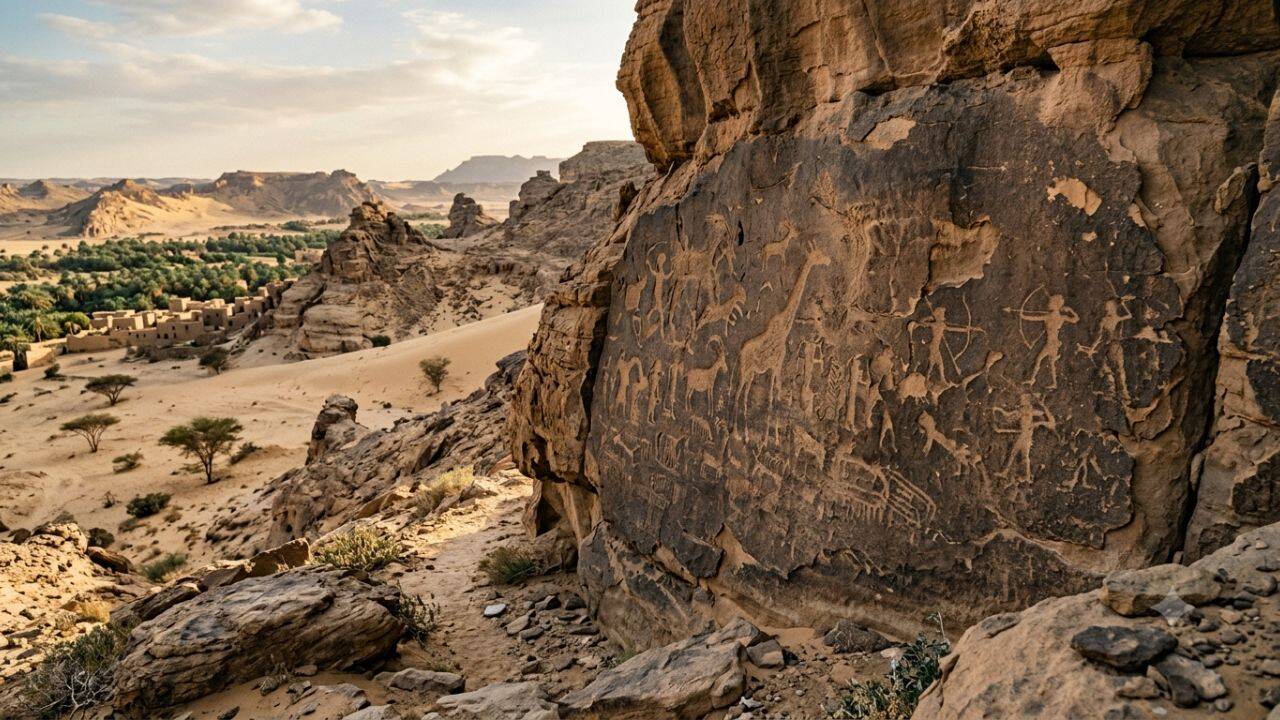
The Triple Threat System of Saharan Rock Art Erosion
The petroglyph repositories of Egypt's Dakhla Oasis represent a continuous 7,000-year historical ledger. Spanning from the Neolithic Bashendi cultural period (6000–5000 BCE) through Dynastic, Greco-Roman, Coptic, and Islamic eras, these open-air galleries document key ecological and civilizational shifts in North Africa. However, current field data indicates a structural crisis: rate of decay is accelerating due to a compound failure mechanism consisting of substrate fragility, atmospheric alteration, and anthropogenic interference.
Understanding the degradation of Dakhla's petroglyphs requires analyzing three distinct physical drivers rather than treating "weathering" as a monolithic phenomenon. For another look, read: this related article.
1. Substrate Instability and Lithic Degradation
The primary medium for Dakhla rock art is Nubian Sandstone. While this sedimentary rock provided prehistoric artists with an easily workable surface, its physical composition constitutes a high-vulnerability substrate.
- Grain Cohesion Deficiency: Nubian sandstone consists predominantly of quartz grains bound by iron oxides or carbonate matrices. In extended arid environments, matrix binding agents degrade. Certain exposed stone formations in Dakhla have lost inter-granular integrity to the point where mechanical force as light as human finger pressure causes surface deflation.
- Thermal Expansion Cycles: Diurnal temperature fluctuations in the Western Desert exceed $30^\circ\text{C}$ between day and night. Differential thermal expansion between the outer surface layer and the cooler interior stone creates subsurface shear stress. Over time, this leads to exfoliation—the complete shedding of whole rock faces carrying the petroglyph layer.
- Differential Hardness Rates: Where iron-rich crusts (ferruginous sandstone) formed over softer underlying layers, artists carved through the hard exterior to create contrasting imagery. Once this protective shell is breached by carving, wind-driven sand grains ($0.1\text{ mm} - 0.5\text{ mm}$ quartz particles) enter the incised grooves, acting as abrasive micro-jets that scour away the exposed inner core.
2. Microclimatic Shifts and Hydrological Degradation
The Western Desert was historically characterized by extreme hyper-aridity. Recent global atmospheric shifts have introduced episodic precipitation events, fundamentally altering the decay rate equation. Similar reporting regarding this has been provided by The Guardian.
[Precipitation Event] -> [Water Infiltration into Micro-Cracks] -> [Salt Dissolution & Recrystallization] -> [Sub-Surface Pressure] -> [Spallation]
- Haloclasty (Salt Weathering): Sporadic heavy rainfall penetrates micro-fractures in the rock face. As water dissolves ground salts and subsequently evaporates under high ambient temperatures, salt crystals expand inside the porous stone matrix. The resulting crystallization pressure exceeds the tensile strength of soft sandstone, causing surface micro-fracturing (spallation).
- Structural Flooding Damage: Sudden rain deluges alter local hydrology, washing sediment over low-lying panels and undercutting the base of freestanding sandstone knolls.
3. Layered Anthropogenic Alteration
Human interaction with rock art panels follows two distinct pathways with fundamentally different preservation implications.
- Historical Stratification: Superimposition of inscriptions—such as Pharaonic hieroglyphs, Greek merchant marks, or Coptic symbols—over prehistoric giraffe and cattle motifs provides valuable chronological sequences. These historical interventions document continuous spatial utility.
- Modern Material Degradation: Contemporary vandalism introduces unrecoverable loss. Modern scratching breaks through the remaining weathered patina, exposing fresh stone directly to wind shear. Additionally, the application of modern pigments or synthetic chemicals permanently alters chemical composition, preventing accurate surface-exposure dating methods like varnish micro-stratigraphy.
Technical Obstacles to Systematic Preservation
Remediating rock art loss in Dakhla involves severe operational constraints that render conventional site-protection tactics ineffective.
Scalability Limits of Physical Enclosures
Unlike concentrated architectural sites, petroglyphs in the Western Desert are distributed across hundreds of square kilometers. Constructing physical shelters or barriers across vast terrain introduces three severe vulnerabilities:
- Wind Shear Alteration: Structures disrupt natural airflow, creating artificial wind eddies that concentrate abrasive dust against surrounding exposed panels.
- Thermal Trapping: Enclosures trap heat, raising localized micro-climatic temperatures and exacerbating thermal stress cycles on fragile sandstone.
- Resource Allocation Deficits: Capital costs associated with maintaining physical security across remote desert locations outweigh realistic cultural ministry budgets.
Limitations of Chemical Stabilizers
Applying consolidated silicates or chemical binders to strengthen friable sandstone presents significant long-term risks:
- Vapor Permeability Loss: Chemical sealants often reduce the permeability of the stone. Moisture trapped behind the consolidated outer shell creates internal hydrostatic pressure, eventually causing larger catastrophic block falls rather than minor surface erosion.
- Chemical Discoloration: Synthetic resins oxidize under intense ultraviolet radiation, darkening the stone surface and obscuring fine incisions within two to five years of application.
Operational Execution Plan for Non-Invasive Preservation
Because physical interventions carry high failure rates, optimal preservation strategy centers on rapid high-density digital captures paired with controlled stratigraphic excavation.
Phase 1: Rapid Spatial Mapping ──> Phase 2: High-Resolution Photogrammetry ──> Phase 3: Targeted Contextual Excavation
Phase 1: High-Speed Spatial Mapping and Scanning
- Structure-from-Motion (SfM) Photogrammetry: Field teams must systematically capture multi-angle sub-millimeter resolution images of each panel. Modern photogrammetric software converts these images into three-dimensional point clouds, preserving surface topography independent of physical substrate survival.
- Reflectance Transformation Imaging (RTI): Utilizing mathematical surface re-lighting techniques reveals shallow, heavily eroded incisions invisible to the naked eye under direct sunlight.
Phase 2: Contextual Excavation and Chronological Calibration
- Basal Sediment Stratigraphy: To establish precise chronological markers without damaging rock panels, excavations must focus on sediment layers directly accumulating at the base of petroglyph-bearing cliffs. Recovered organic material, charcoal, and knapped stone tools provide radiocarbon ($^{14}\text{C}$) and optically stimulated luminescence (OSL) dates.
- Patina Analysis: Recording the thickness and chemical composition of manganese and iron-rich desert varnish within the incisions provides secondary dating controls to sequence multi-period panels.
The Strategic Directive for Desert Heritage Management
Relying on physical conservation to hold back Saharan erosion models a false outcome. Sandstone decay in the Western Desert is an irreversible physical process governed by mechanical and thermal forces. The strategic imperative must pivot entirely from reactive physical preservation to aggressive digital capturing and site-context documentation. Funding and regulatory structures must streamline research permits immediately, prioritizing digital archiving before the physical medium reaches complete structural collapse.


