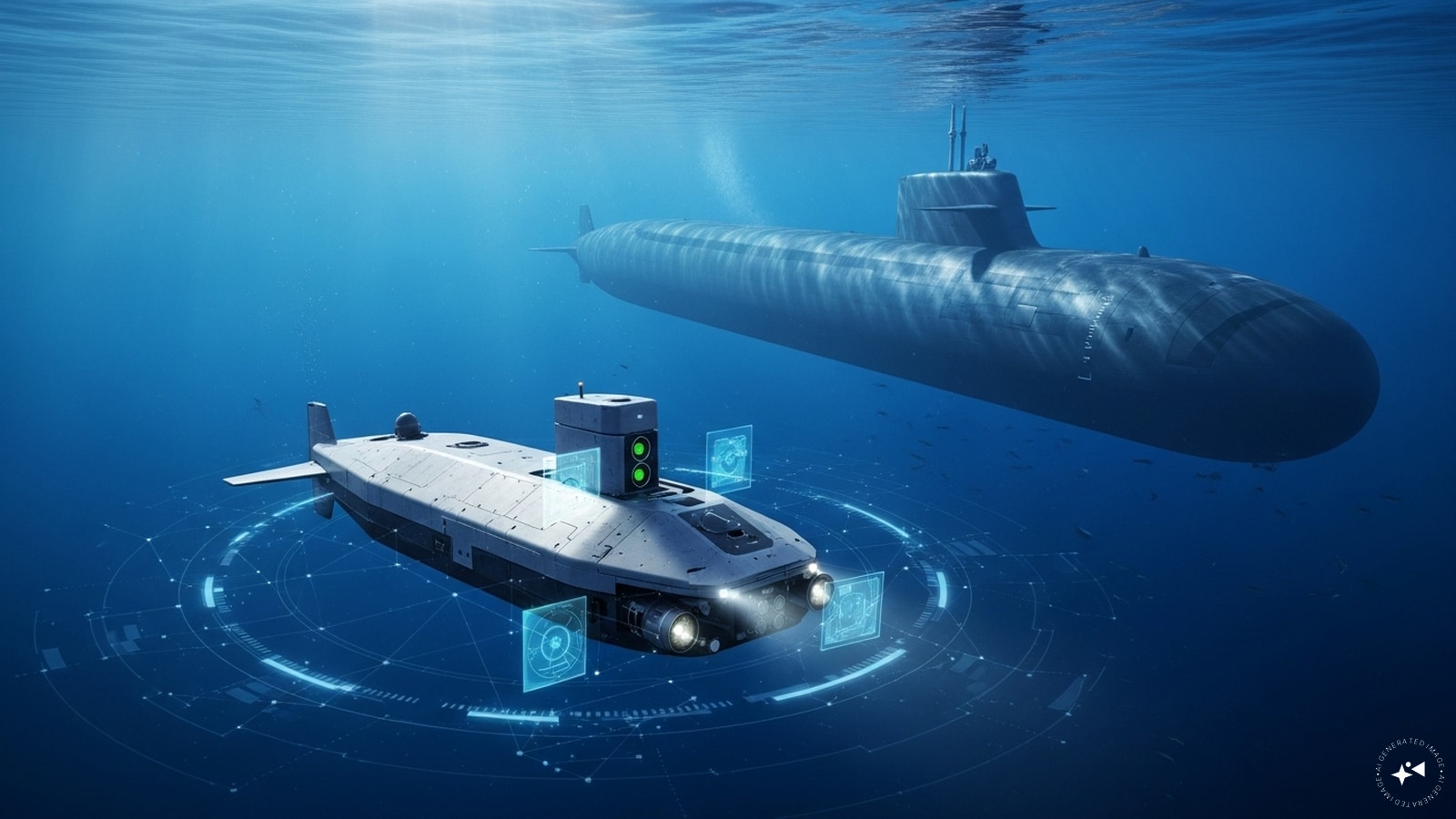
The defense ministers of the United States, the United Kingdom, and Australia stood together in Singapore to announce a major acceleration of their trilateral security pact. Dubbed the first "signature project" of AUKUS Pillar Two, the three nations are co-developing highly adaptable payloads and modular components for uncrewed undersea vehicles. The official timeline sets deliveries to begin in 2027. While public messaging frames this as a routine technological evolution to counter maritime threats, the abrupt shift reveals a deeper anxiety. This accelerated drone initiative is a direct, asymmetric response to the realization that building conventional nuclear submarines is moving far too slowly to match the rapid expansion of Chinese naval power in the Indo-Pacific.
For years, critics have pointed out the glaring vulnerability of the primary AUKUS timeline. Pillar One, the plan to supply Australia with conventional, nuclear-powered attack submarines, operates on a decades-long horizon. The first Australian-built SSN-AUKUS hulls are not expected to hit the water until the early 2040s. In contrast, regional tensions are mounting now. By pivoting heavily toward uncrewed undersea systems, the alliance is attempting to buy intermediate deterrence on a budget. For a different perspective, see: this related article.
The Submarine Industrial Bottleneck
The mathematics of western industrial capacity simply do not add up to a rapid naval expansion. American shipyards are currently struggling to produce even two Virginia-class submarines per year due to persistent supply chain friction and skilled labor shortages. Britain's BAE Systems yard in Barrow-in-Furness is similarly maxed out with its own domestic boat programs. Injecting Australia into this overstressed industrial pipeline was always a high-risk gamble.
Uncrewed systems offer an escape valve from this manufacturing logjam. Building a 7,000-ton nuclear submarine requires specialized nuclear-qualified steel, highly complex reactor components, and hundreds of thousands of highly regulated man-hours. Building an autonomous underwater drone does not. By shifting the immediate focus to autonomous payloads, the alliance can leverage commercial tech sectors, software developers, and smaller, non-traditional defense contractors. Further insight regarding this has been published by NBC News.
The strategy hinges on modularity. Instead of building entirely new drone hulls from scratch, which still takes years of hydrodynamic testing, the 2026 agreement focuses heavily on interchangeable payloads. The U.S., UK, and Australia will initially develop separate national payloads designed to slide into standardized compartments. One nation might focus on advanced sonar arrays, another on acoustic electronic warfare, and a third on mine neutralization systems.
Weapons Tubes as Launchpads
The tactical goal of this initiative is to change how existing crewed submarines operate. Rather than sending a multi-billion-dollar asset into shallow, heavily monitored coastal waters, standard attack submarines will act as motherships. The signature project emphasizes perfecting torpedo-tube launch-and-recovery systems.
This is harder than it sounds. Launching a drone from a standard 21-inch torpedo tube is relatively straightforward. Recovering it while the submarine is moving, without generating acoustic noise that reveals the boat’s location, is an engineering nightmare. Current trials involve automated docking baskets and acoustic homing beacons that guide the drone back into the tube. If perfected, a single crewed submarine can sit in deep water while its robotic scouts map minefields, track hostile surface ships, or monitor shallow choke points like the Taiwan Strait.
The immediate mission priority for these vehicles is the defense of critical underwater infrastructure. The vulnerability of deep-sea data cables and energy pipelines is no longer a theoretical concern. Western intelligence agencies have noted a sharp increase in Russian and Chinese civilian "research" vessels loitering near vital transatlantic and Indo-Pacific communication lines. Crewed submarines are too scarce and expensive to use for routine pipeline patrols. Autonomous drones, capable of loitering on the ocean floor for weeks at a time, provide a persistent sensor web that the alliance currently lacks.
The Software and AI Hurdle
While the hardware can be built quickly, the real bottleneck for this drone fleet is the undersea communications gap. Radio waves do not travel through water. Blue-green lasers and acoustic modems offer a partial solution, but their data rates are abysmally low and easily disrupted.
This means the AUKUS drones cannot be remotely piloted like aerial quadcopters. They must possess genuine autonomy. They need to navigate without GPS, using quantum-derived inertial systems to calculate their position based on local gravity maps and seafloor topography. They must also use onboard artificial intelligence to analyze sonar data in real time, deciding independently whether a detected object is a biological fluke, a buried sea mine, or a hostile submarine.
This reliance on autonomous decision-making introduces a massive gray area into naval doctrine. If an uncrewed vehicle loses contact with its command structure and detects what its algorithm determines to be an imminent threat, does it have the authority to deploy an offensive payload? The official AUKUS statements emphasize "strike capabilities," but they remain deliberately vague about the rules of engagement.
An Inevitable Regional Arms Race
The reaction from Beijing was entirely predictable. Chinese officials immediately condemned the announcement, warning that the deployment of autonomous strike systems will destabilize the region and trigger a localized arms race. The reality is that the arms race is already well underway. China has been rapidly expanding its own uncrewed underwater vehicle programs, displaying large-diameter autonomous submersibles at military parades and utilizing them for extensive hydrological surveying in the South China Sea.
The AUKUS drone rush is an acknowledgement that the old ways of projecting naval power are changing. Western dominance under the waves, once taken for granted, is actively contested. Massive, exquisite platforms like nuclear submarines are becoming too rare and too vital to lose. By flooding the underwater domain with cheaper, expendable, and intelligent machines, the alliance hopes to create a dense layer of friction that makes any hostile maritime adventure too costly to attempt. Whether these systems can be reliably fielded by 2027 remains an open question, but the industrial realities of modern shipbuilding have left the alliance with no other choice.