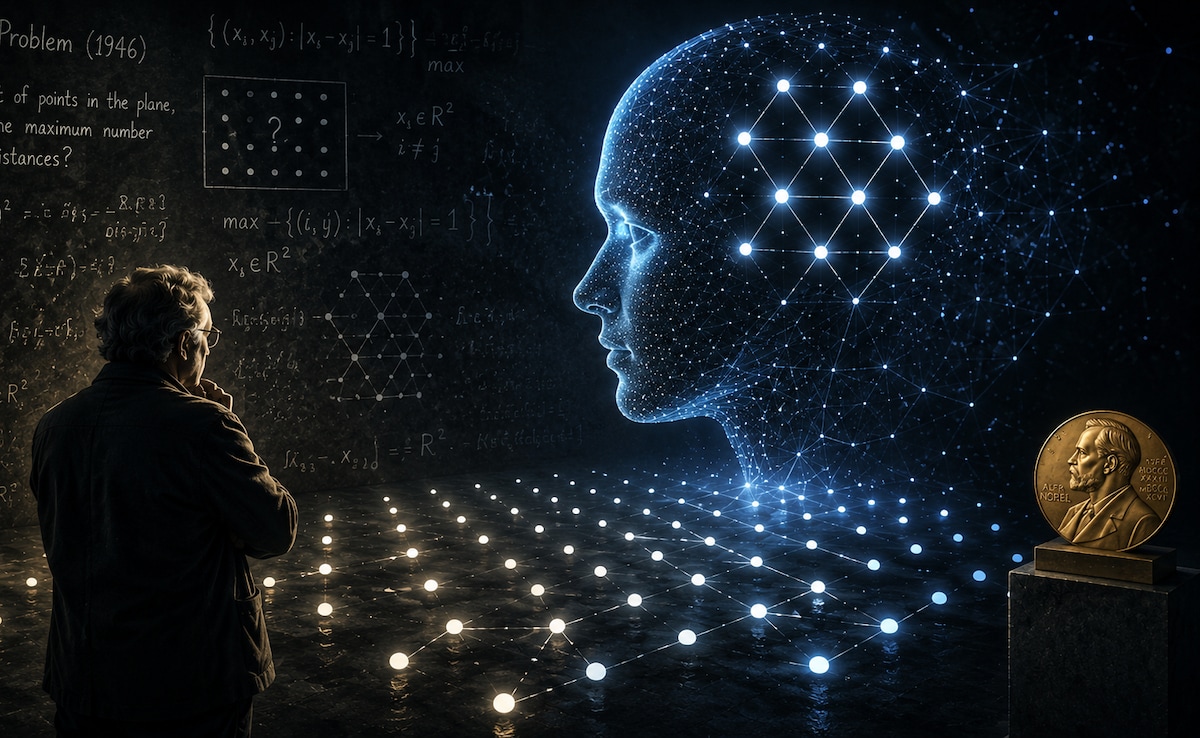
Silicon Valley has a new obsession, and it involves dusting off century-old mathematics textbooks. When reports emerged that artificial intelligence laboratories were turning their massive compute clusters toward solving long-standing mathematical mysteries—specifically targeting foundational problems that have baffled humans since the mid-20th century—the tech industry framed it as a triumph of pure science. They told us that an AI capable of proving complex geometric theorems or cracking prime number conundrums would inherently understand the universe better.
That narrative is incomplete. Tech giants are not spending billions of dollars on electricity just to impress academic committees.
The real driver behind this sudden push into advanced mathematics is a desperate search for architectural survival. Current AI models, built on large language structures, are hitting a hard ceiling. They predict the next word in a sequence based on historical data, a mechanism that makes them excellent mimics but terrible logical thinkers. By forcing these systems to solve rigorous math mysteries, engineers are attempting to fundamentally change how AI processes information, moving from pattern recognition to genuine reasoning. If they succeed, it reshapes global cryptography, supply chain logistics, and software development. If they fail, the current AI boom risks running out of steam.
The Logic Wall
Large language models are fundamentally statistical engines. They operate on probabilities, guessing the most likely next word based on billions of pages of scraped internet text. This works remarkably well for writing essays, generating code templates, or composing poetry.
Math, however, breaks this machinery.
In higher mathematics, a single incorrect sign or a minor logical leap invalidates an entire proof. There is no room for approximation. You cannot hallucinate a prime number. When an AI attempts to solve an 80-year-old math mystery, it cannot rely on its memory of the internet, because the answer does not exist on the internet.
To bridge this gap, labs like OpenAI are combining language models with reinforcement learning and tree-search algorithms. This is the same underlying methodology that allowed systems to defeat human grandmasters at chess and Go. Instead of just guessing the next word, the AI generates multiple potential steps for a mathematical proof, tests them against a rigid set of rules, and discards the paths that fail.
It is a grueling, brute-force approach to logic. By training a system to navigate the unyielding laws of mathematics, researchers are trying to build a digital brain that can verify its own statements before it speaks.
Breaking the Modern Lock
The immediate consequence of an AI that truly understands advanced mathematics lies in the world of data security. Most modern encryption relies on the fact that certain math problems are incredibly easy to perform in one direction but virtually impossible to reverse without a key.
Consider the task of multiplying two massive prime numbers together. A basic computer can do this in milliseconds. However, taking that resulting giant number and figuring out which two primes created it—a process called prime factorization—can take a traditional supercomputer thousands of years. This asymmetry forms the bedrock of secure banking, military communications, and internet privacy.
An artificial intelligence capable of navigating complex mathematical spaces changes that equation.
If an AI discovers a novel, generalized method to solve these underlying hard problems swiftly, current cryptographic standards could crumble overnight. This is not a hypothetical threat about the distant future; it is an active race occurring right now in research labs. Security agencies are already preparing for a post-quantum, post-AI cryptographic era, recognizing that the first entity to control a system capable of solving these foundational math puzzles gains the ability to read everyone else's locked data.
The Optimization Payoff
Beyond the realm of national security, the commercial implications of mathematical AI are immense. Corporate operations are plagued by what mathematicians call NP-hard problems. These are optimization challenges where the number of possible choices grows exponentially with every new variable.
The classic example is the traveling salesperson problem. A delivery truck needs to visit twenty different cities using the most efficient route possible. It sounds simple. Yet, as you add more stops, calculating the absolute best route becomes so computationally heavy that even the fastest computers stall out.
Global shipping firms, semiconductor manufacturers, and electrical grid operators spend billions of dollars every year trying to find close-enough solutions to these math puzzles. A system that can solve or radically approximate these problems using new mathematical shortcuts would save the global economy unimaginable sums. It means chips designed with perfect efficiency, flights routed with zero wasted fuel, and supply chains that adapt instantly to disruptions. The company that owns the math engine owns the infrastructure of global commerce.
The Mirage of General Intelligence
We must treat the corporate hype surrounding these developments with skepticism. Every time an AI lab achieves a minor breakthrough in a math competition or solves a niche geometry problem, marketing departments declare that human-level artificial general intelligence is around the corner.
It is a calculated exaggeration. Solving a mathematical mystery requires immense computational power and highly structured environments. The real world, however, is messy, ambiguous, and deeply unmathematical. A machine can find a flawless proof for an abstract algebraic theorem while remaining completely incapable of understanding human intent, emotional nuance, or ethical responsibility.
Furthermore, these mathematical systems are remarkably narrow. An AI trained to solve complex equations cannot suddenly pivot to diagnosing rare medical conditions or negotiating peace treaties without entirely different datasets and training structures. The ability to calculate is not the same as the ability to understand.
The Real Resource Bottleneck
The hidden bottleneck in this race is not talent or data. It is power.
Running the millions of simulations required for an AI to discover a new mathematical proof requires an astonishing amount of electricity. Traditional data centers are already straining local power grids. The next generation of training facilities will require dedicated nuclear reactors or massive hydroelectric infrastructure just to keep the servers cool.
This creates a stark reality where only a handful of mega-corporations and sovereign states can afford to participate in high-level mathematical discovery. The democratization of scientific research is giving way to an era of concentrated corporate capability. When a breakthrough occurs, it will not belong to the scientific community at large. It will belong to a balance sheet.
The true value of teaching machines to solve ancient math problems is not the trophies or the academic prestige. It is the pursuit of a system that can think for itself, correct its own errors, and bypass the limitations of human intuition. The race is quietly transforming from a battle over better chat widgets into a geopolitical scramble for the ultimate computational leverage.