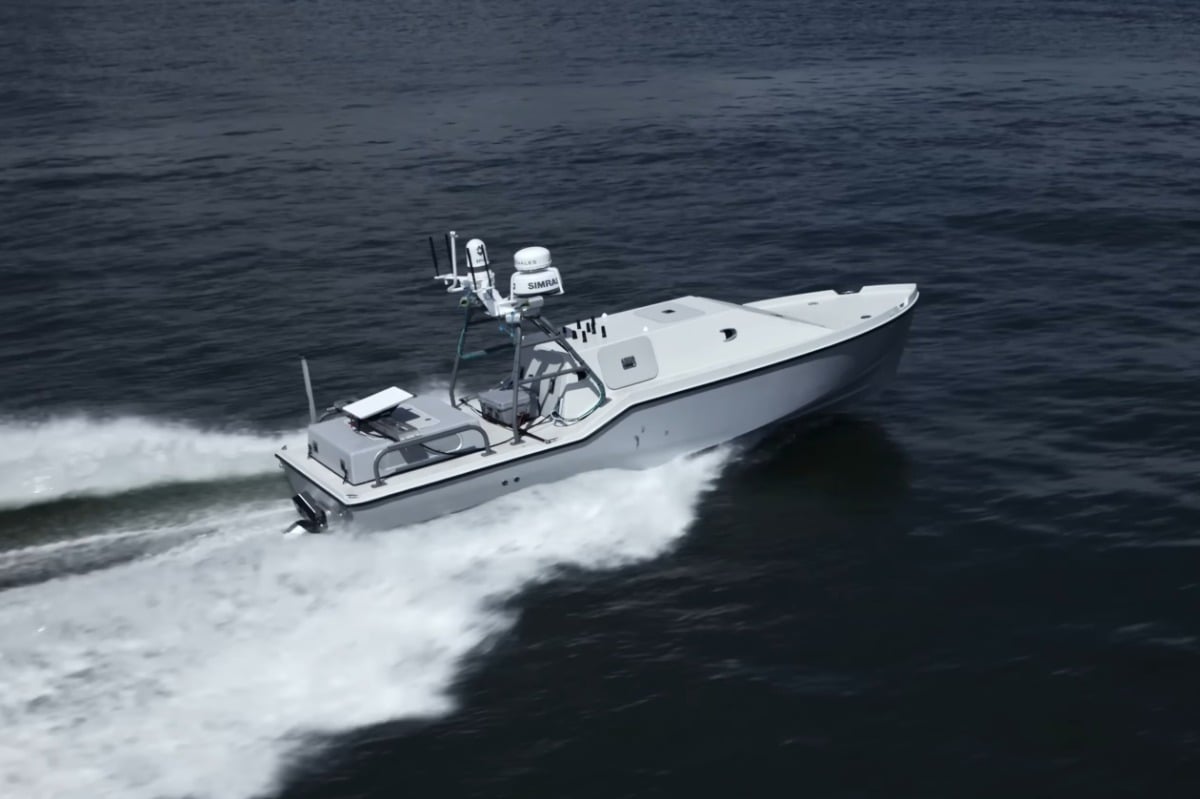
The headlines painted a picture of a clean, futuristic triumph. On Monday evening, a U.S. Army AH-64 Apache attack helicopter went down in the volatile waters near the Strait of Hormuz off the coast of Oman. Within two hours, both crew members were pulled from the sea, safe and stable. The savior was not a roaring Seahawk helicopter or a Navy patrol boat, but a 24-foot, diesel-powered drone boat named the Corsair, built by Texas-based Saronic Technologies.
It was hailed as a historic milestone: the first publicly documented personnel recovery by an autonomous surface vessel in active warfare.
But the scrubbed press releases from U.S. Central Command gloss over the brutal operational reality. The Apache crew did not step onto a pristine automated hospital ship. They pulled themselves out of dark, swells, climbed onto a small, unmanned hull, and clung to its superstructure for dear life while the vessel ferried them to a safer maritime handoff point.
The rescue was born of operational necessity, not just a desire to test hardware. Since operations against Iran began in February, the U.S. military has lost at least seven crewed aircraft in the region. Sending a traditional, multi-million-dollar search-and-rescue helicopter into airspace where an Apache was just downed is an immense risk to more American lives. The Corsair rescue was a desperate, brilliant proof of concept, but it exposes the intense pressure the military faces in modern, attritional warfare.
The Mechanics of a Remote Salvation
To understand why the Pentagon is treating a 24-foot boat as a strategic shift, you have to look at how the asset actually operates. The Corsair belongs to the Navy's Bahrain-based Task Force 59, a unit dedicated entirely to integrating unmanned systems and artificial intelligence into the 5th Fleet’s expansive 2.5-million-square-mile sandbox.
While the boat is described as autonomous, the rescue itself relied on a tight loop of human-machine collaboration.
- Passive Detection: The Apache went down around 7:30 PM local time, casting the crew into darkness. The Corsair utilized its 360-degree passive sensing payload, which includes radar, thermal cameras, and satellite communications, to pinpoint the aviators without emitting active signals that could alert enemy forces.
- Remote Supervision: Once the targets were located, a human operator piloting the vessel remotely from a command center directed the approach.
- The Handoff: The boat traveled at speeds reaching up to 35 knots to reach the crew. Because the vessel lacks arms, medics, or an interior cabin for passengers, the two downed soldiers had to physically board the drone. The craft then acted as a high-speed ferry, carrying them out of the immediate threat zone to an open-water location where a manned helicopter could safely execute a hoist operation.
The architecture making this possible was driven by Saronic's chief technology officer, Vibhav Altekar, a perception engineer who cut his teeth at Anduril working on projects like the Royal Australian Navy's Ghost Shark drone submarine. The software allows the vessel to autonomously manage fuel consumption, navigate heavy surface traffic, and maintain stable positioning in rough seas, all while keeping a human in the loop for critical life-safety decisions.
The Billions Behind the Small Boat
The timing of this rescue is highly convenient for the defense-tech sector. Saronic Technologies, co-founded in 2022 by former Navy SEAL Dino Mavrookas and a team of tech veterans, recently achieved a $9.25 billion valuation. More importantly, the company secured a $392 million production contract with the U.S. Navy that runs through 2031.
This rescue transforms the Corsair from a funded procurement gamble into a combat-proven asset.
The Pentagon is currently pouring billions into the Replicator initiative, a broad strategy championed by Deputy Defense Secretary Kathleen Hicks to field thousands of cheap, attritable, autonomous systems to counter mass-scale adversaries. For decades, naval doctrine relied on billion-dollar destroyers and massive carrier strike groups.
Ukraine changed that equation. Using home-grown sea drones like the Magura V5 and Sea Baby, Ukraine effectively crippled Russia's Black Sea Fleet without possessing a functional navy of its own. The Pentagon watched, took notes, and realized that mass matters more than prestige in a prolonged conflict.
A 24-foot Corsair can carry a 1,000-pound payload over 1,000 nautical miles. It is cheap to build, cheap to maintain, and requires no human crew to risk their lives during a patrol. If an enemy anti-ship missile or drone strikes a Corsair, the U.S. loses a piece of plastic and metal, not a crew of highly trained sailors.
The Flaws and Strategic Fault Lines
Despite the success of the Apache recovery, the incident highlights major vulnerabilities in the Pentagon's current posture. The geopolitical fallout was immediate. U.S. President Donald Trump blamed Iranian forces for shooting down the Apache and ordered retaliatory strikes, which triggered a dangerous cycle of counter-attacks across Bahrain, Kuwait, and Jordan.
In this hyper-escalated environment, sending an autonomous boat to do a human's job is a double-edged sword.
First, the physical limitations of the drone are obvious. If the Apache pilots had been severely injured, unconscious, or trapped in their gear, they could not have climbed onto the Corsair's hull. Current autonomous surface vessels lack the robotic manipulation or internal medical bays required for complex, zero-human rescue operations. The "climb-and-cling" method works for conscious aviators, but fails as a comprehensive combat search-and-rescue solution.
Second, the operational deployment of these drones hands the adversary a wealth of tactical intelligence. Iranian forces monitoring the Strait of Hormuz now have direct, real-world data on how Task Force 59 deploys its autonomous fleet, how quickly the software reacts, and the exact parameters of American remote command-and-control loops.
The Pentagon is betting that sheer numbers will outpace these vulnerabilities. The long-term plan is not to deploy a handful of these vessels, but to flood vital chokepoints with hundreds, eventually thousands, of interconnected sea drones. They will form an unblinking, distributed sensor web that handles everything from mine detection and electronic warfare to logistics and, as we just witnessed, emergency personnel recovery.
The era of relying solely on massive, heavily crewed hulls to dominate the ocean is drawing to a close. The future of maritime power is small, autonomous, and incredibly fast.