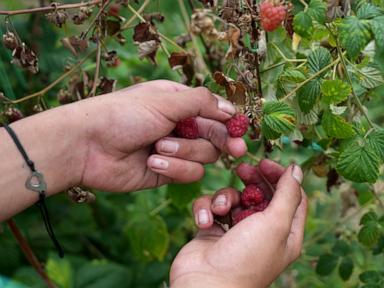
The dirt beneath your fingernails does not wash out easily when it is stained with the juice of a Willamette raspberry. It is a deep, bruised crimson. By early July, nearly every pair of hands in the Serbian town of Arilje carries this exact shade. The color stays for weeks, a stubborn reminder of a relentless harvest.
Walk into any kitchen in this valley during the peak of summer, and you will find it empty. The houses are quiet, doors unlocked, radios playing to vacant living rooms. Everyone is in the hills. From dawn until the suffocating heat of mid-afternoon, grandmother and grandson stand side-by-side before the endless green walls of thorny canes.
Most people eating a parfait in London, a pastry in Paris, or a smoothie in New York have never heard of Arilje. They do not know that this single, sun-drenched patch of western Serbia serves as the quiet heartbeat of the global berry trade. When global supply chains stutter, or when a late spring frost hits these specific Balkan slopes, the price of dessert shifts across western Europe. This is not just farming. It is a high-stakes gamble against nature, played out every year by families who have pinned their entire existential survival on a fruit so delicate it can ruin in a single afternoon of heavy rain.
The Microclimate Lottery
To understand why a tiny Serbian town became the self-proclaimed global capital of raspberries, you have to look at the fog.
Every morning, a thick, milky mist rolls out from the Moravica and Rzav rivers. It pools in the valleys, shielding the soft-skinned berries from the blistering early sun. By noon, the fog burns off, giving way to an intense, high-altitude heat that coaxes out the sugars. The soil here is acidic, rich in organic matter, and perfectly drained by the karst limestone geography underneath.
Consider a hypothetical grower named Dragan. He is fifty-four, with deep-set eyes and skin texturized by decades of mountain wind. Dragan does not look at a thermometer; he feels the humidity in his joints. If you ask him why he doesn't grow plums or apples like the farmers further north, he will point to the steepness of his plot.
"The mountain demands the berry," he says, his voice flat. "Nothing else holds the dirt together when the summer storms hit."
Western Serbia accounts for a massive chunk of global raspberry exports, frequently competing with Poland and Chile for the top spot. But unlike the massive, mechanized corporate farms of South America, Arilje relies on a patchwork of small, family-owned plots. Most are fewer than two hectares. On these vertical fields, tractors are useless. Everything is done by human muscle.
The Ten-Day Window
The economic reality of the raspberry is brutal. A apple can sit in a cold room for months. A potato can wait in the dark. A raspberry begins to rot the moment it is severed from the stem.
The entire year's income for thousands of households is decided in a frantic window of roughly twenty to thirty days. If the pickers are too slow, the fruit overripens and turns to mush, fit only for low-value industrial juice. If they pick too early, the berry lacks the intense fragrance that international buyers demand.
During harvest, the town’s population swells. Migrant workers travel from the poorer southern regions of Serbia, and teenagers skip their summer holidays to earn cash. The routine is punishing.
- 05:00 AM: The first trucks rattle up the mountain tracks. The air is still freezing.
- 12:00 PM: Temperatures hit thirty-five degrees. The sweet, heavy scent of fermenting sugar begins to rise from the baskets.
- 08:00 PM: The final drop-off at the cold storage units, where the berries are flash-frozen to minus twenty degrees.
The tension during these weeks is palpable. In local cafes, no one talks about politics or sports. They talk about the otkupna cena—the purchase price set by the big cold-storage companies.
The relationship between the independent farmers and the export corporations is a dance of mutual dependency and deep mistrust. Because the farmers have no facilities to store fresh fruit, they are forced to hand over their harvest before knowing the final price they will receive. They log their kilograms in small ledger books, cross their fingers, and wait until the end of the season to find out if they made a profit or took a loss.
The Shift to Cold Iron
For decades, the system worked on tradition. But globalization has broken the old rhythm. Today, the real power in Arilje does not sit in the fields; it lives inside the massive, corrugated-iron cold storage facilities that line the main roads.
Step inside one of these facilities, and the sensory contrast is shocking. You move from the sticky, sun-baked humidity of the orchards directly into a sterile, sub-zero warehouse where lasers sort berries by size and color.
The evolution from local farming to global logistics has changed the social structure of the region. Wealth is no longer measured by how many bushes you own, but by how many tons of cooling capacity you control. The younger generation sees this change clearly. Many are refusing to take over their parents' fields, opting instead to study logistics, agronomical engineering, or international trade in Belgrade. They want to be the ones selling to the supermarkets in Germany, not the ones getting pricked by thorns at dawn.
But the vulnerability remains. If a cold storage facility loses power for twelve hours during a July storm, millions of Euros of inventory liquefy into a red tide.
The Weight of the Crop
As twilight falls over Arilje, the sound of the tractors finally fades. In Dragan’s yard, his family sits around a wooden table under a grape arbor. Their hands are stained that familiar, dark purple-red.
His daughter, who is studying economics, scrolls through international market reports on her phone, tracking cold-storage stocks in Rotterdam. Her father ignores the screen, looking instead at the western sky, checking for the bruised clouds that signal hail.
The global market will take what it wants from this valley, dictating terms from boardrooms thousands of miles away. But tonight, the berries are safe in the freezers, the dirt is still holding the mountain together, and the stained hands of Arilje are resting, if only for a few hours, before the morning fog rolls back in.